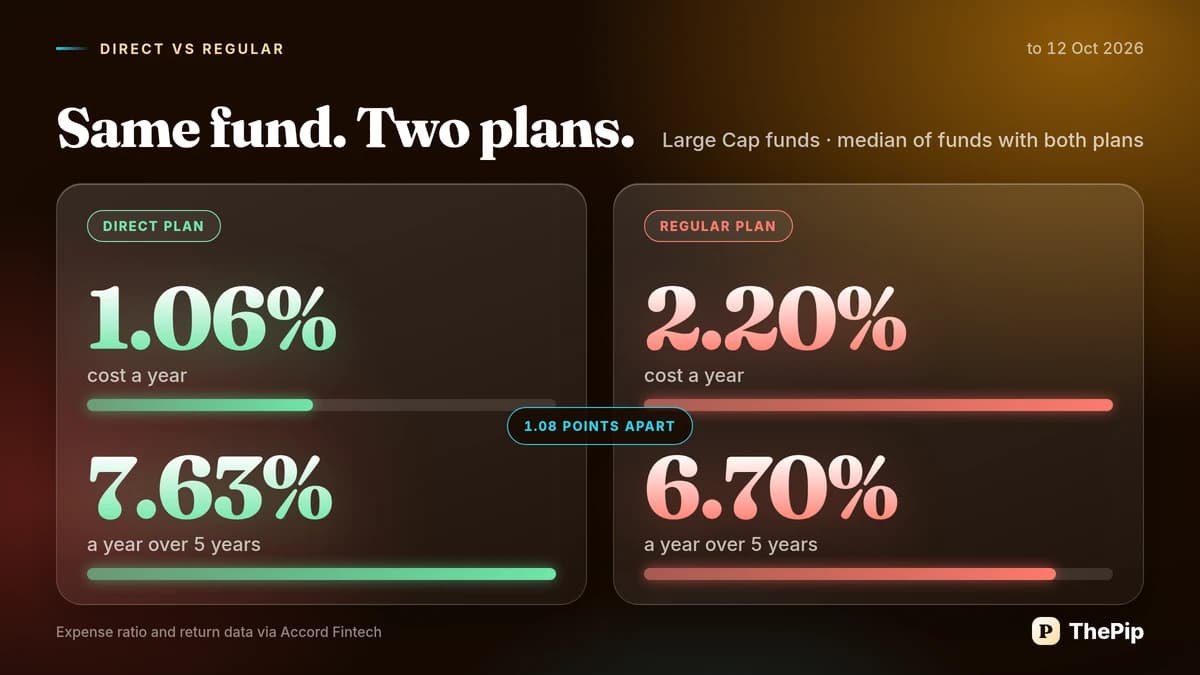
Direct plans of Large Cap funds cost 1.08 percentage points less a year at the median.
Figures as of: 12 October 2026
- Median expense ratio: Direct plan 1.06%, Regular plan 2.20%, a gap of 1.08 percentage points
- 5 years: median annualised return of Direct plans 7.63%, Regular plans 6.70%
- 5 years: every fund returned more in the Direct plan than in the Regular plan
- ₹1,00,000 over 5 years at the median return: ₹1,44,439 in a Direct plan, ₹1,38,319 in a Regular plan
Direct vs Regular plans in Large Cap funds show a median expense ratio gap of 1.08 percentage points. Over the 5-year period to 12 October 2026, the median annualised return was 7.63% for the Direct plan and 6.70% for the Regular plan.
What the two plans are
A mutual fund can offer a Direct plan and a Regular plan. Both hold the same portfolio. A Direct plan is bought straight from the fund house; a Regular plan is bought through a distributor, and its expense ratio is higher. This page compares the two plans of the same 35 Large Cap funds, using the expense ratio and the annualised returns the data feed publishes for each plan, and takes the median across funds. Only funds that have the figure for both plans on the same date are counted for it. It describes what happened and says nothing about the next period.
Direct vs Regular plans in Large Cap funds: the figures
| Measure | Value |
|---|---|
| Direct plan | 1.06% |
| Regular plan | 2.20% |
| Gap (Regular minus Direct), median of funds | 1.08 percentage points |
| Period | Funds with both plans | Direct plan | Regular plan | Gap (Direct minus Regular), median of funds | Funds where Direct returned more |
|---|---|---|---|---|---|
| 1 year | 33 | −6.61% | −7.56% | 1.07 percentage points | 33 of 33 |
| 3 years | 30 | 8.47% | 7.17% | 1.21 percentage points | 30 of 30 |
| 5 years | 28 | 7.63% | 6.70% | 1.14 percentage points | 28 of 28 |
Every fund returned more in the Direct plan than in the Regular plan. Over 1 year, the Direct plan returned −6.61% and the Regular plan returned −7.56%. The median gap in annualised returns was 1.07 percentage points over 1 year, 1.21 percentage points over 3 years, and 1.14 percentage points over 5 years.
| Plan | Value |
|---|---|
| Direct plan | ₹1,44,439 |
| Regular plan | ₹1,38,319 |
| Difference | ₹6,120 |
FAQs
What is the difference between a Direct plan and a Regular plan?
Both plans of a fund hold the same portfolio. A Direct plan is bought straight from the fund house; a Regular plan is bought through a distributor, and its expense ratio is higher.
How much lower is the expense ratio of a Direct plan in Large Cap funds?
Across 35 funds, the median expense ratio is 1.06% for the Direct plan and 2.20% for the Regular plan, a median gap of 1.08 percentage points.
Did Direct plans return more than Regular plans in Large Cap funds?
Over 5 years to 12 October 2026, every fund returned more in the Direct plan than in the Regular plan. The median annualised return was 7.63% for Direct plans and 6.70% for Regular plans.
What difference does the plan make to ₹1,00,000?
At the median annualised return of each plan over 5 years, ₹1,00,000 would have become ₹1,44,439 in a Direct plan and ₹1,38,319 in a Regular plan, a difference of ₹6,120.
Expense ratio and return data: Accord Fintech. Calculations: ThePip. For information only; not investment advice.