Monsoon Sowing Recovers, Easing Food Inflation Fears in India
By ThePip Desk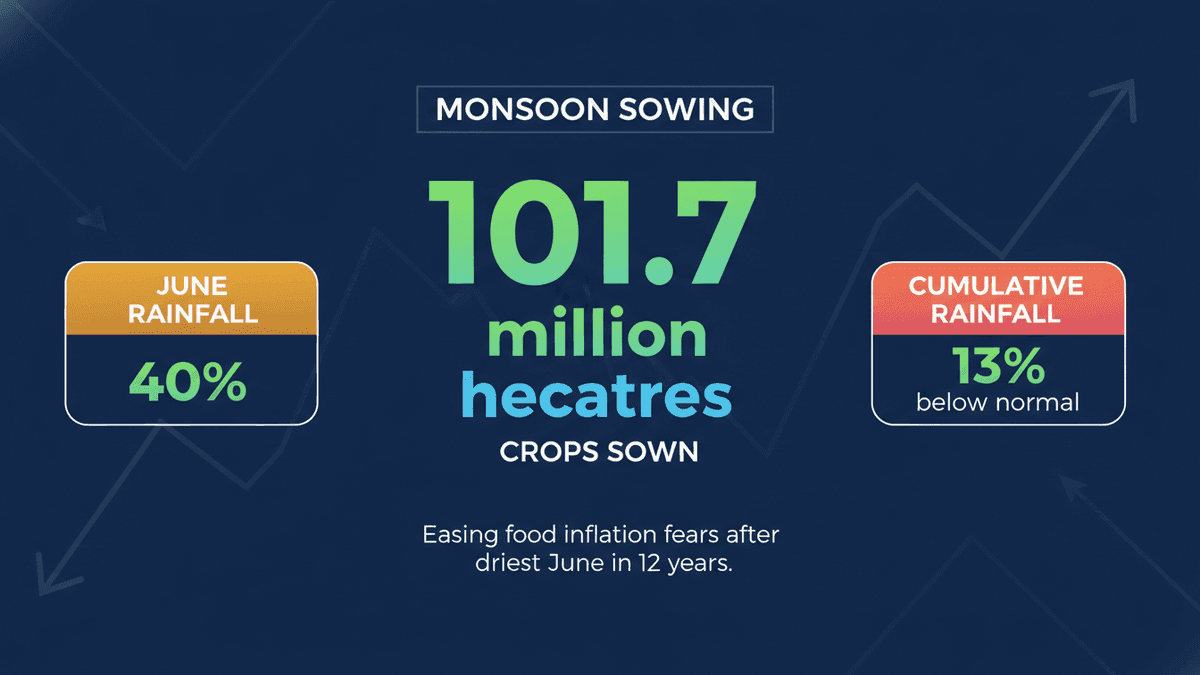
India’s monsoon crop planting rebounds thanks to July rains, easing fears of food inflation after a dry June. Learn about the latest agricultural data.
India’s monsoon crop planting has largely recovered, driven by normal rainfall in July which helped offset the driest June in 12 years. This agricultural rebound is expected to potentially ease food inflation pressures across the country.
Key Monsoon Sowing Data
- June experienced a 40% deficit in rainfall, largely attributed to an El Niño weather pattern.
- As of August 19, cumulative rainfall across India remains 13% below normal, according to the India Meteorological Department.
- By August 14, 101.7 million hectares (251 million acres) of monsoon crops were sown.
- This represents approximately 2% less acreage compared to the previous year.
Agriculture Secretary Atish Chandra confirmed that sowing of major crops, including pulses, oilseeds, and cotton, is progressing satisfactorily. He highlighted that while some crops show a slight decrease in acreage, others have seen an increase.
The southwest monsoon is critical for India, providing approximately three-quarters of its annual rainfall and about half of the country’s yearly foodgrain production. Its performance directly influences the nation’s food security and economic stability.
Crucial Period Ahead for Yields
Rainfall during August and September will be crucial for determining overall crop yields, with the farm ministry actively monitoring conditions alongside state governments. Chandra has urged state governments to encourage farmers to use all available land for cultivation this season, even if sowing is delayed.
While rice planting currently lags, farmers have a window until the end of August, and in some regions, into September, to complete their sowing. Chandra noted it is still premature to estimate the total crop output, with periodic reviews underway with states.
Conversely, a failure in this agricultural rebound could tighten grain supplies, drive up food prices, and complicate ongoing efforts to control inflation. India is already considering a rare reduction in sugar import levies, a move not seen in nearly a decade, to manage supplies.