Industrial World Models & Enterprise Deepfake Threats
By Business Desk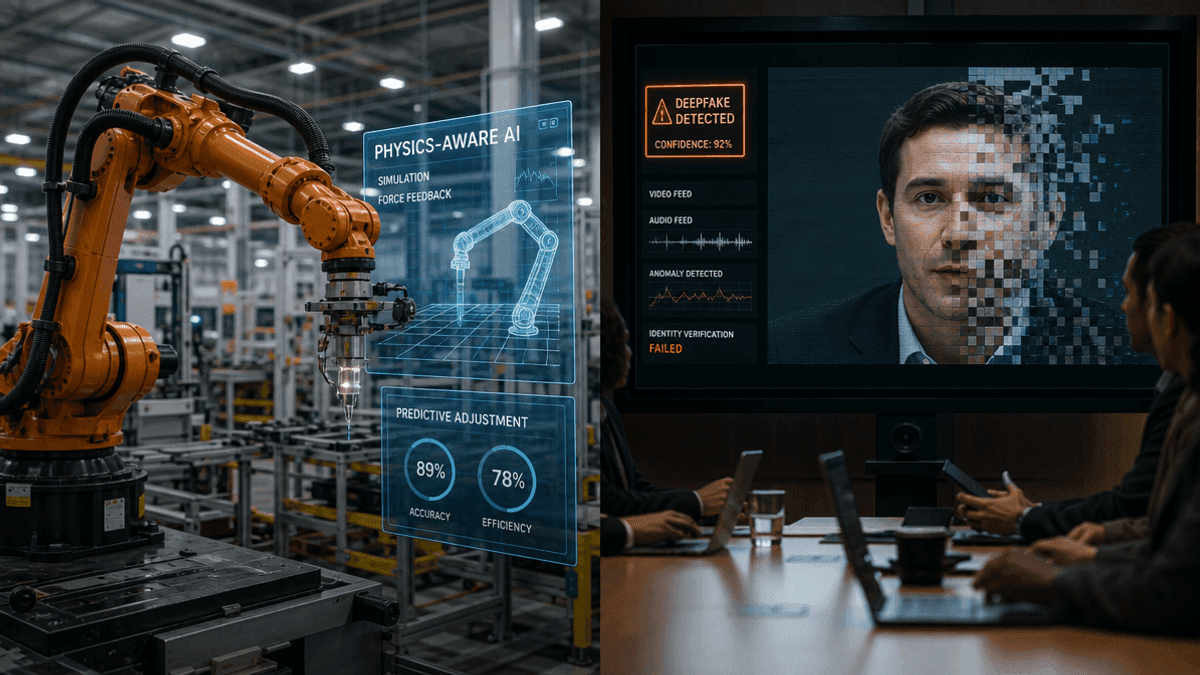
Discover how AI industrial world models revolutionize manufacturing while exposing modern enterprises to surging, sophisticated deepfake security threats.
Artificial intelligence is driving a dual transformation across modern industries, modernizing factory floors with physical intelligence while leaving enterprises exposed to an unprecedented surge in deepfake security breaches. As companies race to integrate advanced automation, security gaps in real-time communications and verification protocols are exposing critical vulnerabilities across global operations.
The Shift Toward Industrial World Models
Industrial manufacturing is experiencing a fundamental shift following advancements in physics-aware AI into physical spaces. Unlike traditional language models limited to text, world models grasp spatial relationships and object behavior to enable transferable intelligence across machinery like autonomous forklifts and welders. Key parameters defining this transition include:
- Simulation-first training allows robots to experience thousands of virtual scenarios before physical deployment.
- World models reduce dependence on single robotics platforms and minimize physical experimentation.
- Cross-machine learning capabilities improve utilization of operational data across different hardware settings.
The Enterprise Deepfake Crisis
While factories scale automation, security leaders face an alarming rise in synthetic media threats that bypass legacy identity controls. Attackers are exploiting human elements in remote communications, virtual meetings, and IT help desks using sophisticated audio and visual impersonations. Core metrics highlighting this security gap include:
- Synthetic media produces hyper-realistic audio and visual content that can deceive advanced detection algorithms.
- Blind spots pose severe threats to digital security, public trust, and the integrity of information.
- Multi-layered verification strategies are necessitated because the arms race heavily favors creators.
Financial Stakes and Verification Challenges
The consequences of unverified digital interactions are escalating rapidly as attackers weaponize generative tools against corporate infrastructure. Organizations hit by synthetic impersonation incidents face severe secondary disruptions. Crucial outcome data comprises:
- Hyper-realistic audio and visual content created by generative tools can deceive even advanced detection algorithms.
- Current arms race between deepfake creators and detection systems is heavily skewed in favor of the creators.
- Multi-layered verification strategies must replace relying solely on artificial intelligence-based detection.
Without a multi-layered verification strategy that moves beyond sole reliance on detection algorithms, enterprise systems will remain vulnerable to real-time identity spoofing. Bridging this security gap requires establishing robust trust frameworks to verify humanity across every digital interaction before synthetic threats force widespread economic disruption.