Small-Cap Funds with Mid-Cap Exposure: Better Liquidity
By Market Desk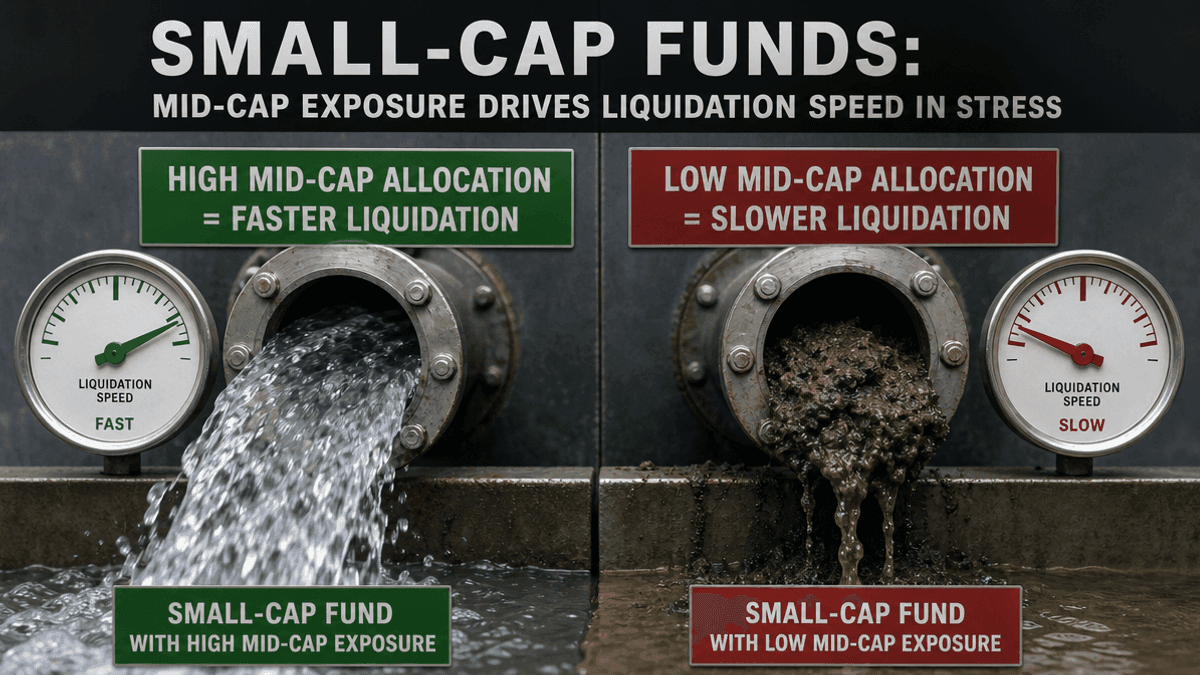
AMFI stress test reveals small-cap funds with higher mid-cap allocations offer superior liquidity, liquidating assets faster during redemption scenarios.
The Association of Mutual Funds in India (AMFI) conducted a stress test in July 2026 on small-cap funds, indicating that schemes with greater midcap stock allocation demonstrate superior liquidity. This translates to faster portfolio liquidation during hypothetical redemption scenarios, a critical finding for investors.
The comprehensive test evaluated 28 small-cap funds, collectively managing approximately ₹4.5 lakh crore in Assets Under Management (AUM) as of July 1, 2026. It specifically measured the days required to liquidate 50% and 25% of a fund’s portfolio.
Midcap Allocation Drives Faster Liquidation
- Samco Small Cap Fund, with 22.41% in midcaps, could liquidate 50% of its portfolio in just 0.06 days and 25% in 0.03 days.
- ITI Small Cap Fund, holding the highest midcap allocation at 24.51%, achieved one-day liquidation for both 50% and 25% of its assets.
- TRUSTMF Small Cap Fund (21.9% midcaps) and PGIM India Small Cap Fund (19.97% midcaps) also reported one-day liquidation periods for both metrics.
Conversely, funds with lower midcap exposure and a higher concentration in small-cap holdings faced significantly extended liquidation timelines. This underscores the direct impact of portfolio composition on a fund’s redemption capacity.
Small-Cap Concentration Extends Liquidation
- Quant Small Cap Fund, with only 8.81% in midcaps and 65.06% in small caps, required 48 days to liquidate 50% of its portfolio and 24 days for 25%.
- SBI Small Cap Fund (5.06% midcaps, 83.87% small caps) needed 46 days for 50% liquidation and 23 days for 25%.
- Tata Small Cap Fund and DSP Small Cap Fund similarly showed prolonged liquidation periods due to their elevated small-cap concentration.
The stress test also highlighted that the sheer size of a fund’s AUM exacerbates liquidity challenges, particularly for those heavily invested in small-cap stocks. Larger funds generally require more time to liquidate substantial portions of their portfolios.
AUM Impact on Liquidation Timelines
- HDFC Small Cap Fund, with ₹41,677.76 crore AUM, needed 44 days to liquidate 50% of its portfolio.
- SBI Small Cap Fund (₹39,942.33 crore AUM) and Quant Small Cap Fund (₹34,065.10 crore AUM) required 46 days and 48 days, respectively, for a 50% liquidation.
- Nippon India Small Cap Fund, the largest in its category with ₹78,943.52 crore AUM, took 26 days, benefiting from a significant allocation of 14.5% to large caps and 13.22% to midcaps.
Regarding valuations, most small-cap funds are currently trading at premiums when compared to their respective benchmarks. This indicates a broader market trend across the segment.
Valuation Metrics Across Funds
- Bajaj Finserv Small Cap Fund recorded the highest portfolio trailing 12-month PE at 49.2, against its benchmark PE of 35.68.
- Bandhan Small Cap Fund reported the lowest portfolio trailing 12-month PE at 19.5.
Investors should note that a fund’s midcap allocation serves as a critical indicator of its capacity to manage heavy redemptions during periods of market stress, with funds holding at least a fifth of their corpus in midcaps appearing better equipped.