SAIL’s Profit Soars, But Valuation Discount Remains
By ThePip Desk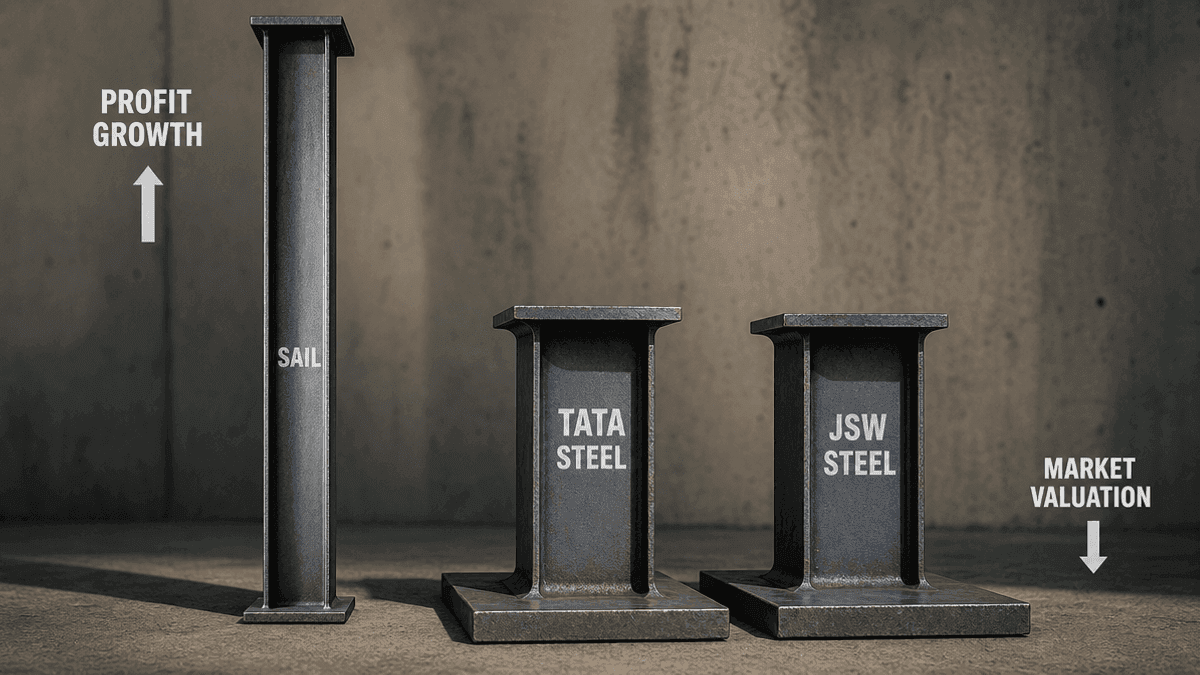
SAIL’s profit jumped 138.8%, yet it trades at a discount to Tata Steel & JSW Steel. Explore the reasons behind this valuation gap and future market share potential.
State-owned Steel Authority of India Ltd (SAIL) reported a remarkable profit surge in Q1FY27, significantly outpacing rivals Tata Steel and JSW Steel. Despite this robust performance, SAIL continues to trade at a substantial discount compared to its larger private sector counterparts. This valuation disparity raises questions about investor perception regarding future market share potential.
Key Financial Highlights Q1FY27
- SAIL’s net profit soared by 138.8% year-on-year to Rs 1,636 crore, even with a slight dip in sales volume.
- The company’s realizations per tonne climbed by 5.7%, contributing to an operating profit margin increase of 500 basis points to 15.8%.
- JSW Steel saw its consolidated net profit rise by 112.6% year-on-year to Rs 4,696 crore, achieving its best-ever first-quarter steel sales volume of 6.25 million tonnes.
- JSW Steel’s realizations grew by 5.9% to Rs 75,782 per tonne, with its consolidated operating profit margin improving by 220 basis points to 19.8%.
- Tata Steel’s consolidated net profit increased by 18.8% to Rs 2,385.2 crore, largely due to strong operational performance in India.
SAIL’s impressive profit growth stemmed from a higher proportion of flat steel products, which constituted 52.7% of its production and are crucial for automotive and electrical appliance industries. Stringent cost controls further bolstered its operating profit margin during the quarter.
Sector-Wide Tailwinds Drive Performance
The entire steel sector benefited from strong demand conditions during the June 2026 quarter, particularly from automotive and electrical appliance user industries. Higher price realizations per tonne across the board played a critical role in the improved financial performance of leading steel companies.
- Weak Chinese steel production, which declined by 3% year-on-year, reduced global supply pressures.
- Increased tariffs on steel imports by major consuming nations provided a protective environment for domestic players.
These global factors, alongside sustained domestic demand, contributed to better price realizations and enhanced profitability for Indian steelmakers, offsetting any visible impact from the Middle East crisis on user industry demand.
The Persistent Valuation Disparity
Despite SAIL’s superior profit growth, it continues to trade at a significant discount to its peers, ranging from 18% to 39.5% when compared to Tata Steel and JSW Steel. This valuation gap reflects investor sentiment regarding the future growth trajectories of these companies.
- Investors perceive Tata Steel and JSW Steel as having greater potential for future market share expansion.
- In terms of Return on Equity (RoE), Tata Steel leads with 11.7%, followed by JSW Steel at 10.2%, and SAIL trailing at 6.48%.
While Tata Steel’s Indian operations delivered robust performance with 5.17 million tonnes and a 29.6% rise in segment profit, its European operations faced sluggish demand and losses due to regional conflicts and a plant shutdown. This highlights the varied operational landscapes even within the top players.
Looking ahead, the upcoming festive season is anticipated to boost demand for steel products. However, investors should remain vigilant regarding input prices, which could be impacted by ongoing geopolitical crises, underscoring the dynamic nature of the steel market.