India’s Debt: High Interest Costs Despite Manageable Ratio
By ThePip Desk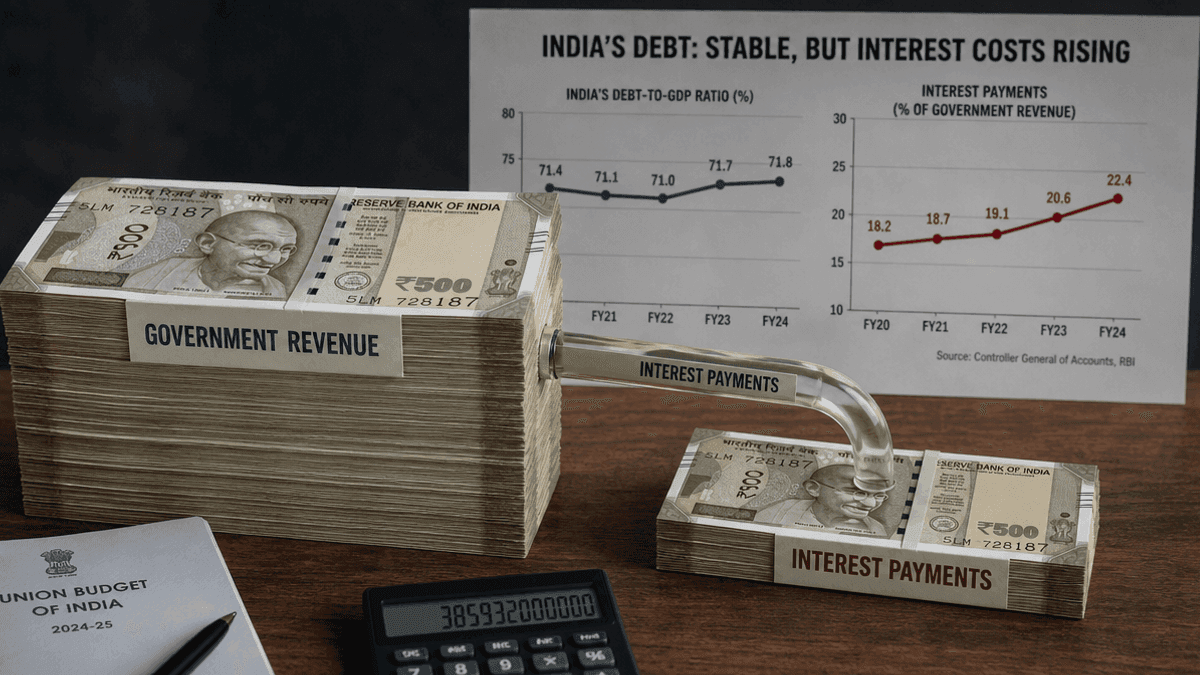
India’s debt-to-GDP ratio is manageable, but high interest costs are a growing concern, exceeding those of nations with larger debt burdens. Learn why.
While India’s debt-to-GDP ratio appears manageable and broadly stable at around 80%, the interest cost associated with servicing this debt presents a significant concern. Prasanna Tantri, an associate professor of finance at the Indian School of Business (ISB), highlighted this disparity, noting India’s higher interest payments compared to nations with larger debt burdens.
Key Debt and Interest Figures
- India’s debt-to-GDP ratio stands at approximately 80%.
- Interest payments for the Centre are 3.7% of GDP.
- Including states, total interest payments reach around 5.5% of GDP.
Tantri emphasized the need to understand why India incurs such substantial servicing costs for a debt stock he considers manageable. He ruled out low tax collection or low inflation as mechanical explanations for this elevated expenditure.
The discussion was initiated by author Anand Ranganathan, who pointed out that the Centre’s debt totals about ₹201 lakh crore. He added that the general government debt, encompassing both the Centre and states, surpasses 80% of GDP.
Ranganathan further detailed that the interest bill for fiscal year 2027 (FY27) is budgeted at over ₹14 lakh crore. This significant sum is projected to consume 40% of the Centre’s revenue, making it the primary charge on tax rupees.
He also criticized certain states for allocating borrowed funds to non-asset-creating expenditures. An example cited was twelve states dedicating around ₹2 lakh crore for women-centric cash schemes in FY26 without generating assets to service the corresponding debt.
Countering Debt Sustainability Claims
In contrast, Kanchan Gupta, a senior adviser at the Ministry of Information and Broadcasting, presented a different perspective. Gupta argued that the debt stock alone does not determine sustainability, highlighting a declining Centre’s debt ratio following the pandemic.
He stated that the fiscal deficit for FY27 is budgeted at 4.3% of GDP, with central debt at about 55.6%. Gupta also noted that the International Monetary Fund (IMF) projects India’s debt ratio to decrease in the medium term and assesses sovereign-stress risk as moderate.
- FY27 fiscal deficit budgeted at 4.3% of GDP.
- Central debt estimated at about 55.6%.
- IMF projects India’s debt ratio to decline in the medium term.
Gupta clarified that the 40% interest-to-revenue ratio signifies a measure of fiscal space, not an indication of insolvency. He also mentioned that some economists even advocate for increased government borrowing.
Regarding state spending, Gupta argued that expenditures on women-oriented transfers do not automatically imply that borrowed funds financed these transfers. He stressed that government budgets are fungible, necessitating a thorough examination of each state’s revenue balance, borrowing, capital expenditure, and debt sustainability.