India Services PMI Dips to 4-Year Low Amid Weakening Demand
By Business Desk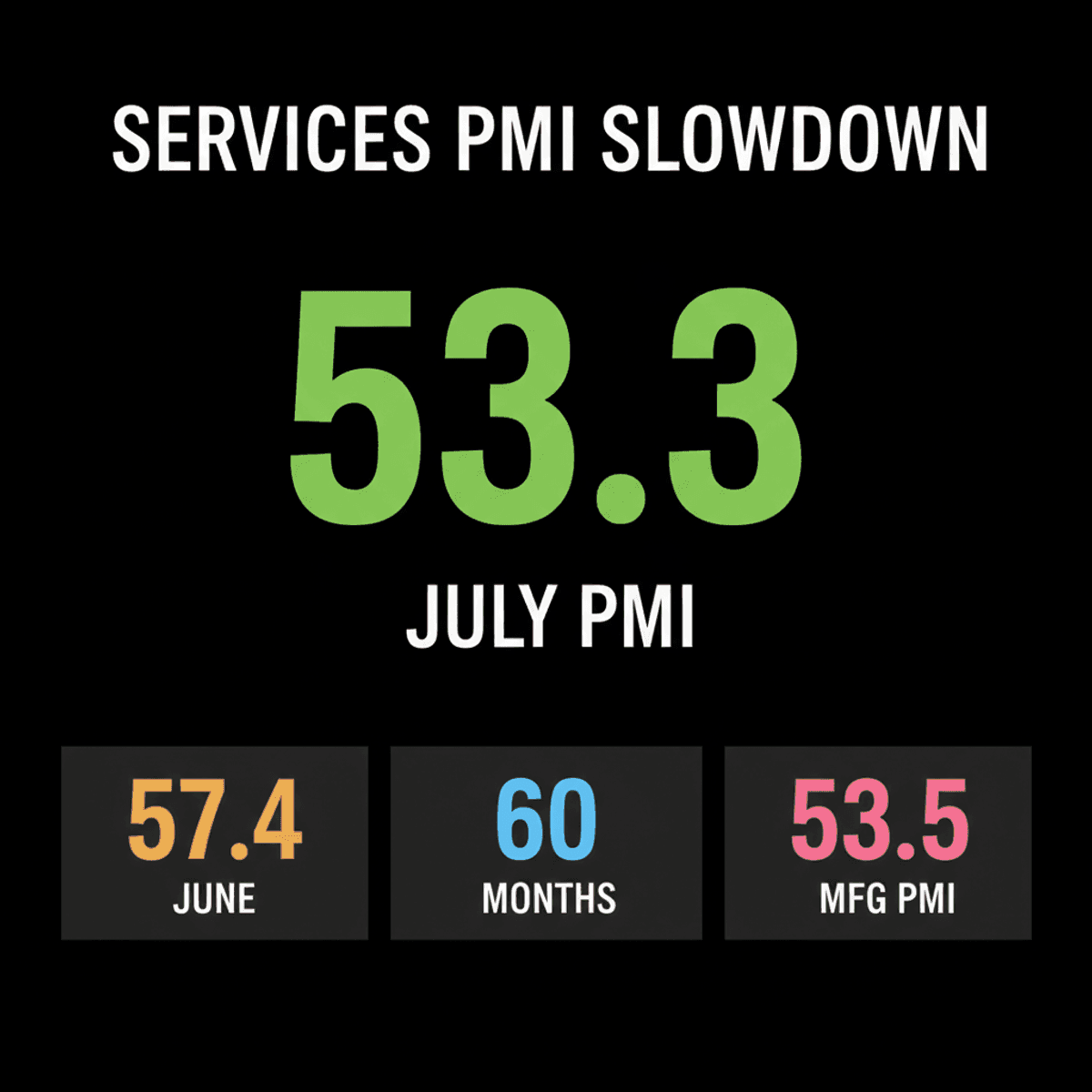
India’s services sector growth slows significantly in July, hitting a four-year low of 53.3 on the HSBC India Services PMI due to easing demand and competition.
India’s services sector experienced its slowest growth in over four years during July, according to a recent private survey. The HSBC India Services Purchasing Managers’ Index (PMI) fell to 53.3 in July from 57.4 in June, marking its lowest point since February 2022.
Despite this deceleration, the index remained above the 50-mark, indicating that the sector has been in an expansionary phase for the 60th consecutive month. The moderation was primarily driven by softer domestic demand, intense competition, and postponed orders.
Understanding the Services PMI
The Purchasing Managers’ Index (PMI) is a key economic indicator derived from monthly surveys of private sector companies. A reading above 50 signifies expansion in the sector, while a reading below 50 indicates contraction.
The current 53.3 reading shows continued growth, but at a significantly reduced pace compared to previous months. This slowdown impacted both overall business activity and the inflow of new orders.
Key Figures from July’s Report
- The HSBC India Services PMI dropped to 53.3 in July, down from 57.4 in June.
- This represents the lowest reading for the services sector since February 2022.
- The sector has maintained an expansionary trajectory for 60 consecutive months.
- The Manufacturing PMI also eased to 53.5 in July, a nearly five-month low.
- Consequently, the HSBC India Composite PMI Output Index fell to 54.3 in July, an over four-year low.
Factors Behind the Slowdown
Several factors contributed to the marked slowdown observed in India’s robust services sector. These elements collectively impacted business activity and the generation of new business inflows.
- Softer domestic demand was a primary driver of the reduced growth.
- Fierce competition among service providers added pressure to businesses.
- Postponed orders further contributed to the deceleration in activity.
Areas of Resilience and Cost Dynamics
While overall growth slowed, certain segments showed resilience and new export orders saw solid expansion. New business inflows expanded at their slowest rate since February 2022, with only the finance and insurance sector reporting faster growth.
Export orders demonstrated strong performance, particularly from clients in the United Arab Emirates, the United Kingdom, and the United States. Employment also saw a modest rebound in July after a six-month low in June, with 6% of firms indicating higher payrolls.
- New business inflows marked their slowest pace since February 2022.
- The finance and insurance segment was the sole area showing quicker expansion.
- Input cost inflation eased to a six-month low, influenced by fuel, labor, material, technology, and transportation costs.
- Selling prices, however, rose at their quickest pace since April.
Composite Index Reflects Broader Moderation
The moderation in services activity mirrored a similar slowdown within the manufacturing sector. The HSBC India Composite PMI Output Index, which combines both sectors, also declined to an over four-year low.
Although manufacturing production growth slightly increased, the services economy experienced a sharper slowdown. However, the stronger employment growth within the services sector helped mitigate the manufacturing slowdown, contributing to faster overall job creation at the composite level.