India’s Family Businesses Hit ₹138 Trillion, Beat Markets
By Business Desk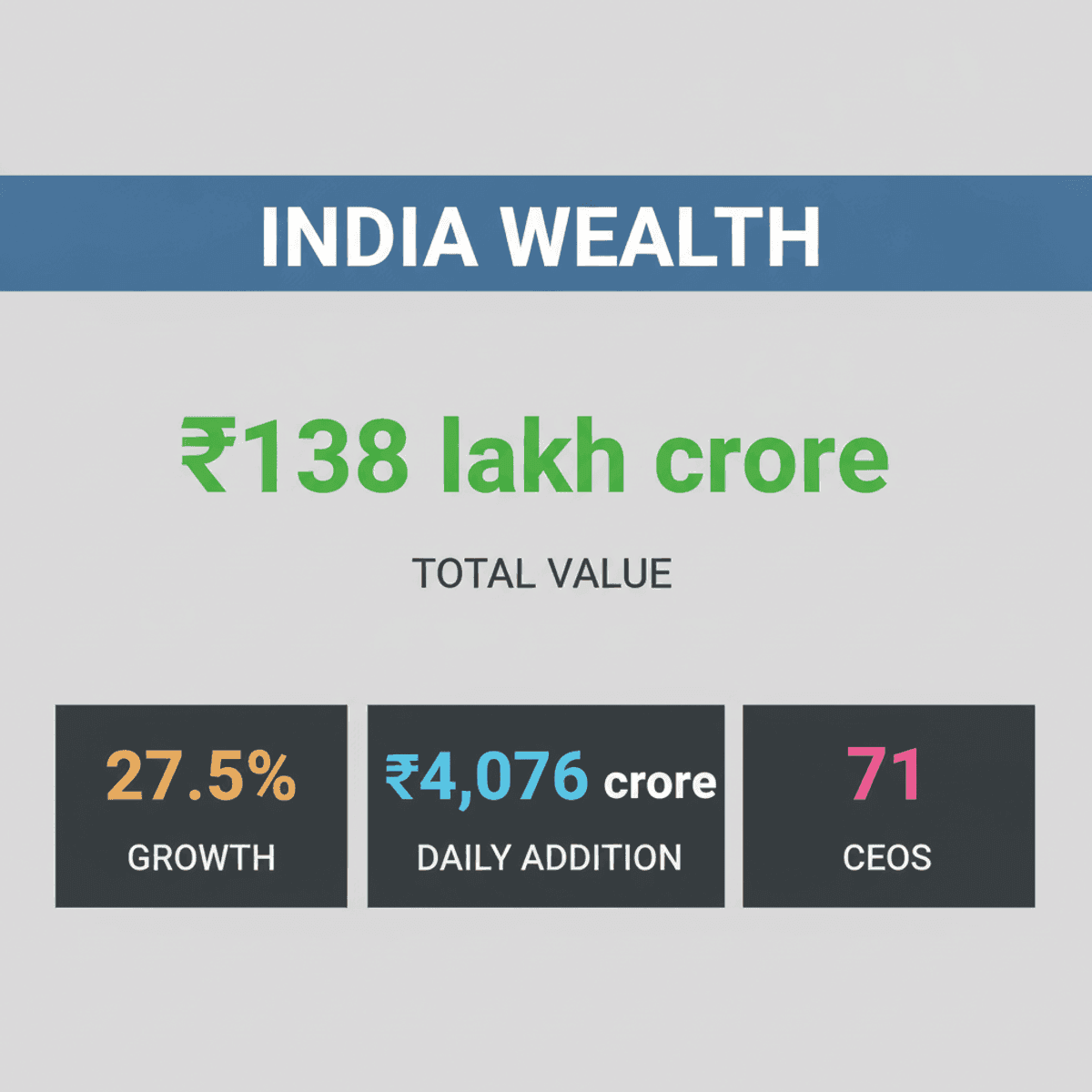
India’s top 300 family businesses surge to ₹138 lakh crore, adding ₹4,076 crore daily. Discover how they’re outpacing market declines with professional management.
India’s premier family businesses have demonstrated remarkable resilience, collectively amassing ₹138 lakh crore ($1.46 trillion) in value. This significant growth, adding approximately ₹4,076 crore daily over the past two years, stands in stark contrast to broader market declines. The 2026 Barclays Private Clients Hurun India Most Valuable Family Businesses List underscores this robust expansion, with a 27.5% increase since 2024 despite downturns in the Nifty 50 and Sensex.
Key Numbers: India’s Family Business Surge
- Total value of top 300 family businesses: ₹138 lakh crore ($1.46 trillion)
- Daily value addition over two years: ₹4,076 crore
- Growth since 2024: 27.5%
- Ambani family valuation: ₹25.82 lakh crore (down 8.5%)
- Birla family valuation: ₹8.14 lakh crore (up 26%)
- Jindal family valuation: ₹8.02 lakh crore (up 40%)
- Anil Agarwal family growth: 75% over past year, 212% over three years
- Value of 100 first-generation family businesses: ₹77.8 trillion
- Total value of 400 families: ₹215.8 lakh crore
- Number of companies with professional CEOs: 71
Dominant Dynasties and Emerging Powerhouses
While the Ambani family, through Reliance Industries, retains the top spot at ₹25.82 lakh crore, their valuation saw an 8.5% decrease over the last year. This highlights the dynamic nature of top-tier wealth, where even established giants face shifts. The list reveals significant gains for other prominent families.
- The Kumar Mangalam Birla family secured second place with ₹8.14 lakh crore, marking a 26% increase.
- The Jindal family jumped to third, seeing their value rise by 40% to ₹8.02 lakh crore.
- The Bajaj and Mahindra families, while holding fourth and fifth positions respectively, experienced slight declines in their valuations.
- The Anil Agarwal family demonstrated substantial momentum, with their value surging 75% to ₹4.45 lakh crore after Vedanta’s demerger, culminating in a 212% rise over three years.
This concentration of wealth remains a defining feature of India’s economic landscape. The top three families alone command approximately ₹42 lakh crore, representing nearly 9% of India’s total listed market capitalization. Furthermore, the top 10 families on the list account for a striking 51% of the total value across all 300 families.
First-Generation Wealth Reshapes Landscape
A compelling narrative from this year’s report is the robust emergence of first-generation family businesses, with 100 such entities collectively holding a value of ₹77.8 trillion. When combined with established players, 400 families contribute a staggering ₹215.8 lakh crore to the economy. This illustrates a profound shift in wealth creation dynamics beyond traditional industrial legacies.
- The Adani family spearheads this first-generation category, boasting a valuation of ₹19.6 lakh crore.
- Following closely is Sunil Bharti Mittal’s family, with Bharti Airtel contributing to their ₹12.1 lakh crore valuation.
Anas Rahman Junaid, Founder and Chief Researcher at Hurun India, noted the escalating prominence of these new entrepreneurs. The number of families worth at least $1 billion has increased by 48%, now totaling 230, signifying a broader base of wealth generation.
Professionalization: A New Era for Family Wealth
The report also underscores a critical trend towards enhanced professionalization in managing family wealth. This evolution reflects growing complexity and the imperative for structured growth. Adrish Ghosh, India head of Barclays Private Bank, emphasized the increasing focus on several key areas.
- Succession planning to ensure smooth transitions of leadership and assets.
- Robust governance structures that define roles and responsibilities.
- The establishment of dedicated family-office structures for comprehensive wealth management.
- Strategic approaches to liquidity management and global diversification of assets.
Evidently, this shift extends beyond traditional industrial houses; 79 of the top 300 families and 36% of first-generation families have established formal family offices. The increasing adoption of professional CEOs, now numbering 71 among the listed companies, further signals a move towards separating ownership from management to navigate intricate business environments and facilitate succession.
Shifting Geographic Centres of Influence
Mumbai continues its reign as the primary hub for these family enterprises, hosting 95 companies from the list. However, the report indicates a dynamic redistribution of new wealth creation across India. While the NCR and Kolkata remain significant centers, the rise of first-generation businesses is noticeably accelerating in other regions. Cities such as Hyderabad, Chhatrapati Sambhajinagar, and Thrissur are emerging as new focal points for entrepreneurial success. This geographic diversification suggests a broader, more distributed economic vitality across the nation.
The sustained growth and professionalization within India’s family businesses, coupled with the rise of first-generation entrepreneurs, highlight a maturing economic landscape. This trajectory suggests a future where structured wealth management and dynamic geographic expansion will continue to redefine India’s corporate powerhouses, moving beyond traditional strongholds to foster new centres of economic influence.