India Construction Equipment Sector: FY27 Growth Slows to Single Digits
By Business Desk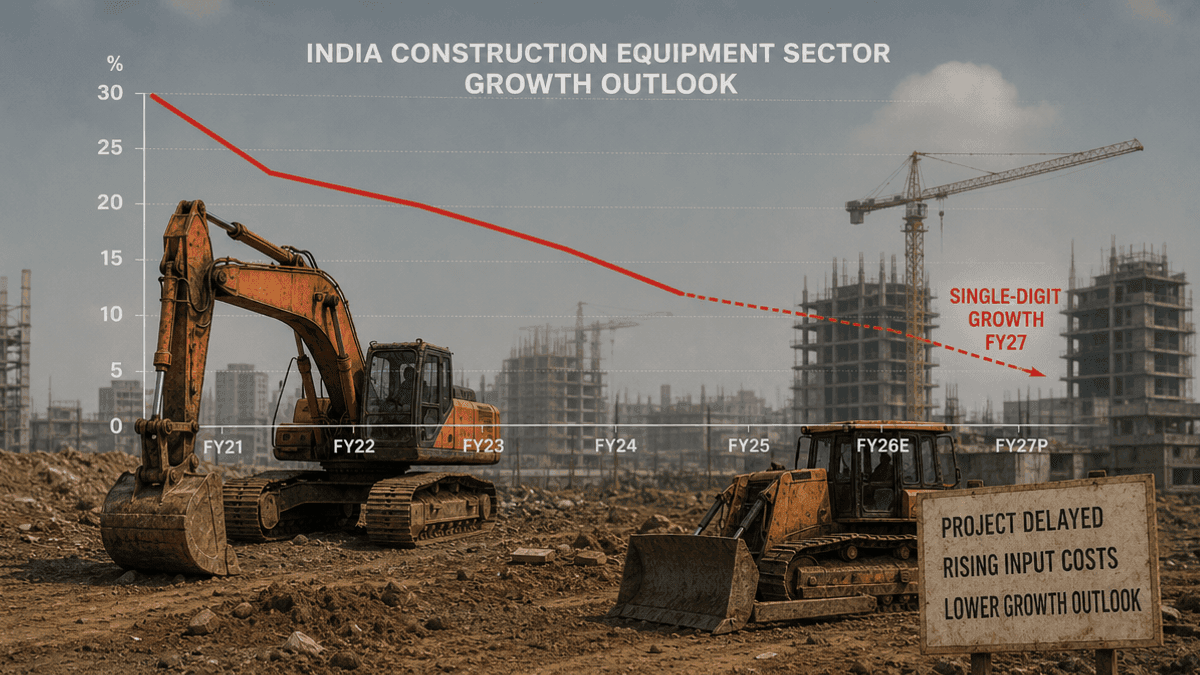
India’s construction equipment industry faces a slowdown, projecting single-digit growth for FY27 due to rising costs, project delays, and financing challenges.
India’s construction equipment sector anticipates a significant shift, projecting a move from robust double-digit expansion to a cautious single-digit growth outlook for FY27. This tempered forecast stems directly from escalating input costs and a noticeable slowdown in infrastructure project execution, as indicated by industry experts.
Key Growth Metrics
- Overall construction equipment sales declined by 2% in FY26.
- Domestic sales fell by nearly 7% during the same period.
- Exports provided a partial offset, surging by 32% in FY26.
- Initial FY27 growth projections from ICEMA are for single-digit rates.
- ICRA independently projects the industry to grow by only 3-5% in FY27.
- The broader construction sector’s revenue growth is expected at 6-8% for FY27.
This cautious sentiment, articulated by Shalabh Chaturvedi, Vice President of the Indian Construction Equipment Manufacturers’ Association (ICEMA), replaces earlier expectations for stronger growth. The industry is grappling with a confluence of factors that are eroding contractor profitability and dampening new project momentum.
Mounting Cost Pressures and Project Delays
A primary concern revolves around the surging input costs, notably for materials like steel and bitumen. Bitumen prices, for example, nearly doubled before a slight moderation, directly impacting the profitability of existing contracts for many developers.
- Escalating steel prices.
- Significant rise in bitumen costs.
- Slower progress on existing road, highway, and mining projects.
- Delays in awarding new infrastructure projects.
- Increased equipment costs due to stricter CEV Stage V emission norms.
- Higher borrowing costs for companies and contractors.
- Challenges in contractor liquidity and financing.
- Broader headwinds from geopolitical conflicts.
In response to these challenges, the Ministry of Road Transport and Highways implemented a temporary cost-escalation relief mechanism. Additionally, highway contract rules were adjusted to reflect current market rates for materials, allowing monthly payments to alleviate financial strain on contractors.
Varied Company Performance and Future Outlook
Individual company performance within the sector reflects a mixed picture, highlighting the uneven impact of current market conditions. While some entities demonstrated revenue growth in Q1 FY27, others faced declines, with margins consistently under pressure from rising costs.
- Action Construction Equipment reported Q1 FY27 revenue growth.
- Escorts Kubota also saw Q1 FY27 revenue growth, despite margin pressure.
- Road developers like KNR Constructions experienced revenue declines.
- H.G. Infra Engineering similarly faced revenue contraction.
- PNC Infratech, however, achieved significant revenue growth.
This divergence suggests an expanding construction cycle, but one marked by considerable variation across specific projects and companies. The industry’s trajectory for the remainder of FY27 will be critically dependent on several key external factors.
The sector’s ability to rebound hinges on the speed of new project awards and the efficient transition of existing orders into active construction phases. Furthermore, stability in commodity prices, improved contractor liquidity, and more favorable financing costs will be crucial determinants for overall industry health and growth.