Google & Wadhwani AI Launch HealthVaani App for Rural India
By Business Desk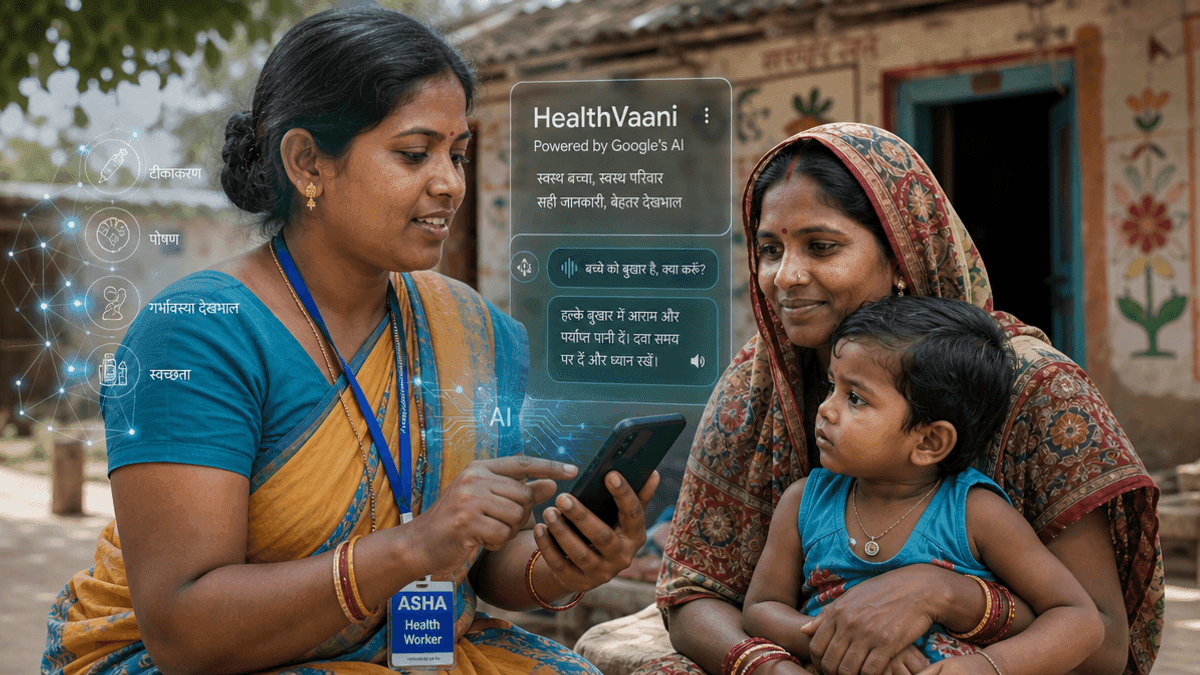
Google and Wadhwani AI partner to launch HealthVaani App, empowering 2.2M+ frontline healthcare workers in rural India with AI-driven health info.
Google and Wadhwani AI have partnered to launch the HealthVaani App, a significant initiative aimed at bolstering primary healthcare services across rural India. This application is specifically designed to support more than 2.2 million frontline health and development workers, including ASHA and Anganwadi personnel, who form the backbone of healthcare access for many Indian communities.
The HealthVaani App provides immediate, validated, and evidence-based health information directly to mobile devices. Its core function is to assist workers with critical tasks such as identifying malnutrition, managing common childhood illnesses, and advising on maternal and newborn health, alongside appropriate nutrition.
Leveraging Advanced AI for Healthcare
Powered by Google’s Gemini Models, the HealthVaani App is integrated into the existing Poshan Tracker application already utilized by frontline workers. This technological foundation is key to bridging information gaps and ensuring the reliability of medical guidance.
Shekar Sivasubramanian, Head of Wadhwani AI, and Preeti Lobana, Vice President and Country Manager at Google India, highlighted the app’s role in overcoming human memory limitations. They confirmed the technology draws from a precise, authorized set of medical documents, ensuring accuracy.
Google’s Gemini Flash model ensures the app operates with speed and cost-efficiency, particularly crucial in low-resource environments. Concurrently, the Gemini Embedding model facilitates semantic retrieval, allowing the app to understand the intent behind user questions even when medical terminology is not precisely used.
Addressing India’s Linguistic Diversity
A crucial aspect of this initiative involves its capacity to cater to India’s extensive linguistic and cultural landscape. The application currently supports four languages: Marathi, Odiya, Hindi, and English.
Plans are underway to expand this linguistic support to a total of 12 languages. This expansion ensures that frontline workers can access vital health information in their native dialects, addressing nuanced cultural and contextual requirements.
Strategic Partnerships and Future Implications
The collaboration extends to key government bodies, including the Ministry of Health and Family Welfare and the Ministry of Women and Child Development. Successful pilot programs have already been completed with ASHA workers across Uttar Pradesh, Haryana, Meghalaya, Madhya Pradesh, Rajasthan, and Arunachal Pradesh.
Additionally, Anganwadi workers in Odisha and Maharashtra have participated in these pilot phases. The long-term vision for this AI-driven model includes replication in other vital sectors, such as agriculture and education, underscoring AI’s potential to resolve broader societal challenges.