US Treasury Yields Stable Aug 14, 2026: Key Rates
By Market Desk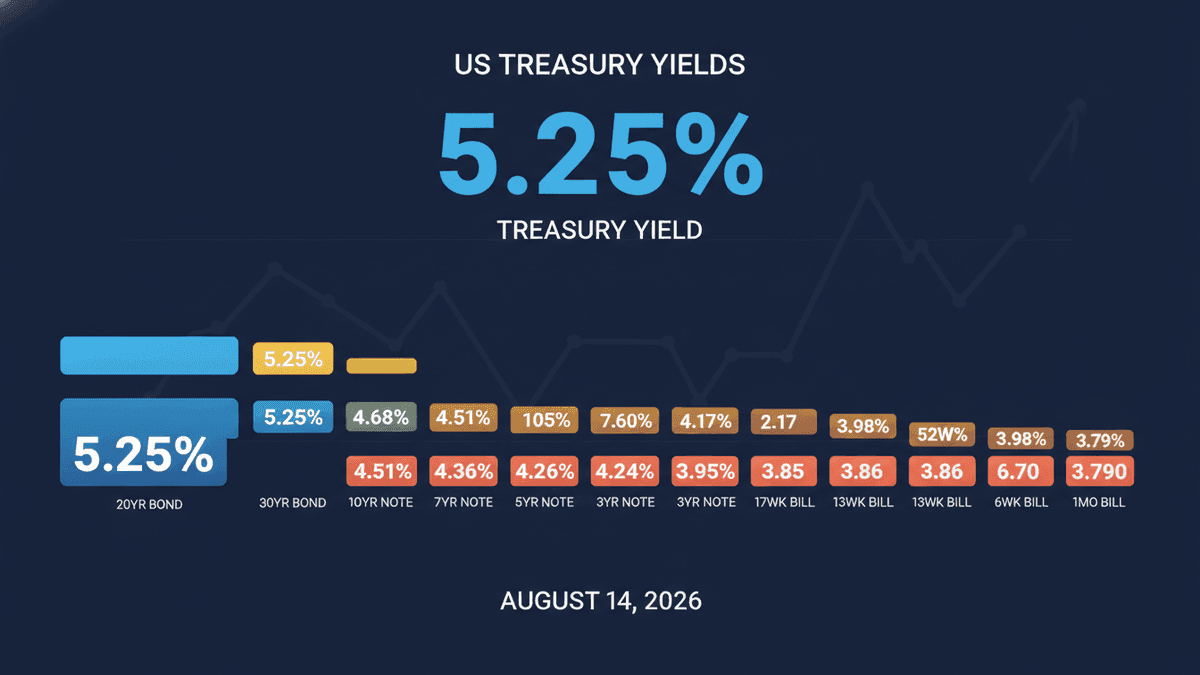
Explore U.S. Treasury yields on August 14, 2026. Detailed rates for T-bills, notes, and bonds offer insights into stable, low-risk investment returns.
U.S. Treasury securities presented a detailed yield landscape on August 14, 2026, affirming their role as highly secure investments backed by the full faith and credit of the U.S. government. These instruments continue to offer a reliable avenue for low-risk returns across various maturities.
August 14, 2026, Yield Overview
- One-month T-bill: 3.79%
- Six-week T-bill: 3.80%
- Eight-week T-bill: 3.81%
- 13-week T-bill: 3.86%
- 17-week T-bill: 3.88%
- 26-week T-bill: 3.95%
- 52-week T-bill: 3.98%
- Two-year Treasury note: 4.17%
- Three-year Treasury note: 4.24%
- Five-year Treasury note: 4.36%
- Seven-year Treasury note: 4.51%
- 10-year Treasury note: 4.68%
- 20-year Treasury bond: 5.25%
- 30-year Treasury bond: 5.25%
The Forbes Advisor article clarified the distinct structures of these securities. Treasury bills mature between four and 52 weeks and are sold at a discount from their face value.
Treasury notes carry maturities of two, three, five, seven, or 10 years, providing fixed interest payments semi-annually. Longer-term Treasury bonds, with 20 and 30-year maturities, also offer fixed semi-annual interest payments.
Key Security Types and Acquisition
Beyond standard offerings, Treasury Inflation-Protected Securities (TIPS) are designed to shield investments from inflation. Their principal adjusts based on changes in the Consumer Price Index.
Investors can acquire these government-backed securities through direct electronic auctions via a TreasuryDirect account. Alternatively, they can purchase them indirectly in the secondary market using brokerage accounts and banks.
Tax Implications and Market Dynamics
Interest earned on T-bills receives favorable tax treatment, being exempt from state and local income taxes. However, it remains subject to federal income tax regulations.
A fundamental market principle dictates an inverse relationship between bond prices and interest rates. Holding bonds until their maturity date can protect investors from temporary price volatility observed in the secondary market.