F&O Market: Trader Numbers Drop, Average Losses Hit 5-Year High
By Market Desk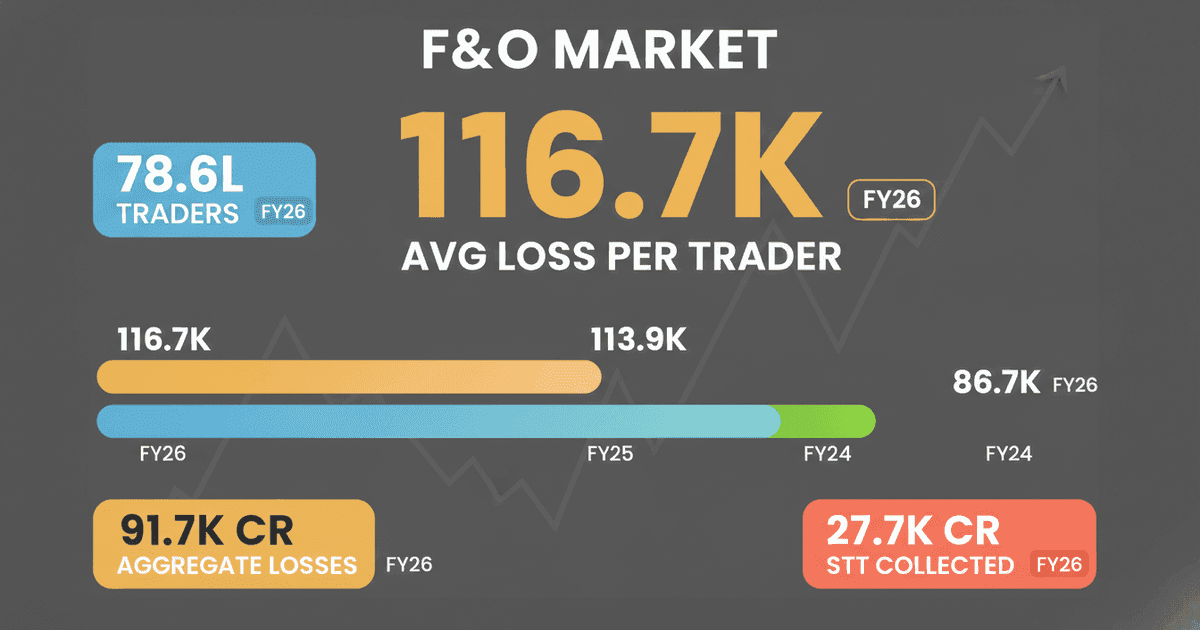
India’s F&O market saw a significant drop in retail traders in FY26, with average losses per trader reaching a five-year high. Learn more about the market trends.
India’s futures and options (F&O) market witnessed a notable reduction in retail participation during FY26, according to a recent Ministry of Finance report. While the overall number of individual traders decreased significantly, the average loss incurred per trader climbed to its highest point in five years.
The report indicates that the number of individual traders fell by almost 20 lakh, dropping to 78.6 lakh in FY26 from 98.1 lakh in the previous fiscal year. Concurrently, the aggregate net losses for individual traders saw their first decline since FY22.
- Individual Traders (FY26): 78.6 lakh
- Individual Traders (FY25): 98.1 lakh
- Aggregate Net Losses (FY26): Rs 91,685 crore
- Aggregate Net Losses (FY25): Rs 1.12 lakh crore
Despite the dip in total losses, the financial burden on each participating trader intensified. The average loss per person reached a five-year peak, underscoring a worsening individual financial outcome within the segment.
- Average Loss Per Trader (FY26): Rs 1,16,654
- Average Loss Per Trader (FY25): Rs 1,13,913
- Average Loss Per Trader (FY24): Rs 86,728
SEBI’s Regulatory Interventions
The government attributes this decline in both retail participation and overall net losses to a series of stringent regulatory and surveillance measures. These actions were systematically introduced by SEBI (Securities and Exchange Board of India) starting in November 2024.
The initial phase of SEBI’s interventions, launched in November 2024, focused on modifying market structures and risk management protocols. These changes aimed to enhance market stability and protect investors from excessive risks.
- Rationalization of weekly index derivative products
- Increased tail-risk coverage on expiry days
- Larger contract sizes for index derivatives
- Upfront collection of option premiums
Further measures were implemented in May 2025, designed to streamline operational aspects and improve oversight. These adjustments sought to create a more harmonized and closely monitored trading environment across various exchanges.
- Streamline expiry days across exchanges
- Enhance monitoring of position limits
Despite these extensive changes, the Ministry of Finance noted that SEBI has yet to examine the impact of algorithmic and high-frequency trading on market fairness, particularly concerning retail investors. Simultaneously, the Securities Transaction Tax (STT) collected from the F&O segment demonstrated a substantial increase, reflecting the underlying trading activity despite fewer participants.
- Securities Transaction Tax (FY26): Rs 27,695 crore
- Securities Transaction Tax (FY25): Rs 22,225 crore