BRICS Ministers Agree on WTO Reform & MSME Trade Finance
By Business Desk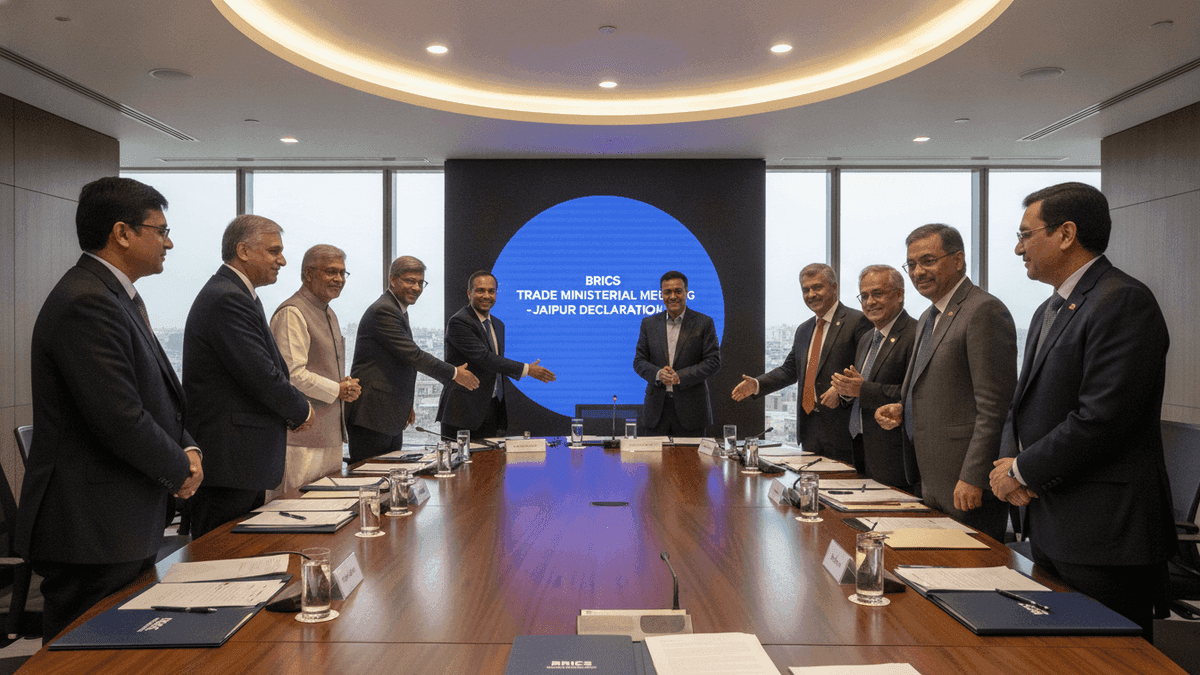
BRICS trade ministers, led by India, reached consensus on WTO reforms and enhancing trade finance access for MSMEs, aiming for resilient global value chains.
India successfully secured a consensus among BRICS trade ministers on August 7, 2026, during the 16th BRICS Trade Ministers’ Meeting in Jaipur. Chaired by Union Commerce and Industry Minister Piyush Goyal, this meeting established a comprehensive package of trade outcomes.
The ministers reaffirmed robust support for the World Trade Organization (WTO) and committed to enhancing access to trade finance for micro, small, and medium enterprises (MSMEs). Additionally, progress was made on establishing resilient global value chains.
Key Outcomes for Global Trade
The adopted outcomes include a Chair’s Statement and an Outcome Document, complete with four annexes covering multilateral trade, MSMEs, global value chains, and digitally delivered services. Ministers reiterated their commitment to a rules-based multilateral trading system, emphasizing the WTO as its core.
They advocated for preserving special and differential treatment for developing countries and the restoration of a fully functional, two-tier, and binding WTO dispute-settlement system. The necessity for policy space, enabling developing economies to ensure food and livelihood security, was also acknowledged.
Boosting MSME Trade Finance
A significant achievement from the meeting was the adoption of the Jaipur Consensus, which commits member nations to study a BRICS invoice-discounting mechanism. This mechanism aims to address the estimated $2.5 trillion global trade-finance gap that disproportionately affects smaller businesses.
Guiding principles for credit-assessment frameworks for export-oriented MSMEs were also adopted, encouraging lenders to evaluate firms based on cash flows rather than traditional collateral. This forms part of a broader plan for MSME internationalization.
Strengthening Global Value Chains
Ministers also approved a Global Value Chains (GVC) Action Plan for the period 2026-30. This plan outlines specific initiatives to fortify international supply networks, including the creation of a BRICS Technical Council and BRICS Connect.
Other initiatives involve a joint study on GVCs and the exploration of strategic supply-chain and investment-promotion platforms. These platforms will focus particularly on critical sectors such as pharmaceuticals and food security.
Advancing Digital Services and Partnerships
To facilitate cross-border digital commerce, principles were adopted to ensure safe and secure digitally delivered services. Furthermore, progress was noted on the Strategy for BRICS Economic Partnership 2030, which will be submitted to BRICS leaders for their endorsement.
These collective efforts underscore a concerted push towards a more integrated and resilient global trade environment, reflecting the ongoing collaboration among member nations.