UPI Dominates India’s Digital Payments as Cash Declines
By ThePip Desk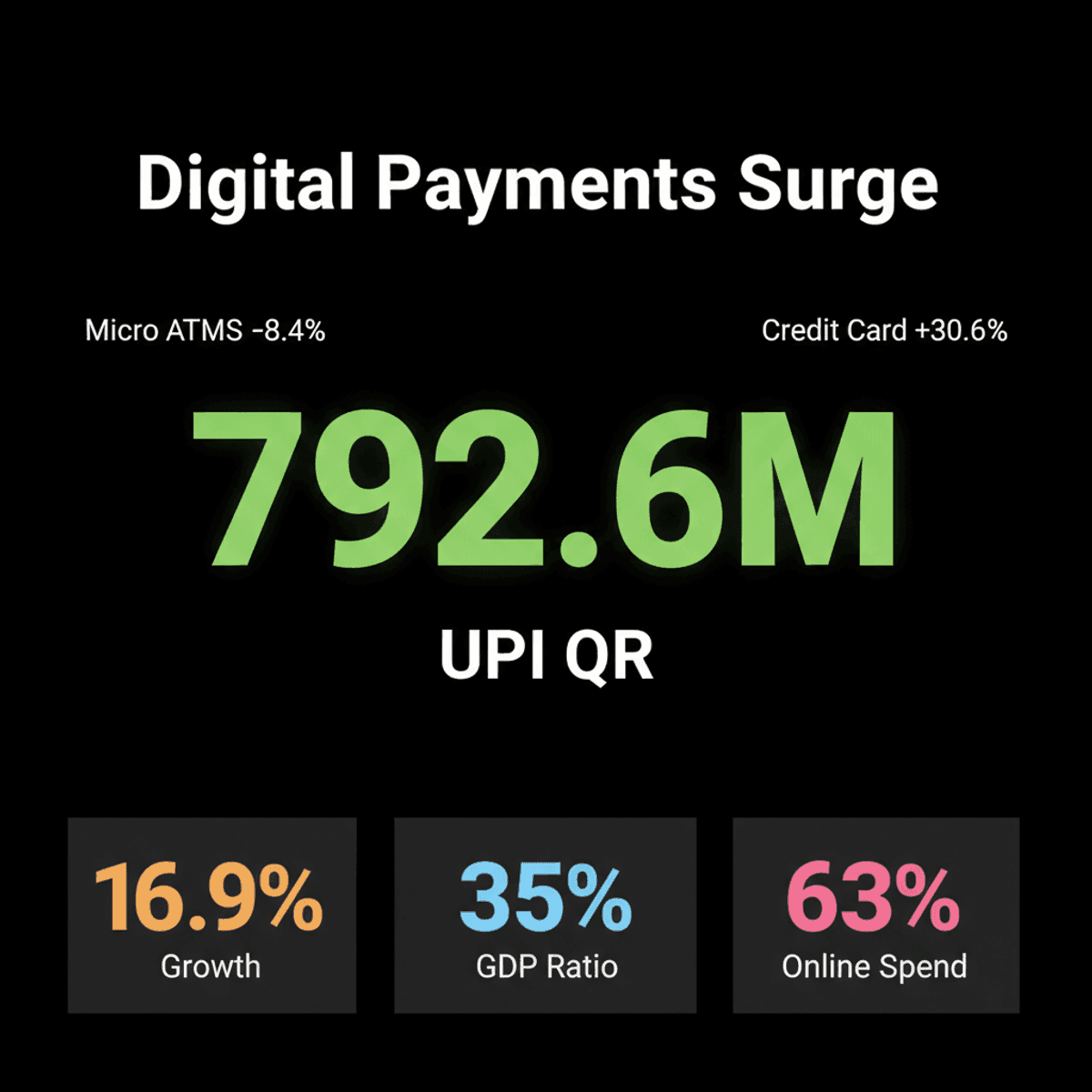
India’s digital payment revolution is here! UPI QR codes surge 16.9% while traditional ATMs decline, signaling a major shift in financial infrastructure.
India’s payment landscape is undergoing a fundamental transformation, moving decisively from hardware-centric systems towards advanced software-led digital channels. This significant shift is predominantly fueled by the widespread adoption of Unified Payments Interface (UPI) QR codes and increasing online card transactions.
Data from the Reserve Bank of India reveals a substantial increase in UPI QR code transaction volume, which rose by 16.9% year-on-year to reach 792.6 million by the close of June. This surge underscores a clear preference among consumers and merchants for efficient quick response code payments.
Contrasting Trends in Traditional Infrastructure
Conversely, traditional cash access points are experiencing a notable decline. Micro ATMs saw an 8.4% decrease, falling to fewer than 1.34 million units, while off-site ATMs contracted by 6.8%, totaling 73,426. The overall ATM and cash-recycler network remained largely stable at approximately 210,000 units.
Pranav Gundlapalle, head of India Financials at Bernstein, affirmed India’s strong progression towards cashless payments, noting a 22% expansion in total payment value for FY26. This growth propelled the cashless payments-to-GDP ratio to 35%. UPI payments are responsible for the majority of this incremental digital transaction growth.
Evolving Card Transaction Patterns
The change in consumer behavior extends to card usage patterns. Credit card e-commerce volume jumped by 30.6% over the year, with online purchases constituting about 63% of all credit card spending. This indicates a strong migration from physical card use to digital transactions.
In parallel, physical point-of-sale transactions made with debit cards dropped by 12.3%, and debit card ATM withdrawals decreased by 8.6%. These figures reflect a broader disengagement from cash-heavy and hardware-dependent payment methods.
Banks are strategically reallocating resources within their ATM infrastructure, increasing on-site ATMs and cash recyclers by 3.9% to roughly 136,000 units, while concurrently reducing off-site machines. Micro ATMs faced an even sharper contraction, declining by 3.8% in the June quarter and 8.4% annually.
Prakash Agarwal, a partner at Gefion Capital, highlighted this as a fundamental shift in India’s payment architecture. He stated that software-based QR and online channels are capturing incremental growth, leading to a rationalization of hardware-intensive cash and merchant-acceptance networks.
This ongoing evolution points to a sustained move towards digital payment methods, driven by consumer convenience and the strategic adaptation of financial infrastructure to software-centric solutions.