India Commercial Funding Surges to ₹10.65 Trillion
By Business Desk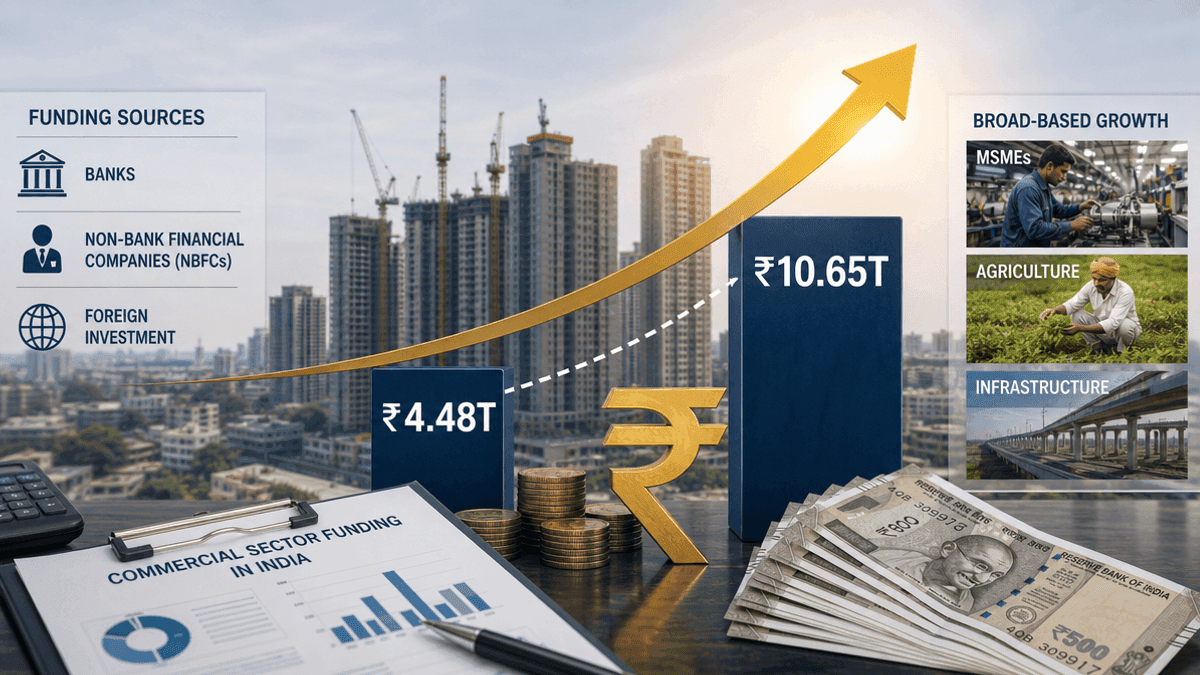
India’s commercial sector funding skyrockets to ₹10.65 trillion in April-July FY27, fueled by a massive surge in non-food bank credit and diversified financial inflows.
India’s commercial sector witnessed a significant influx of financial resources, more than doubling to ₹10.65 trillion during April-July FY27. This substantial increase comes from ₹4.48 trillion recorded in the same period last year, according to data from the Reserve Bank of India (RBI).
Key Funding Figures
- Total financial resources flow: ₹10.65 trillion (April-July FY27)
- Previous year’s total: ₹4.48 trillion
- Non-food bank credit soared to: ₹6.69 trillion
- Previous year’s non-food bank credit: ₹0.73 trillion
- Funding from non-bank sources: ₹3.96 trillion
- Previous year’s non-bank funding: ₹3.76 trillion
- Foreign funding increased to: ₹2.08 trillion
- Previous year’s foreign funding: ₹1.39 trillion
The primary catalyst for this surge was a sharp rise in non-food bank credit, which dramatically expanded from ₹0.73 trillion a year ago. Analysts observed that this credit growth was broadly distributed across various economic segments.
Broad-Based Credit Expansion
The expansion in credit impacted several key areas, indicating widespread economic activity. Both large corporations and Micro, Small, and Medium Enterprises (MSMEs) experienced significant growth in funding.
- Industry
- Services
- Agriculture
- Personal loans
- Infrastructure
Beyond traditional bank lending, other financial channels also contributed to the overall growth. Non-bank sources provided increased funding, demonstrating a diversified financial landscape.
Foreign funding also saw a notable rise, influenced by recent RBI policies. These policies pertain to external commercial borrowings (ECBs) and other overseas borrowing mechanisms.
Sectoral Credit Trends in June 2026
The RBI’s monthly bulletin for June 2026 highlighted sustained robust growth in bank credit across major sectors. Agricultural credit accelerated considerably, while industrial credit maintained its momentum.
- Agriculture and allied activities advances grew year-on-year by 16.8% (up from 6.8% a year prior).
- Personal loans segment expanded by 15.8% (compared to 11.7% a year ago).
All industrial categories, including micro, small, medium, and large enterprises, showed broad-based expansion. Specific industries recorded strong year-on-year growth, underscoring targeted demand.
- Infrastructure
- Engineering
- Food processing
- Textiles
- Construction
- Basic metals
- Petroleum, coal products, nuclear fuels
- Chemical products
Shifting Lending Priorities and Corporate Demand
Sachin Sachdeva, Vice-President and Sector Head, Financial Sector Ratings, Icra, noted a strategic shift in bank lending. Banks are increasingly prioritizing MSMEs and secured retail loans, with specific segments showing particular strength.
Gold and vehicle loans exhibited significant momentum within the secured retail category. While housing credit growth has been slower due to yield pressures, there is a greater emphasis on loans against property (LAP) to achieve better yields.
Corporate loan portfolios have also grown in recent quarters, driven by market dynamics. Elevated bond market yields have redirected some credit demand towards banks, which offer more attractive financing rates. Improved asset quality in the wholesale book has further bolstered confidence, renewing focus on corporate lending.