Bank of Japan Holds Rate at 1.00% as Inflation Nears Target
By ThePip Desk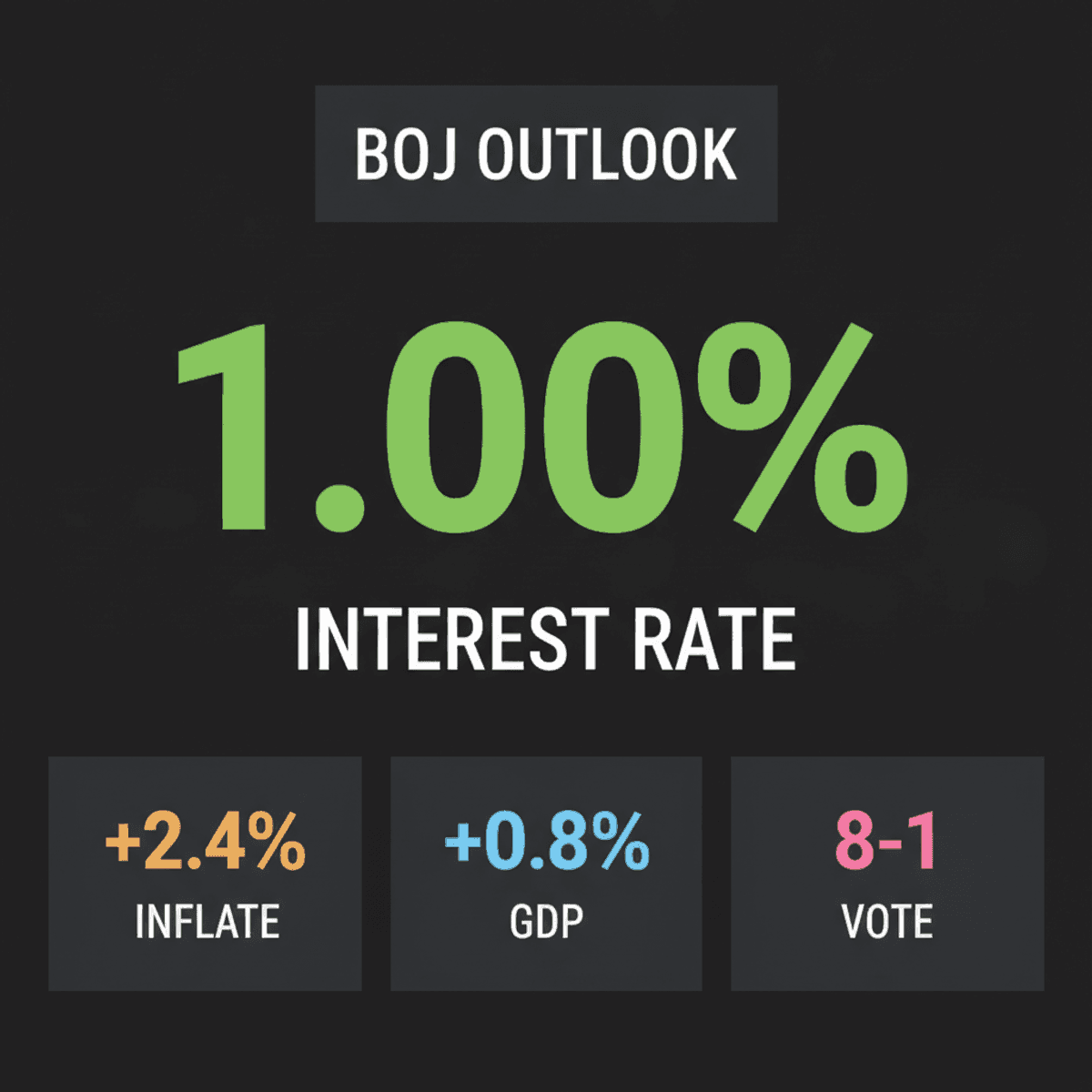
The Bank of Japan maintains its benchmark interest rate at 1.00%, signaling a steady approach as underlying inflation moves closer to its 2% objective.
The Bank of Japan (BoJ) concluded its two-day monetary policy review meeting on Friday, opting to hold its short-term interest rate steady at 1.00%. This decision was widely anticipated by market participants.
The central bank’s board approved the measure with an 8-1 vote. Board member Takata proposed an increase to 1.25%, but the majority rejected this proposal.
BoJ’s Inflation Assessment and Future Path
In its monetary policy statement, the BoJ noted that underlying inflation is approaching its 2% target. Financial conditions across the economy remain accommodative.
The BoJ indicated its intention to continue raising interest rates in the future. The timing and pace of these adjustments will depend on evolving economic and price developments, alongside financial conditions.
The central bank also highlighted specific areas of concern for its policy outlook. Particular attention will be paid to the impact of Middle East developments on foreign exchange markets, the broader economy, and domestic prices.
Updated Economic Projections from Outlook Report
The BoJ’s latest Outlook Report provided revised forecasts for key economic indicators.
The median core Consumer Price Index (CPI) projection for fiscal 2027 was revised upwards to +2.4% from the April forecast of +2.3%. The projection for fiscal 2028 remained unchanged at +2.0%.
Real Gross Domestic Product (GDP) forecasts also saw slight upward adjustments. Fiscal 2026 is now projected at +0.6% (up from +0.5%), and fiscal 2027 at +0.8% (up from +0.7%). The fiscal 2028 forecast held steady at +0.8%.
The report underscored that the mechanism of wages and prices rising moderately in interaction is expected to be maintained. Medium-to-long-term inflation expectations are also anticipated to increase.
Underlying inflation is now projected to reach the BoJ’s price target between the second half of fiscal 2026 and fiscal 2027. The risks to prices are currently skewed to the upside.
Recognized Risks and Market Reaction
A separate BoJ report on risks indicated a decrease in significant downside risks to economic activity. Conversely, it noted increased upside risks to prices.
This report highlighted the rapid progression of price pass-through from high crude oil prices in business-to-business transactions. There is a clear risk of underlying CPI inflation potentially exceeding the 2% target.
Factors such as the recent rise in semiconductor prices and the depreciation of the yen are expected to contribute to higher prices for durable goods and a wide array of other items. Following the BoJ’s announcement, the Japanese Yen (JPY) weakened against the US Dollar (USD).
The USD/JPY pair rose by 0.78% to trade at 160.80, reflecting the market’s immediate reaction to the policy decision and forward guidance.