India Auto Parts Sector: Talent & Material Crunch Amidst Growth
By Business Desk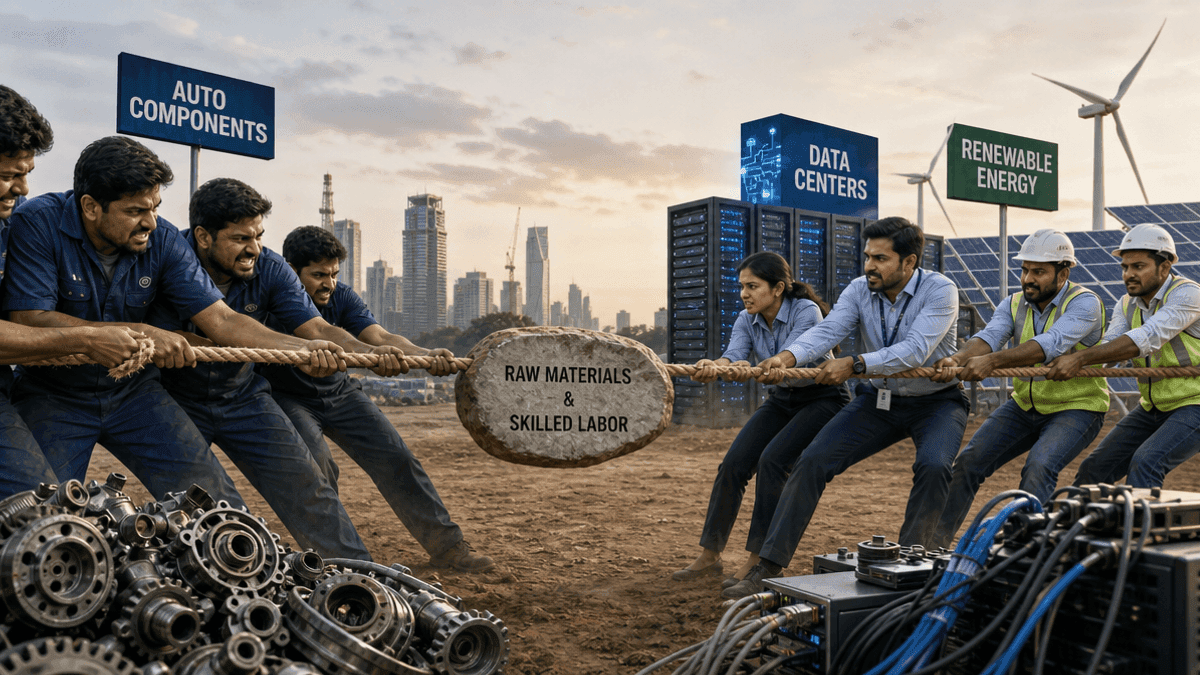
India’s auto-component industry faces a dual challenge: intense competition for talent and raw materials from booming data centers and renewable energy sectors. Learn about the impact and strategies.
India’s auto-component industry faces escalating competition for both skilled manpower and essential raw materials. This scarcity stems from the rapid expansion of other high-growth sectors, particularly data centers and renewable energy.
Intensifying Resource Scarcity
A joint report by the Automotive Component Manufacturers Association of India (ACMA) and Boston Consulting Group (BCG) highlights how this resource pressure compounds existing industry challenges. These include supply-chain disruptions, persistent labor shortages, and fluctuating demand patterns.
Saurabh Chhajer, a partner and managing director at BCG, noted that auto-component manufacturers in various clusters are now directly competing with industries experiencing a ‘super cycle.’ This dynamic significantly increases stress on common raw materials and shared labor pools.
Key figures underscore the scale and ambition within the sector and related investments:
- The auto-component sector is currently valued at approximately $80 billion.
- Current exports stand at $23 billion.
- An ambitious export target of $100 billion has been set for FY30.
- Global data-center investment is projected to reach $7 trillion by 2030, according to McKinsey estimates.
Sustained Demand Amid Pressures
Despite these operational hurdles, the demand for auto components remains robust. Vinnie Mehta, Director General of ACMA, confirmed strong momentum through the first quarter and July, with original equipment manufacturer (OEM) schedules indicating continued positive traction.
This positive outlook extends into the festive season, with expectations for another strong financial year. Mehta also underscored the industry’s critical role in assisting the vehicle sector to meet increasingly demanding customer expectations and navigate complex product and ecosystem requirements.
Strategic Responses to Challenges
In response to the intensifying competition for resources, component makers are proactively pursuing strategies to boost exports. They are also working to deepen their integration into global supply chains.
The competition for resources is anticipated to grow further as India commits more investment to data-center infrastructure and renewable energy. These strategic moves aim to secure the industry’s future amidst a changing economic landscape.
To tackle the complexities of multi-tier supply chains, demand volatility, and rising OEM expectations for quality and reliability, a significant portion of the industry has adopted advanced manufacturing. More than two-thirds of surveyed auto-component manufacturers have implemented smart factory initiatives.
These initiatives, ranging from pilot programs to fully integrated systems, are designed to enhance productivity and alleviate constraints related to manpower. They represent a crucial step in modernizing operations and ensuring competitiveness.