AI Revolutionizes Filmmaking: Lower Costs, New Stories
By Sivam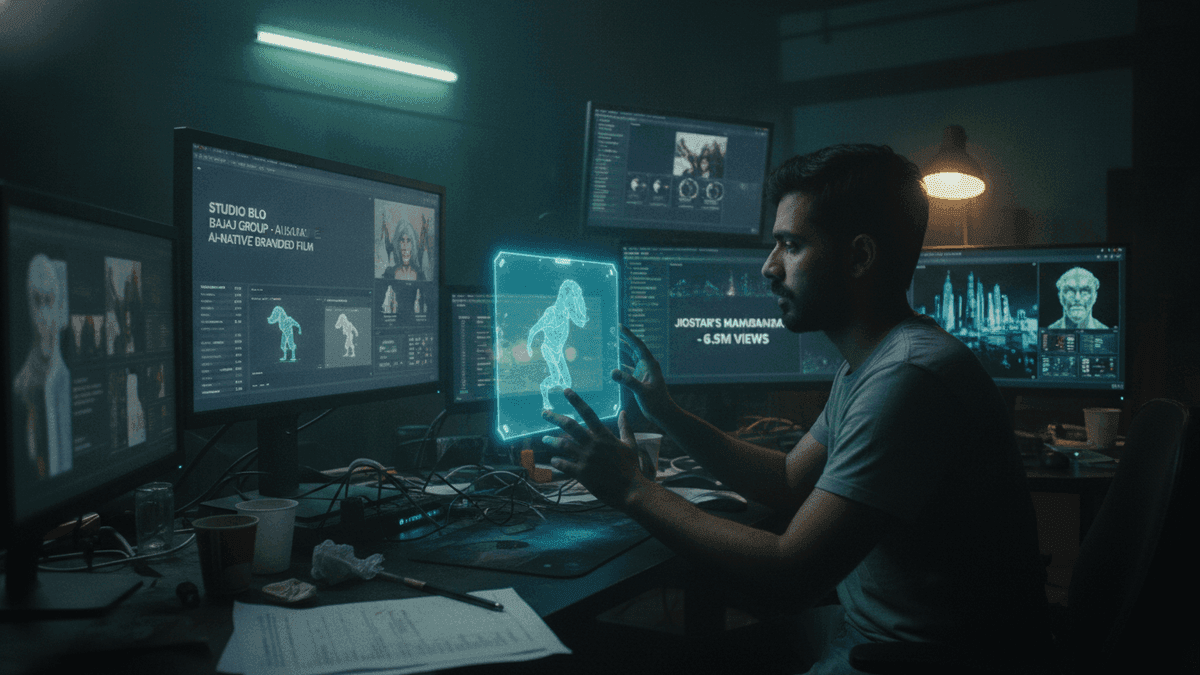
Generative AI is democratizing filmmaking, slashing costs, and challenging traditional studios. Explore how AI is reshaping the future of cinema.
AI Drives Filmmaking Revolution
The global film industry is undergoing a significant transformation driven by generative artificial intelligence, challenging traditional production models that relied on large production houses, expensive equipment, and substantial investments. This technological shift is democratizing access to filmmaking and dramatically altering how cinematic content is conceived, produced, and distributed.
A notable example includes JioStar’s AI adaptation of Mahabharat, which garnered 6.5 million views on its debut day. Similarly, Studio Blo, an AI-native filmmaking lab, collaborated with filmmaker Rajkumar Hirani on an AI-native branded film for Bajaj Group, utilizing AI for facial cloning, voice recreation, and visual storytelling. These initiatives highlight AI’s growing influence across the entire production cycle.
Transforming Production Workflows
AI is increasingly serving as an assistant director, with filmmakers adopting AI-native productions where significant portions of a film are generated, modified, and enhanced using generative AI models. Storyboarding and pre-visualization have emerged as early large-scale applications, allowing for rapid iteration and concept development.
Independent filmmaker Vikrant Patankar leverages AI, specifically Claude Sonnet, for script refinement, scene development, and dialogue, emphasizing collaborative drafting over direct AI output. Production teams also use generative AI in the concept phase to quickly generate variations of characters, environments, and visual moods. Shajy Thomas, cofounder and CTO of Astra Studios, noted that AI can generate hundreds of concept variations for elements like creatures or hero assets rapidly, compressing traditionally extensive manual design cycles.
The technology’s impact extends into VFX pipelines, where image-to-3D generation models are being explored for secondary characters, props, and environmental assets. Software ecosystems like Adobe, Houdini, and Foundry are integrating AI-assisted tools to accelerate repetitive VFX tasks. However, generative AI still faces challenges in producing consistent, controllable, and production-ready outputs at film quality, particularly in maintaining character continuity, lighting consistency, and realistic performances.
Startups are emerging to address these limitations. NeuralGarage, for instance, offers VisualDub technology to correct dialogue and improve lip-syncing without costly reshoots. Its Drama AI expression editor allows creators to alter facial expressions post-production. Beyond creative tools, London-headquartered Storyvord AI is developing an AI coproduction platform for American and European markets, offering tools for budgeting, compliance, scheduling, storyboarding, and predictive audience analysis. Gaurav Sharma, founder of Storyvord AI, stated,