Corporate Directors Vanish: Singapore Workers Abandoned
By Sivam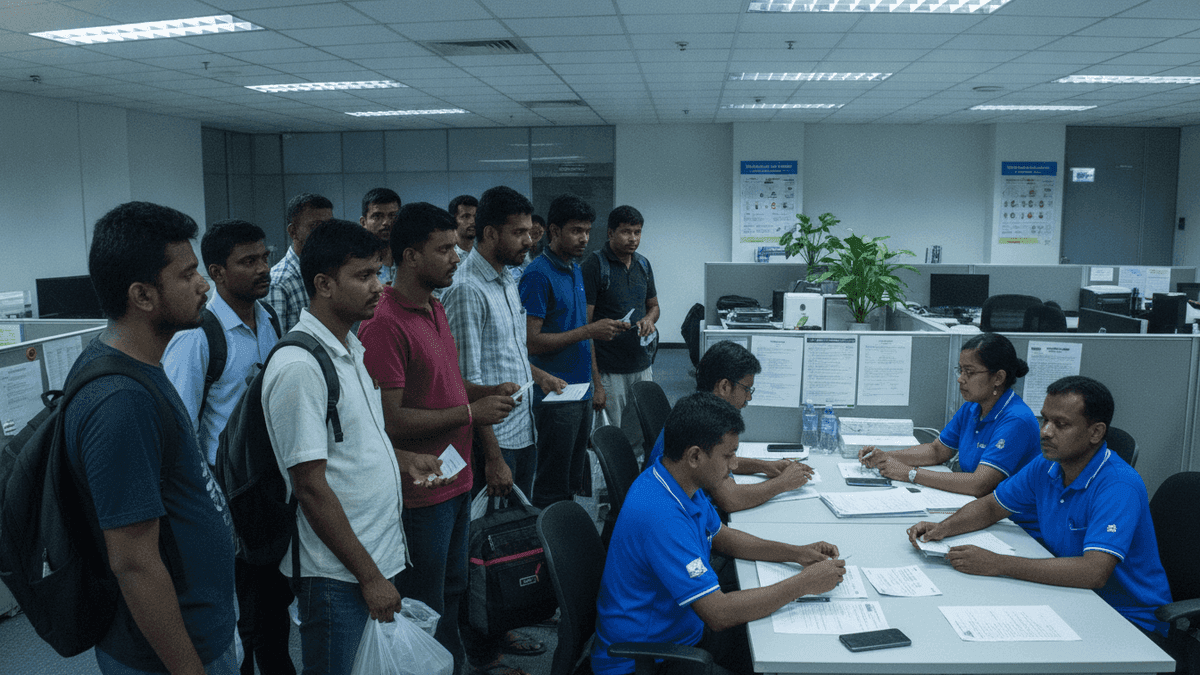
Over 400 migrant workers abandoned by Singaporean firms. Directors evade responsibility, leaving workers without wages. Authorities provide assistance.
A familiar pattern of corporate accountability challenges has emerged in Singapore, as over 400 workers from India and Bangladesh find themselves abandoned without wages and accommodation. Three companies—SK Industries, KPA Engineering, and VVR Plant Engineering—are implicated in the incident, with a common director, Ramu Palani Velu, identified as an Indian national and permanent resident of Singapore, now reportedly having left the country.
This situation, while specific in its details, echoes a broader, persistent challenge: the ease with which some corporate entities and their leadership can seemingly sidestep their obligations. The High Commission of India has confirmed engagement with the affected workers, alongside the National Trades Union Congress (NTUC) and the Ministry of Manpower (MOM), who are actively providing immediate assistance.
The affected individuals, many of whom were hired by KPA Engineering, a firm specializing in air-con maintenance, and its related entity SK Industries, reported to MOM on Monday after their employers became uncontactable. NTUC Secretary-General Ng Chee Meng and Minister of State for Manpower Dinesh Vasu Dash met with the workers, assuring them of support that includes SGD200 in cash and supermarket vouchers, along with arrangements for alternate accommodation and job placements.
Checks on the corporate intelligence platform Sayari reveal Ramu Palani Velu’s directorship across seven companies primarily involved in air-conditioning, plumbing, and building services. KPA Engineering, which he founded in 2014, was last recorded with SGD1 million in capital. VVR Plant Engineering, formerly known as VMD Integrated, was taken over by Ramu in 2025 (likely a typo for an earlier year), having been previously owned by Indian nationals Ravi Victor and Ravi Vijayarani, and their Singaporean son, Ravi Martin Abraham. Martin, 23, stated his family sold the company to Ramu, valuing its access to specialized process sector work permits.
The pattern of directorship changes and the subsequent disappearance of a key figure underscore the complexities in tracing ultimate responsibility within intricate corporate structures. Sundaramoorthy Komathy, another Indian national, served as a director with Ramu from 2016 to 2018 at KPA Engineering, followed by Krishnamurthy Sundaramoorthy becoming an active director in 2020, according to The Straits Times. These shifts highlight the fluid nature of corporate leadership that can complicate accountability when issues arise.
While the immediate focus remains on securing the welfare of the abandoned workers, this incident serves as a stark reminder of the recurring vulnerabilities in systems designed to protect labor. The challenge is not merely isolated to a single event but points to the enduring need for robust oversight and clear mechanisms to hold corporate leaders accountable, especially when they appear to vanish, leaving a trail of unfulfilled obligations.
One Thing To Consider Today
Before assuming that a corporate entity’s structure guarantees stability or accountability, it is always worth examining the history of its leadership and ownership changes. The ease with which directors can shift roles or depart jurisdictions can often be a tell-tale sign of potential future challenges, demanding a calmer, more investigative approach to understanding underlying risks.