India’s Higher Education: Global Talent Magnet Sees 18.9% Growth
By ThePip Desk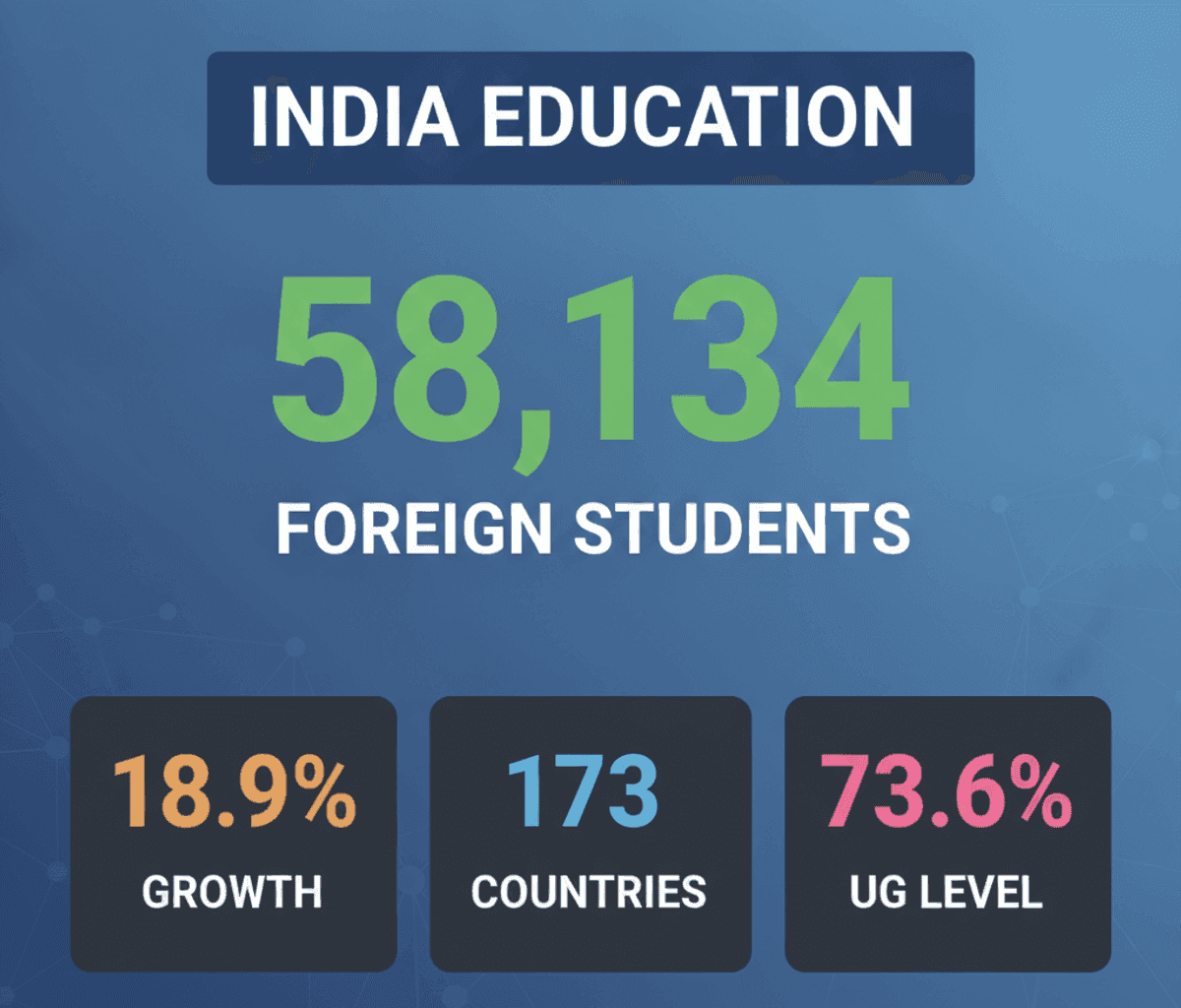
India’s higher education sector sees a significant 18.9% surge in foreign student enrollment, attracting talent from 173 countries. Discover key source nations and top destination states.
India’s higher education landscape is demonstrating a clear structural pattern of increasing international appeal, as evidenced by the All India Survey on Higher Education (AISHE) for 2023-24. The nation’s institutions successfully drew 58,134 foreign students from 173 countries during the academic year, marking a robust 18.9% increase over the past five years since 2019-20, when enrolments stood at 48,898.
This growth is not uniform, revealing distinct geographical and programmatic preferences among international students. Nepal continues to be the dominant source, contributing a substantial 24.1% of the total foreign student population. Other significant contributors include the UAE at 7%, the US at 5.9%, Bangladesh at 5.9%, Nigeria at 5.5%, and Zimbabwe at 4%, indicating a broad international reach.
Domestically, Karnataka has emerged as the leading destination state, attracting 7,914 international students. This slight lead over Punjab, which enrolled 7,902 students, suggests a competitive environment among states for global talent. Other key states include Maharashtra with 6,190 enrolments, Uttar Pradesh with 5,953, and Tamil Nadu with 5,694, collectively highlighting a distributed yet concentrated demand across India’s educational hubs.
A deeper look into program distribution reveals a strong preference for undergraduate studies, which account for 73.6% of foreign enrolments, totaling 42,779 students. Postgraduate programs attract a smaller, yet significant, 16.8% of students, or 9,845 individuals. This compositional insight suggests that India’s appeal primarily lies in foundational higher education, potentially due to cost-effectiveness or specific course offerings.
The sustained upward trajectory in foreign student numbers, encompassing both male and female students, underscores the efficacy of strategic initiatives. The Ministry of Education’s ‘Study in India’ (SII) program, launched in 2018, appears to be a load-bearing mechanism in this structural shift. Its continued expansion could further solidify India’s position as a preferred global education destination, fostering intellectual exchange and soft power.