Rupee Crisis: NRI Investor Slams India Property Yields
By Sivam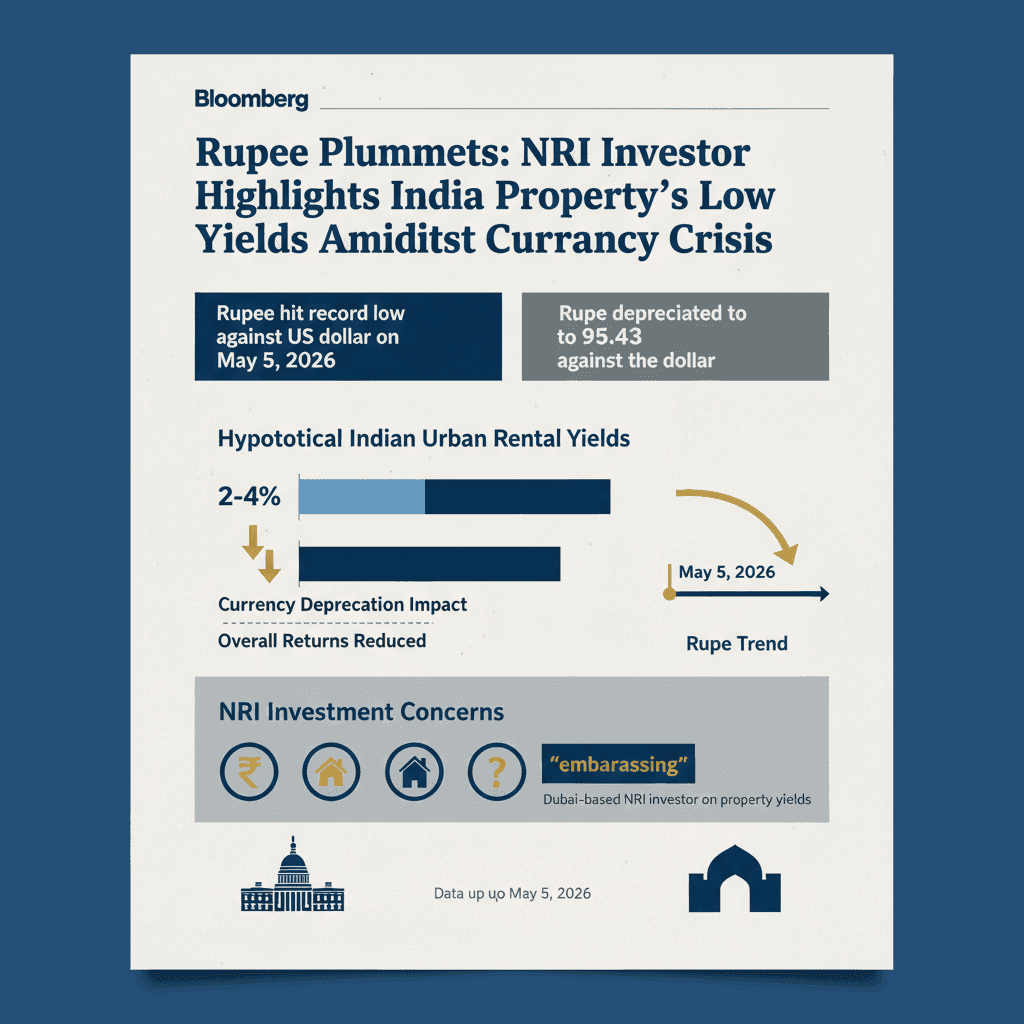
As the Indian Rupee hits a historic low, a Dubai-based NRI investor criticizes India’s real estate yields as ’embarrassing’ amidst currency crisis.
The Indian Rupee has hit a record low against the US dollar on May 5, 2026, a development exacerbated by the ongoing conflict between the United States and Iran. Following a weak opening, the Rupee depreciated to 95.43 against the dollar, marking its lowest point historically. This significant currency fluctuation has brought to light critical concerns for Non-Resident Indian (NRI) investors, particularly those with substantial investments in India’s real estate sector. The prevailing economic climate and currency depreciation are casting a shadow over the expected returns from property investments, prompting a re-evaluation of their viability.
The Impact of Rupee Depreciation on NRI Investments
The weakening of the Indian Rupee has a direct and often negative correlation with the returns experienced by NRIs on their investments held in India. When the Rupee falls against major currencies like the US dollar, the value of assets held in India, when converted back to the NRI’s primary currency, diminishes. For an NRI based in Dubai, for instance, whose earnings are typically in Dirhams or US Dollars, a weaker Rupee means that the income generated from Indian assets, such as rental income from property or capital gains from sales, translates to a smaller amount in their home currency. This erosion of value can significantly impact the overall profitability and attractiveness of investing in the Indian market.
Real Estate Yields Under Scrutiny
The current market sentiment, amplified by the Rupee’s slide, has brought the yields on Indian real estate investments under intense scrutiny. A Dubai-based NRI investor, speaking on condition of anonymity, described the yield from property investments in India as ’embarrassing.’ This sentiment reflects a broader concern among investors who find that the rental yields – the annual return on investment from rental income – are often low compared to the capital appreciation expected or the yields available in other global markets. In many prime Indian urban areas, rental yields can hover between 2-4%, which, when factored against property prices, management costs, and taxes, leaves little room for substantial profit, especially when currency depreciation further eats into returns.
Geopolitical Tensions and Economic Uncertainty
The recent slump in the Rupee is attributed, in part, to the heightened geopolitical tensions involving the United States and Iran. Such global instability often leads to capital flight from emerging markets as investors seek safer havens for their funds. This increased risk aversion, coupled with domestic economic factors, can put downward pressure on the currency. For NRIs, this uncertainty adds another layer of risk to their investment strategies in India. The expectation of steady returns from real estate, a traditional favorite for many NRIs, is now challenged by the volatility introduced by external economic and political factors, making the prospect of investing in Indian property less appealing than it once was.
Strategic Considerations for NRI Property Investors
In light of these challenges, NRI investors are being compelled to reassess their property investment strategies in India. The focus is shifting from purely capital appreciation to a more holistic view that includes rental yields, currency risks, and the overall economic outlook. Diversification into other asset classes or exploring investment opportunities in markets with more stable currency regimes and higher yields might become more attractive. The ’embarrassing’ yields, combined with the depreciating Rupee, suggest that real estate in India may no longer offer the compelling returns it once did for international investors, necessitating a more cautious and strategic approach to future investments.