UAE President Gifts Cerebras AI Superchip to PM Modi
By Sivam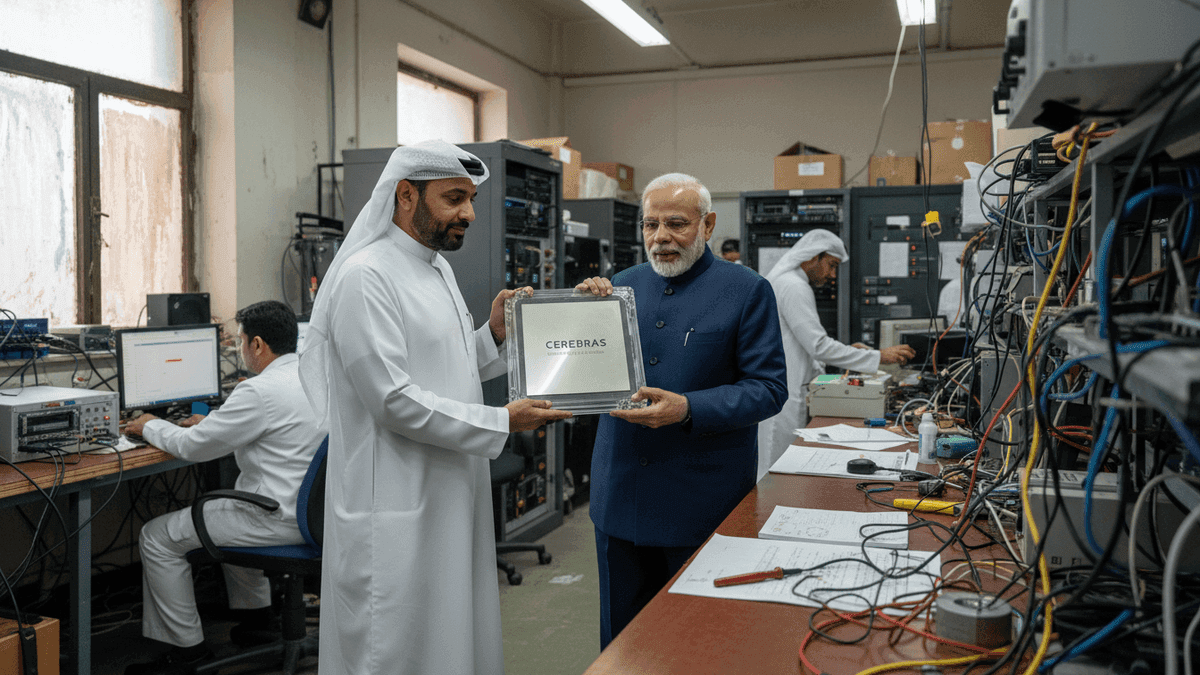
UAE President gifts Cerebras AI superchip to PM Modi, launching ‘Condor Galaxy India’ AI supercomputing partnership, strengthening tech ties.
UAE President Gifts Cerebras AI Superchip to PM Modi, Solidifying Tech Partnership
In a move underscoring the deepening technological collaboration between the United Arab Emirates and India, UAE President Sheikh Mohamed bin Zayed Al Nahyan presented a Cerebras AI superchip to Indian Prime Minister Narendra Modi. This significant exchange occurred shortly after Prime Minister Modi’s arrival in the UAE for a diplomatic tour, following his attendance at the BRICS foreign ministers’ conclave in New Delhi. The gesture was more than symbolic; it marked the formal initiation of ‘Condor Galaxy India,’ a substantial 8-exaflop AI supercomputing partnership between the UAE’s Abu Dhabi-based tech firm G42 and India. The physical chip gifted to Prime Minister Modi represents the foundational element of this ambitious infrastructure project, which aims to deploy 64 Cerebras CS-3 systems to establish one of the largest AI compute clusters in India.
Cerebras Systems: Revolutionizing AI Compute with Wafer-Scale Engines
The Cerebras chip is at the core of this burgeoning India-UAE technological alliance. Cerebras Systems, founded in 2015 by a team of semiconductor industry veterans, has adopted a radical approach to chip design, diverging significantly from conventional methods. Unlike traditional Graphics Processing Units (GPUs) that utilize numerous smaller chips from a silicon wafer, Cerebras manufactures a single, massive processor using an entire wafer. This architecture, termed the Wafer-Scale Engine (WSE), integrates over 4 trillion transistors and nearly one million AI-optimized cores onto a single piece of silicon. The WSE-3, Cerebras’s latest iteration, boasts an impressive 44 GB on-chip SRAM with data transfer speeds of 21 petabytes per second and a proprietary on-wafer fabric delivering an aggregate bandwidth of 214 petabits per second. This design innovation allows for AI model training with up to 24 trillion parameters without the need for complex code splitting, significantly reducing data communication latency and potentially delivering up to 20 times faster AI training and inference capabilities.
Condor Galaxy India: A Leap Forward in India’s AI Ambitions
The ‘Condor Galaxy India’ project, formalized by the gifting of the Cerebras chip, aligns perfectly with India’s domestic AI development goals. This partnership is poised to bring sovereign AI compute capabilities onshore, thereby reducing India’s reliance on foreign cloud infrastructure and providing domestic startups and researchers with access to frontier-scale computing power. The project was initially announced by Prime Minister Modi and President Al Nahyan during the latter’s visit to India in January. Subsequently, G42 and India’s Centre for Development of Advanced Computing (C-DAC) signed a term sheet to deploy the 8-exaflop supercomputer cluster. G42, in collaboration with C-DAC, will manage the installation, deployment, operation, and maintenance of this system. Upon completion, this project will represent a monumental step for the Indian AI ecosystem, with its proposed eight exaflop capacity dwarfing the combined compute power of India’s current flagship AI supercomputers.
Strategic Implications and Future Outlook of the India-UAE Tech Collaboration
The deployment of the AI compute cluster is expected to foster a new era of joint research and development across critical sectors such as health and genomics, energy, and geospatial analytics. It will empower researchers, institutions, and innovators from both nations to advance scientific frontiers and address significant global challenges. The project’s potential applications include accelerating drug discovery, processing satellite data for disaster management, simulating efficient smart energy grids, and supporting broader research initiatives. A crucial aspect of this collaboration is data sovereignty, as hosting the infrastructure and data within India addresses concerns regarding data residency, security, and national control. G42 CEO Mansoor Al Mansoori highlighted that the deployment of their Intelligence Grid in India signifies a practical approach to AI-native transformation, delivering infrastructure that converts energy and compute into sovereign, nation-scale intelligence. This initiative not only boosts India’s technological capabilities but also reinforces the strategic importance of the India-UAE partnership in the rapidly evolving global technology landscape.