Zepto IPO Delayed: Valuation Gap Between Private & Public Markets
By Market Desk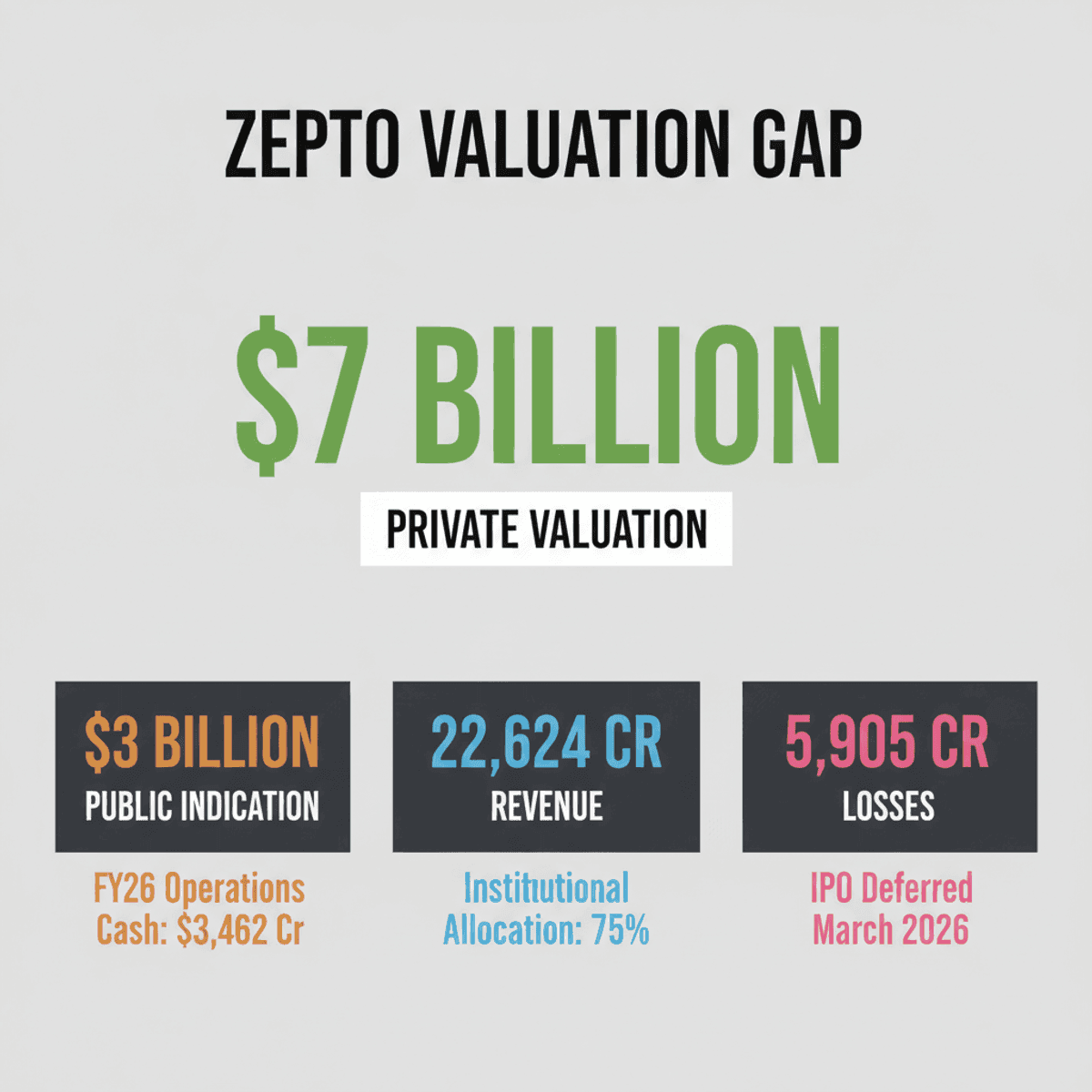
Zepto postpones IPO due to a significant valuation gap, with mutual funds valuing the quick commerce firm much lower than its private funding round.
Quick commerce firm Zepto has postponed its Initial Public Offering (IPO) after domestic mutual funds valued the company significantly lower than its last private funding round. This decision underscores a critical divergence in valuation perspectives between private and public market institutions.
Private investors, including CalPERS in October 2025, had previously valued Zepto at a robust $7 billion. However, public market institutions indicated a valuation ranging from only $2.5 billion to $3 billion, revealing a substantial discrepancy.
Key Financials & Valuation Gap
- Zepto’s private valuation: $7 billion (October 2025 by CalPERS)
- Public market valuation indication: $2.5 billion to $3 billion
- Revenue from operations in FY26: Rs 22,624 crore (more than doubled)
- Losses in FY26: Rs 5,905 crore (increased)
- Cash consumed by operations in FY26: Rs 3,462 crore
- Regulation 6(2) institutional allocation mandate: at least 75% of net offer
This situation serves as a crucial lesson for retail investors regarding the mechanics of the public market. Unlike private investors, who often have a vested interest in higher valuations, public buyers retain the freedom to refuse an inflated price.
Mutual funds, in this instance, effectively acted as agents for retail investors by not agreeing to an inflated valuation. This echoes a similar deferral by PhonePe in March 2026, signaling a broader market shift where private valuations are increasingly viewed as merely an initial offer from sellers.
Zepto’s Operational Challenges
While Zepto’s revenue from operations more than doubled in FY26 to Rs 22,624 crore, its losses also grew to Rs 5,905 crore during the same period. Operations consumed Rs 3,462 crore in cash, reflecting the costs associated with rapid expansion despite an improved adjusted loss per order.
The company was seeking to list under Regulation 6(2), a route for firms not meeting standard eligibility tests. This regulation mandates that at least 75% of the net offer must go to institutions, significantly limiting retail investor participation.
Navigating IPO Investing
The deferral grants Zepto additional time but does not resolve its underlying economic challenges, as the company continues to burn cash. Improving unit economics often conflicts directly with growth objectives, a trade-off Zepto must navigate.
For investors considering future IPOs, several enduring rules remain paramount:
- The seller ultimately chooses the timing of the IPO.
- Judge the price of the offering over its structural details.
- There is no inherent urgency to invest in any IPO.
Additionally, investors should conduct four essential checks before applying for an IPO. These include understanding the eligibility route, comparing acquisition costs, verifying cash generated from operations, and closely monitoring institutional subscription levels.
Mutual funds demonstrated their protective role for retail investors in the Zepto scenario. Investors should maintain a selective approach, especially given the high volume of new issues frequently entering the Indian market.