NSE Launches Gold Receipts: Digitizing India’s Bullion Market
By Varun Mittal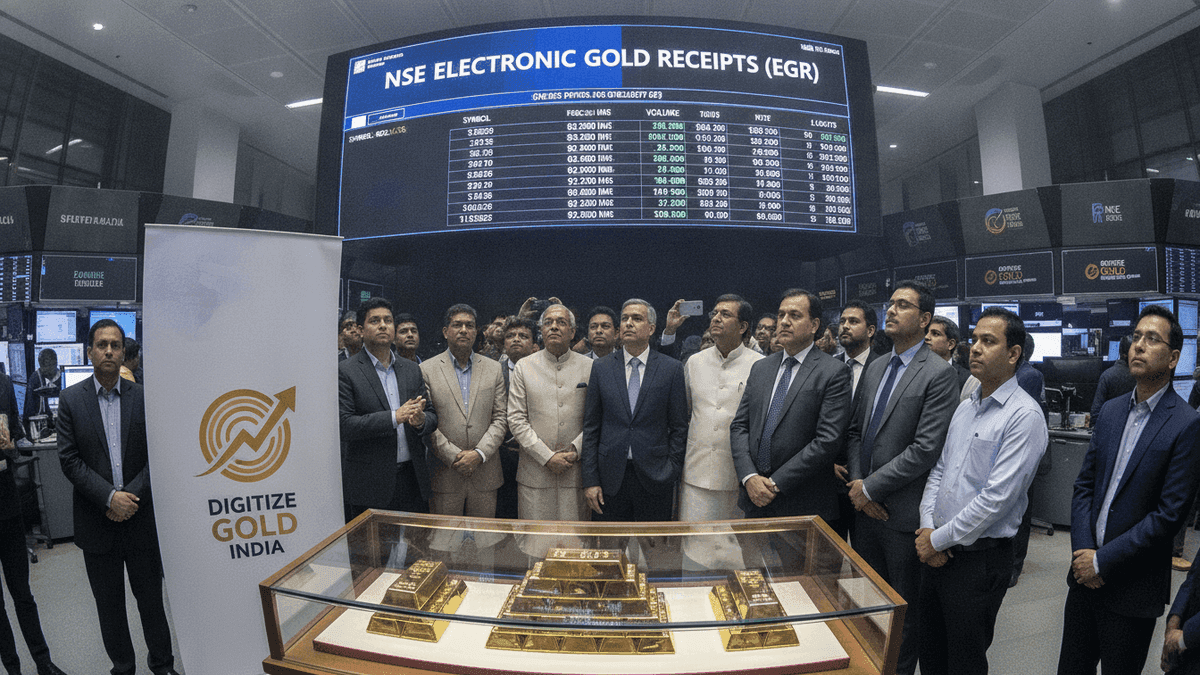
NSE introduces Electronic Gold Receipts (EGRs) to digitize India’s gold market, ensuring physical backing for transparency and investor confidence. Discover the future of bullion trading.
NSE Introduces Electronic Gold Receipts
The National Stock Exchange (NSE) has launched Electronic Gold Receipts (EGRs) in a definitive stride to digitize India’s vast and largely unorganized gold market. This strategic initiative aims to fundamentally transform the country’s bullion trade into a more transparent, structured, and high-velocity digital framework. Crucially, unlike other investment products that merely offer synthetic exposure to gold prices, the EGR model ensures that every single unit issued is robustly backed by an equivalent amount of physical gold, securely stored in SEBI-regulated vaulting facilities across the nation.
This inherent physical backing, coupled with the explicit allowance for converting receipts into tangible gold, is meticulously designed to bridge a critical trust gap within the market. It specifically targets both cautious retail investors and professional jewelers who have historically demonstrated significant hesitation towards purely paper-based gold derivatives. By offering a verifiable and convertible asset, EGRs aim to instill confidence and broaden participation.
Aiming for Enhanced Price Discovery and Efficiency
A pivotal development poised to significantly enhance market efficiency is the planned shift to a T+1 settlement cycle for bullion transactions. India’s traditional gold market has long been characterized by notable regional price variations, a direct consequence of deep-seated supply chain inefficiencies and a pervasive lack of real-time pricing data across its highly fragmented segments.
By centralizing these disparate markets under a unified, single order book, the NSE intends to firmly establish its new infrastructure as the definitive primary benchmark for spot gold pricing nationwide. This centralization is expected to effectively narrow the often-wide bid-ask spreads that local bullion dealers currently capitalize on, thereby offering investors unprecedented access to transparent, exchange-verified pricing that was previously unavailable to the average household or small business.
Overcoming Adoption and Liquidity Challenges
Despite the strong institutional push for modernization, the successful adoption and cost aspects of EGRs present several substantial challenges that could impede widespread acceptance. The mandatory vaulting and insurance fees associated with holding EGRs introduce a structural expense ratio. This ratio could potentially surpass the management fees of existing Gold Exchange Traded Funds (ETFs), thereby making the product less attractive to India’s highly cost-sensitive retail participants.
Furthermore, the product’s inherent reliance on India’s established demat account infrastructure means its reach is fundamentally limited to current demat account holders. This structural limitation effectively excludes vast rural populations, which represent a significant segment of physical gold demand but often lack adequate access to formal financial infrastructure or digital trading platforms.
Initial trading phases also carry a persistent and notable risk of thin liquidity. Should trading volumes fail to achieve a critical mass, bid-ask spreads could ironically widen beyond those found in traditional over-the-counter markets. This outcome would effectively negate the very price discovery advantage the exchange aims to provide, potentially deterring early adopters.
Future Prospects and Market Integration
Market participants are now closely observing the successful integration of large-scale refiners into the vaulting ecosystem, which is crucial for the seamless operation of the EGR framework. The frictionless flow of gold, from its initial import and subsequent refining stages, through the exchange, and ultimately to the end consumer, will serve as the ultimate indicator of the program’s long-term viability and operational success.
Brokerage sentiment suggests that if the NSE can effectively attract a robust cadre of institutional liquidity providers to actively market-make the EGRs, the instrument possesses significant potential to displace a considerable portion of the unorganized physical bullion trade. However, achieving this ambitious goal will undeniably necessitate overcoming significant regulatory hurdles and deeply entrenched cultural inertia within the complex Indian gold market, demanding sustained effort and policy support.