India’s ESG Shift: Driving Competitiveness for 2047
By ThePip Desk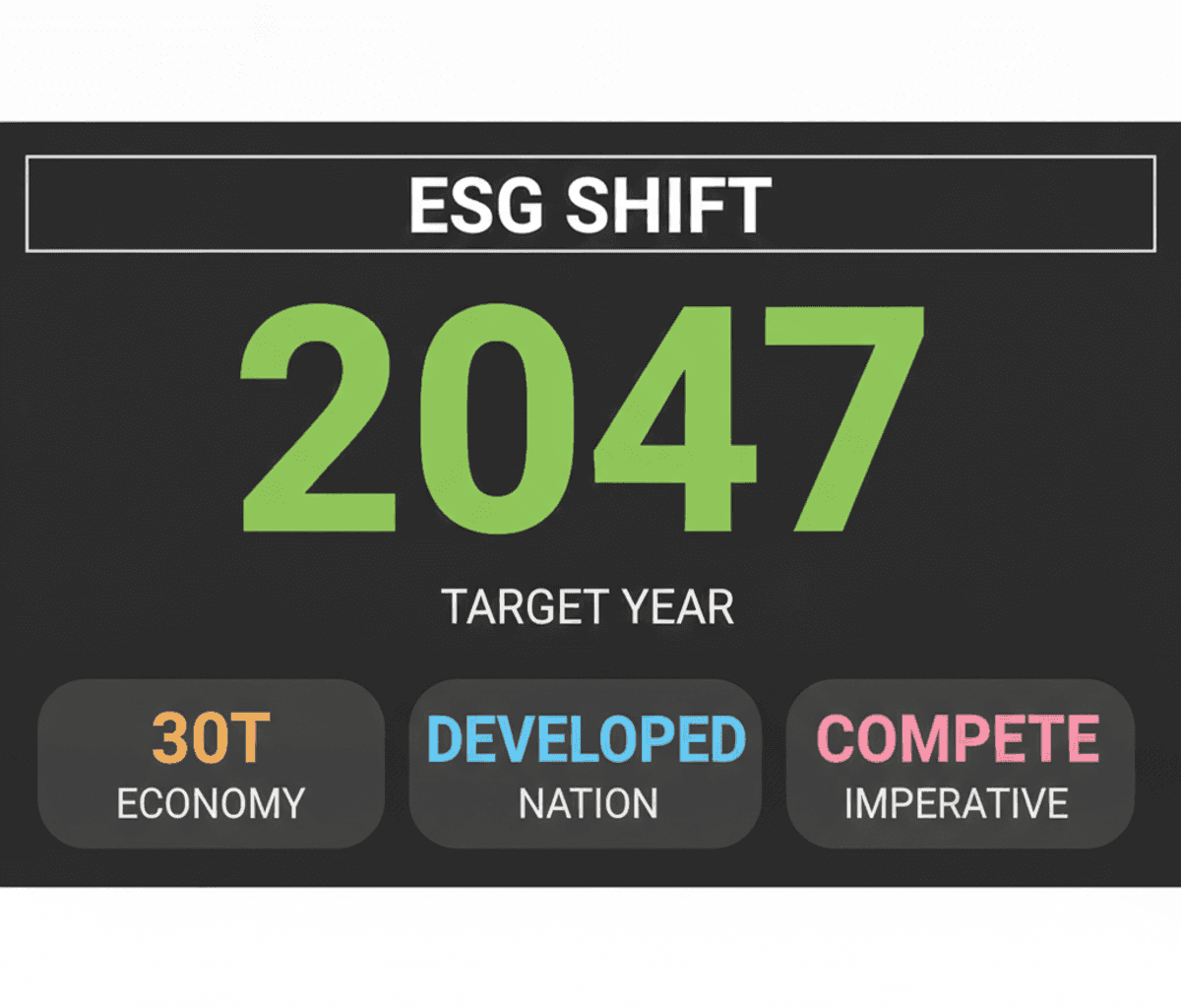
India’s MCA redefines ESG from compliance to strategic value, crucial for economic competitiveness and the 2047 ‘Viksit Bharat’ vision.
India is embarking on a profound structural transformation, positioning Environmental, Social, and Governance (ESG) principles not merely as regulatory checkboxes, but as foundational pillars for its future economic prowess. The Ministry of Corporate Affairs (MCA) has unequivocally stated that ESG-led responsible business conduct is paramount for India’s economic competitiveness, serving as a critical enabler for the nation’s ambitious vision of becoming a developed economy by 2047.
The Question: Why ESG Matters Now for India’s Economic Trajectory
The conventional view often frames ESG as a matter of corporate social responsibility or a compliance overhead. However, for a rapidly developing economy like India, the MCA’s stance redefines ESG as a strategic imperative directly linked to national competitiveness and the ‘Viksit Bharat’ vision. This perspective elevates sustainability beyond a ‘nice-to-have’ and embeds it within the core economic growth model, fostering competitive enterprises, trusted markets, inclusive growth, and environmental sustainability.
First Principles: The Mechanism of Value Creation Through ESG
At its core, a robust embrace of ESG principles strengthens the fundamental mechanisms of value creation and risk mitigation for businesses, which collectively underpins national economic health. By integrating environmental stewardship, social equity, and sound governance, enterprises can enhance operational efficiency, attract long-term capital, manage reputational risks, and build resilience against future disruptions. This systemic integration is what transforms individual company practices into a national competitive advantage, particularly in a globalized economy increasingly scrutinizing sustainability credentials.
The Framework: From Compliance (ESG 1.0) to Strategic Imperative (ESG 2.0)
India’s journey towards sustainability is evolving through distinct phases, characterized by Gyaneshwar Kumar Singh, IICA Director General and CEO, as a shift from ‘ESG 1.0’ to ‘ESG 2.0’. The initial phase, ESG 1.0, largely focused on meeting basic regulatory compliance requirements. ESG 2.0, however, signifies a strategic leap, where ESG acts as a direct driver for long-term enterprise value, business resilience, and comprehensive risk management. This framework implies a deeper embedding of sustainability into core business strategy and decision-making processes, moving beyond superficial adherence.
The Evidence: Official Endorsement and Rigorous Demands
The official pronouncements underscore this structural shift. Nitin Gupta, Chairperson of the National Financial Reporting Authority (NFRA), emphasized the critical need to improve the quality, reliability, and usefulness of sustainability disclosures. He asserted that sustainability information must be relevant, comparable, evidence-based, and verifiable, supported by robust methodologies, reliable source systems, and effective internal controls. Gupta explicitly called for sustainability reporting to adhere to the same discipline as financial reporting and auditing, including rigorous documentation, traceability, evidence retention, and independent examination to enhance credibility. This demand for parity with financial reporting highlights the seriousness with which these disclosures are now viewed at the highest levels.
Furthermore, Singh noted that India’s ambition to achieve a USD 30 trillion economy by 2047 necessitates ESG principles to transcend mere regulatory compliance. He outlined that the next phase should focus on embedding sustainability into board-level decision-making, reinforcing legal and regulatory frameworks for sustainability data assurance, and harnessing emerging technologies, including artificial intelligence, to enhance data quality, traceability, and transparency across value chains.
The Counter-Thesis: Perceived Burdens vs. Systemic Benefits
A common counter-argument against stringent ESG integration, particularly within developing economies, is the perceived administrative and financial burden it imposes, especially on smaller entities. Micro, Small, and Medium Enterprises (MSMEs), which form the backbone of India’s economy, often face challenges in adopting complex reporting standards due to resource constraints. This perspective suggests that an overly zealous approach could stifle growth rather than promote it.
However, the MCA’s approach acknowledges these challenges, advocating for a proportionate and pragmatic implementation of sustainability reporting. This includes leveraging technology and strengthening institutional capacities, particularly across value chains and among MSMEs. The intent is not to overburden, but to enable, ensuring that the benefits of enhanced competitiveness and access to capital outweigh the initial integration costs. By making reporting accessible and supported, the systemic benefits for the entire economy are prioritized over short-term compliance hurdles.
What Most People Get Wrong: ESG as an Optional Add-On
Many still perceive ESG as an optional or peripheral aspect of business, relevant only to large, publicly traded companies or those seeking international capital. What this perspective misses is the fundamental shift articulated by the MCA: ESG is becoming an intrinsic part of the economic development model for India. It is no longer an ‘add-on’ but a core driver of resilience and long-term value, impacting market trust, access to talent, regulatory stability, and ultimately, national economic standing. Ignoring this evolution means misunderstanding the structural changes underway in India’s business environment.
What This Means for the Reader: A Strategic Imperative for All Businesses
For any business operating in India, this means re-evaluating internal processes and strategic planning through an ESG lens. The emphasis on high-quality, verifiable disclosures, akin to financial reporting, signals a future where sustainability data will be scrutinized with equal rigor. This is not merely about avoiding penalties; it is about securing a competitive edge, fostering investor confidence, and aligning with the national economic vision. Companies must proactively integrate ESG into their operations, supply chains, and governance structures, preparing for an environment where robust sustainability performance is a prerequisite for sustained success.
Perspective: Building a Resilient, Future-Ready Economy
India’s commitment to embedding ESG into its economic fabric is a long-term strategic play aimed at building a resilient, future-ready economy. The transition from compliance-driven ESG 1.0 to value-driven ESG 2.0 reflects a sophisticated understanding that sustainable development is inextricably linked to economic prosperity. This evolution will not be without its challenges, particularly in standardizing data and supporting smaller enterprises, but the foundational shift articulated by the MCA, NFRA, and IICA establishes a clear path for India to achieve its 2047 vision as a developed and globally competitive nation.
ONE THING TO CONSIDER TODAY
When assessing the long-term viability of an enterprise or sector in India, it is crucial to move beyond traditional financial metrics and incorporate the quality and verifiability of its sustainability disclosures. Consider whether the business has genuinely integrated ESG into its strategic decision-making, rather than merely treating it as a reporting exercise. This deeper analytical lens provides a more comprehensive view of its future resilience and competitive positioning in an economy increasingly defined by responsible conduct.