India’s Economy to Hit 9.7% of Global GDP by 2030
By ThePip Desk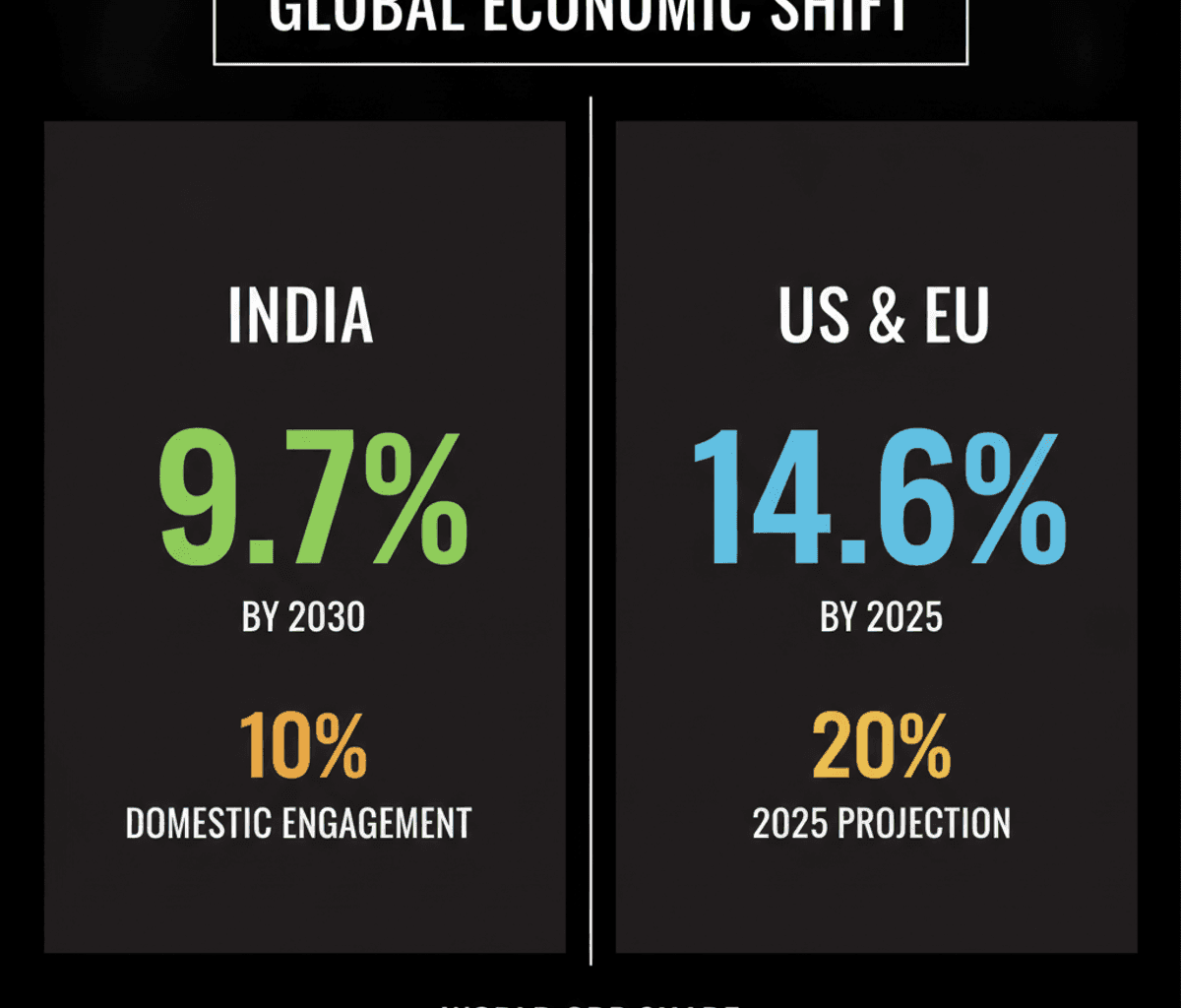
India’s GDP share to reach 9.7% by 2030, driven by domestic capital formation, signaling a major global economic power shift.
India is poised to significantly reshape the global economic landscape, with its share of world Gross Domestic Product projected to reach 9.7% by 2030. This forecast, detailed in a working paper from the Economic Advisory Council to the Prime Minister (EAC-PM), underscores a profound rebalancing of international economic power, shifting decisively towards emerging economies.
The analytical framework underpinning this growth highlights India’s robust domestic engagement in global savings and investment, now exceeding 10% of the total. This strong local capital formation is not merely a statistic; it represents the foundational mechanism supporting sustained long-term infrastructure and industrial expansion, a critical component for any rising economic power.
To contextualize this trajectory, consider China’s remarkable ascent. From a 4% share of global output in 1992, China now commands nearly 20% of the world’s GDP, measured by purchasing power parity. This nation has become a dominant force in global investment, contributing approximately 30% of total world capital allocation, effectively taking the economic position the United States held three decades prior.
Conversely, established economic powers are experiencing a relative contraction. The United States’ share of world GDP, which stood at 20% in 1992, is projected to decrease to 14.6% by 2025. Similarly, European nations have witnessed a gradual reduction in their global economic influence, illustrating a clear structural pattern of economic decentralization away from traditional hubs.
For market participants, these macroeconomic shifts signal a durable long-term transition towards emerging economies. The critical analytical lens for India involves observing the effective deployment of its burgeoning domestic capital into productive sectors such as manufacturing, technology, and infrastructure. This is not about speculative company valuations, but about the structural efficiency of capital allocation within a growing economy.
As India approaches a nearly 10% share of global output, the long-term perspective for investors must focus on how governmental policies and industrial efficiencies continue to influence this capital deployment. Understanding these underlying mechanisms, rather than simply tracking quarterly figures, offers a more robust framework for navigating the evolving global economic order throughout the remainder of the decade.