Indian Airfares to Rise 10% After Jet Fuel Price Hike
By Varun Mittal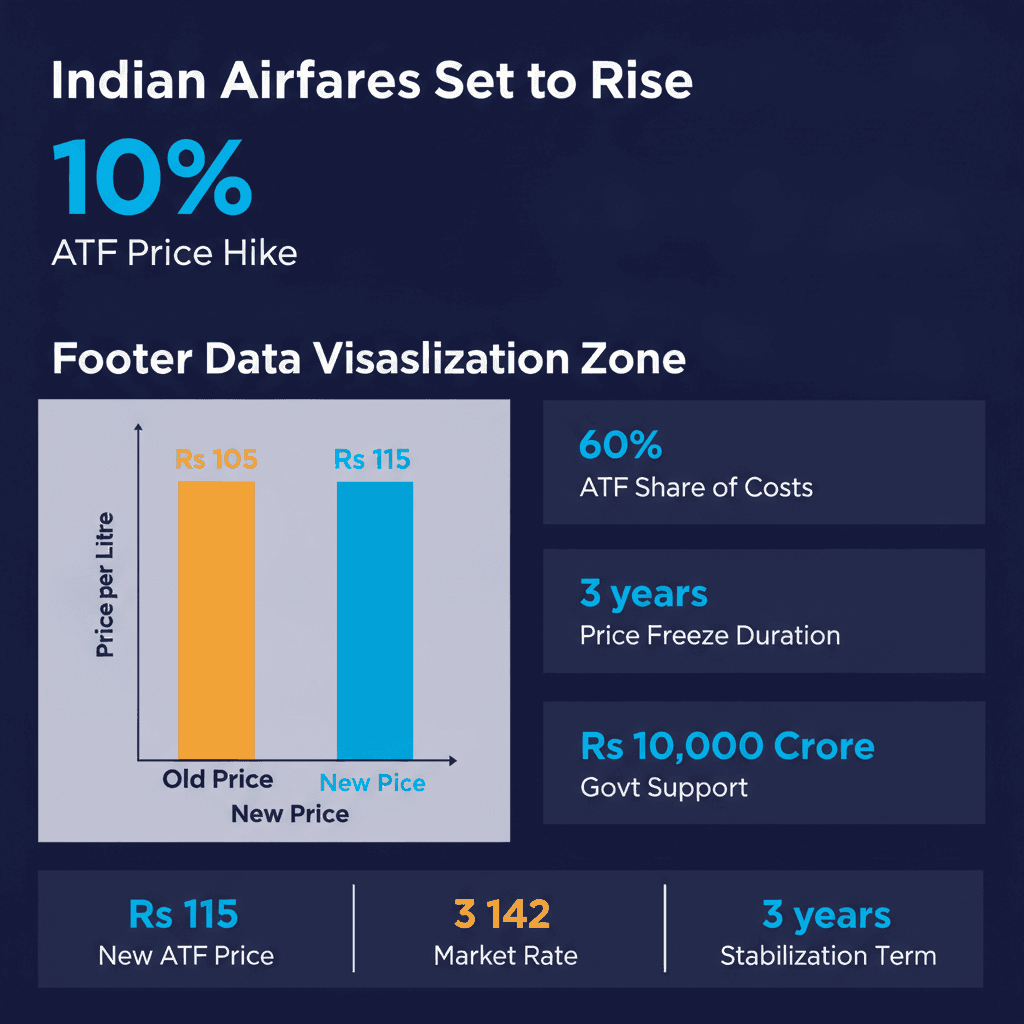
Indian airfares are set to increase by up to 10% as oil companies raise Aviation Turbine Fuel (ATF) prices, impacting airline operating costs and passenger fares.
Indian Airfares Set to Rise as OMCs Hike Jet Fuel Prices by 10%
Indian air travel is poised to become more expensive following a significant 10% increase in Aviation Turbine Fuel (ATF) prices implemented by oil marketing companies (OMCs). This adjustment, introduced under a new price-stabilization regime, is widely expected to directly translate into higher airfares for passengers traveling within and from India.
Effective immediately, the cost of jet fuel for domestic carriers has risen to Rs 115 per litre, marking an increase from the previous rate of Rs 105 per litre. This upward revision in fuel costs represents a substantial financial challenge for airlines, considering that ATF typically accounts for a critical 60% of an airline’s total operating expenditures. The direct impact of this hike on operational budgets is likely to compel carriers to adjust ticket prices accordingly.
New Price-Stabilization Regime Offers Optional Relief
The price hike is concomitant with the introduction of an optional price-stabilization regime, a strategic move designed to provide some predictability for Indian carriers amidst volatile global energy markets. Under this new mechanism, participating airlines can opt to freeze their ATF prices at the new Rs 115 per litre for a fixed duration of three years. This stability applies to both domestic and international flights operated by Indian carriers that choose to enroll in the scheme.
This government-backed initiative, announced as a Rs 10,000-crore “price stabilisation support” scheme, aims to mitigate the adverse effects of sudden and sharp fluctuations in global oil prices. Such volatility has historically impacted the financial health of the aviation sector, leading to unpredictable operational costs and, consequently, variable ticket pricing for consumers. The optional nature of the scheme allows airlines to weigh the benefits of price certainty against market flexibility.
Government to Provide Budgetary Support to OMCs
To ensure the viability of this price-stabilization framework, the government has committed to providing budgetary support in the form of interest-free advances to the oil marketing companies. This financial mechanism is crucial for compensating OMCs, enabling them to absorb and not pass on higher fuel costs to Indian carriers that have opted into the scheme during periods when global crude oil prices surge. This indirect subsidy aims to maintain the agreed-upon stable fuel price for participating airlines.
Conversely, airlines that choose not to participate in this new regime will continue to procure their jet fuel at prevailing market-linked prices. These rates currently hover around Rs 142 per litre, a figure that is significantly higher than the stabilized price and is comparable to what international airlines typically pay. This disparity creates a clear incentive for domestic carriers to evaluate the long-term financial benefits of the stabilization scheme.
Implications for Indian Aviation Sector and Passengers
The immediate consequence of the 10% increase in ATF prices is the anticipated rise in operational expenditures across the Indian aviation sector. This escalation in costs is expected to be passed on to consumers through higher airfares, making flying a more expensive proposition. While the stabilization mechanism offers a degree of long-term cost predictability for participating airlines, the initial upward adjustment marks a pivotal shift in the economic landscape for both the industry and its patrons.
The introduction of this optional price regime presents Indian carriers with a critical strategic decision. They must assess whether to lock in a stable, albeit higher, fuel cost for the next three years, thereby gaining cost certainty, or to continue operating under the fluctuating open market rates. This choice will undoubtedly shape their financial performance, operational strategies, and competitive positioning within the dynamic Indian aviation market in the foreseeable future.