India Tourism Growth Hindered by Structural Issues: WTTC
By ThePip Desk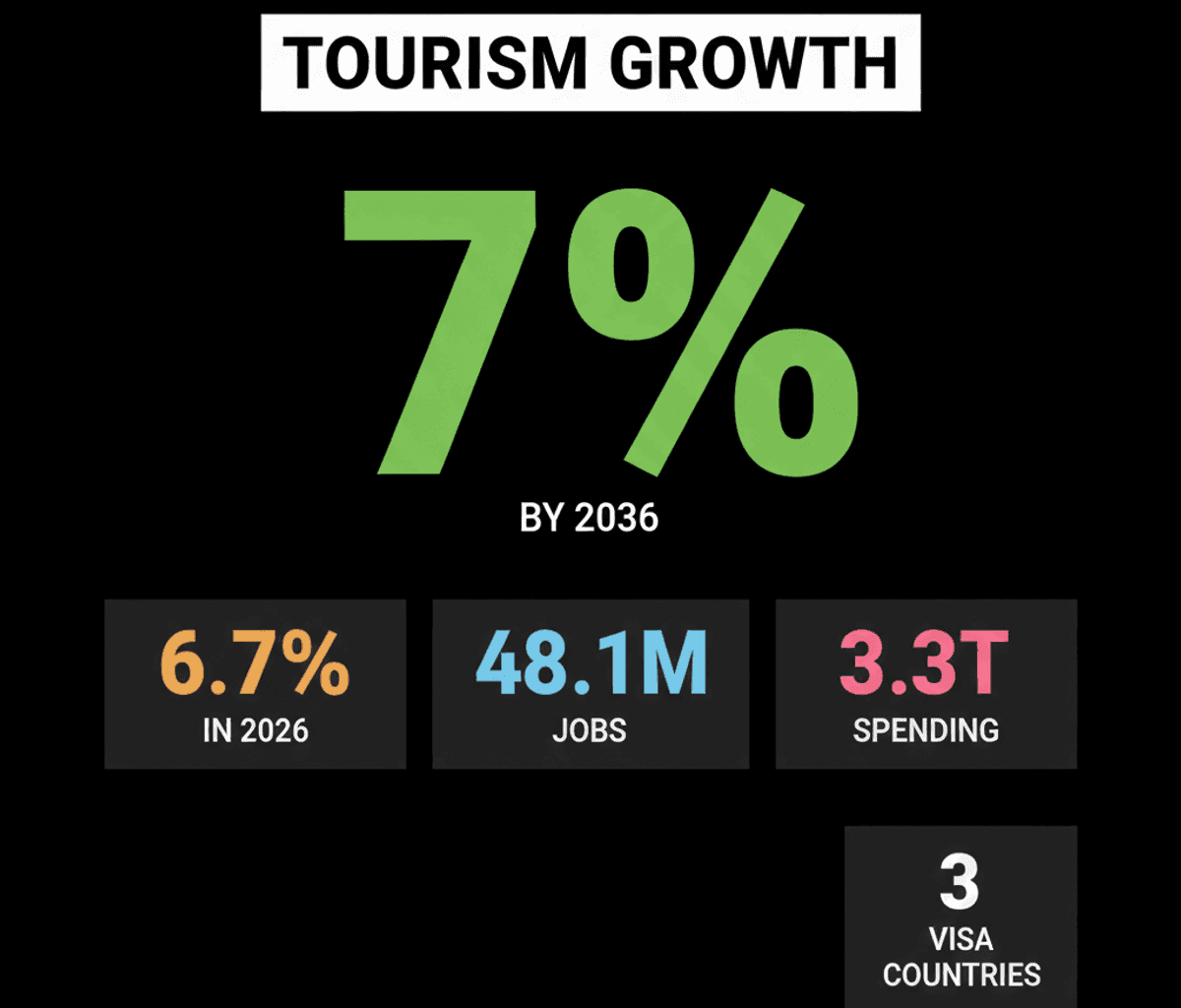
India’s tourism sector faces structural hurdles like restrictive visas and poor connectivity, limiting its growth potential despite strong GDP projections, according to WTTC.
India’s travel and tourism sector is poised for significant expansion, with the World Travel and Tourism Council (WTTC) projecting its contribution to the nation’s Gross Domestic Product (GDP) to reach 6.7% in 2026, climbing further to 7% by 2036. These figures suggest an economic trajectory for tourism that is anticipated to outpace India’s overall economic growth. Yet, beneath these optimistic headline numbers lies a critical structural challenge: the sector’s full potential remains largely unrealized due to systemic impediments.
First Principles: The Friction in Market Access
A primary mechanism hindering India’s tourism growth is the friction embedded in its market access policies, particularly visa regulations. As WTTC President and CEO Gloria Guevara noted, India currently offers visa-free access to a mere three countries. This stands in stark contrast to global competitors like China, which extends visa-free entry to 70 nations, and Thailand, providing access to 90. This disparity in accessibility directly translates into higher friction costs for potential international visitors, creating a significant barrier to inbound tourism growth.
To mitigate this, Guevara advocates for a fundamental shift in visa processing. Her recommendations include expanding the e-visa system beyond its current air and sea entry points, transitioning towards a fully digital arrival process, and integrating tourism services. These reforms are not merely administrative adjustments; they represent a strategic re-evaluation of how India positions itself on the global tourism stage, directly impacting the ease and attractiveness of travel.
The Framework: Supply-Side Constraints and Demand Generation
Beyond visa friction, India’s tourism ecosystem faces a dual challenge of supply-side constraints in connectivity and a deficit in proactive international demand generation. Limited air and land infrastructure restricts the physical capacity to host a larger influx of tourists and hampers access to diverse destinations, particularly tier-2 and tier-3 cities. Guevara specifically highlighted the need to accelerate high-speed rail projects, such as the Mumbai-Ahmedabad corridor, to enhance regional accessibility.
Concurrently, insufficient funding for international promotional efforts in key source markets curtails the proactive generation of demand. While domestic spending is robust, the international visitor segment, which often brings higher per capita expenditure, requires targeted marketing to compete effectively on a global scale. Without adequate promotional investment, India struggles to capture a larger share of the global travel market, leaving significant economic value on the table.
The Evidence: Economic Contribution and Job Creation
The WTTC’s projections underscore the substantial economic leverage the tourism sector offers. The sector’s GDP contribution stood at 6.9% in 2019, experiencing a slight dip to 6.6% in 2025 despite a rise in the rupee’s value, before its projected recovery and growth. This volatility highlights the sector’s sensitivity to external factors but also its inherent resilience and potential for rebound with strategic intervention.
In terms of employment, the sector is forecast to support 48.1 million jobs in 2026, with a projected increase to 63.5 million by 2036. This significant job creation capacity makes tourism a vital component of India’s broader socio-economic development agenda. The financial impact is equally compelling: international visitor spending is projected to reach Rs 3.3 trillion in 2026, while domestic spending is anticipated to hit Rs 19 trillion in the same year. The top source markets for inbound arrivals in 2025 were the United States, Bangladesh, the United Kingdom, Japan, and Malaysia, indicating clear target demographics for enhanced promotional efforts.
What Most People Get Wrong
A common misconception is that growth projections, however strong, inherently signify optimal performance. While India’s tourism sector is undeniably growing, focusing solely on the upward trajectory can obscure the underlying structural inefficiencies that prevent it from reaching its true, exponential potential. The gap between current performance and what could be achieved with targeted policy reforms is often overlooked, leading to a degree of complacency regarding necessary systemic changes.
What This Means for the Reader
For policymakers, this analysis provides a clear roadmap: addressing fundamental structural issues, particularly in visa policy and connectivity, is not merely about incremental gains but about unlocking a significant economic multiplier. For businesses operating within the vast tourism ecosystem, understanding these macro hurdles underscores the imperative to advocate for and adapt to potential policy shifts that could fundamentally reshape market dynamics and redefine India’s global tourism footprint.
Perspective / Long View
The long-term perspective reveals that resolving these structural challenges is not just an economic imperative but a strategic one. By systematically dismantling friction points and bolstering both supply-side capacity and demand generation, India can reposition itself as a premier global tourism destination. This strategic shift promises not only substantial economic dividends through increased GDP contribution and job creation but also enhanced cultural exchange and soft power on the international stage, yielding enduring benefits for decades to come.