India Eyes Doubled Trade with North Macedonia via Digital Infrastructure
By Business Desk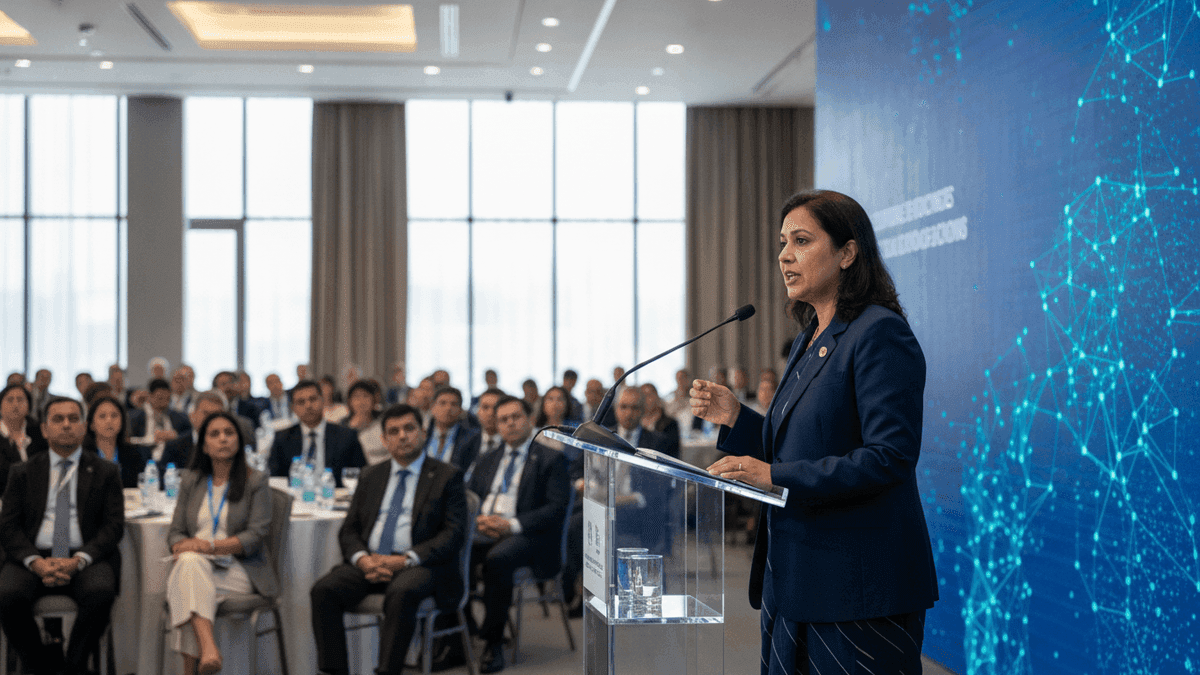
India aims to double bilateral trade with North Macedonia by 2030, focusing on digital infrastructure and strategic investments. President Murmu highlights untapped potential.
President Droupadi Murmu, on a state visit to North Macedonia, has called for a significant deepening of economic and commercial ties, setting an ambitious target to double bilateral trade volume by the end of the decade. This directive, articulated at the India-North Macedonia Business Forum in Skopje on Tuesday, signals a strategic pivot in India’s engagement with nations holding key geopolitical positions and underscores a broader framework for global economic integration.
The current trade relationship, noted by President Murmu, represents only a fraction of its full potential. India’s exports to North Macedonia primarily include organic chemicals, high-grade iron and steel, electrical machinery, and textiles, while North Macedonia contributes high-quality marble to the Indian market. The push is not merely for increased volume but for a fundamental diversification of trade and a substantial increase in mutual investments across emerging sectors.
The Structural Logic of Bilateral Expansion
The emphasis on North Macedonia extends beyond traditional diplomatic gestures; it reflects a calculated strategic engagement. North Macedonia’s role as a vital gateway connecting the Mediterranean with Central Europe positions it as a crucial node in broader trade corridors. For India, leveraging such strategic locations is integral to expanding its global economic footprint and diversifying its trade partnerships away from over-reliance on established routes.
The stated goal of doubling trade volume by the end of the decade, while ambitious, is underpinned by a recognition of underleveraged opportunities. This structural gap suggests that previous engagement mechanisms may not have fully captured the economic synergies available, necessitating a more proactive, investment-driven approach to unlock latent potential in both goods and services.
Digital Public Infrastructure: A New Export Model
A significant component of India’s proposed engagement model is the export and adoption of its Digital Public Infrastructure (DPI), exemplified by the Unified Payments Interface (UPI). President Murmu highlighted how India’s digital transformation has revolutionized governance and financial inclusion domestically, and she extended an invitation for North Macedonia to participate in this digital revolution.
This represents a paradigm shift from conventional trade, where India is not merely exporting goods but offering a proven systemic framework for economic integration and efficiency. The DPI model provides a scalable, inclusive platform that can streamline financial transactions, enhance governance, and foster digital innovation, effectively becoming a new form of infrastructural export that can structurally reshape a partner nation’s economy.
Targeted Sectors and Investment Synergies
The specific sectors identified for new investments—digital innovation, artificial intelligence, pharmaceuticals, healthcare, agro-processing, and the green energy transition—are not arbitrary. These areas align directly with India’s burgeoning technological capabilities and its strategic priorities for sustainable growth, while also addressing critical needs and emerging opportunities within North Macedonia.
This targeted approach fosters genuine investment synergies rather than one-sided trade flows. By focusing on sectors where both nations can contribute and benefit, India aims to build a more resilient and mutually beneficial economic partnership. This framework encourages shared growth and technology transfer, leveraging North Macedonia’s highly educated and multilingual talent pool to drive innovation.
Beyond Diplomacy: A Framework for Global Economic Integration
President Murmu’s visit, marking the first-ever bilateral visit by an Indian President to North Macedonia, underscores a deliberate strategy to embed India’s economic and digital models globally. Her engagements with North Macedonian President Dr. Gordana Siljanovska-Davkova and Assembly Speaker Afrim Gashi further solidify this commitment to scaling engagement bilaterally and across the wider region.
This approach suggests that India’s long-term strategy involves cultivating deep, structural relationships where bilateral ties are not solely transactional. Instead, they are built on shared digital frameworks, strategic investments, and a mutual understanding of geopolitical and economic positioning. Such a template offers a durable model for India’s broader engagement with strategically important smaller economies, fostering integration that extends beyond traditional trade figures into systemic collaboration.