India-Moldova Forum: New Economic Diplomacy for Digital & Green Sectors
By Business Desk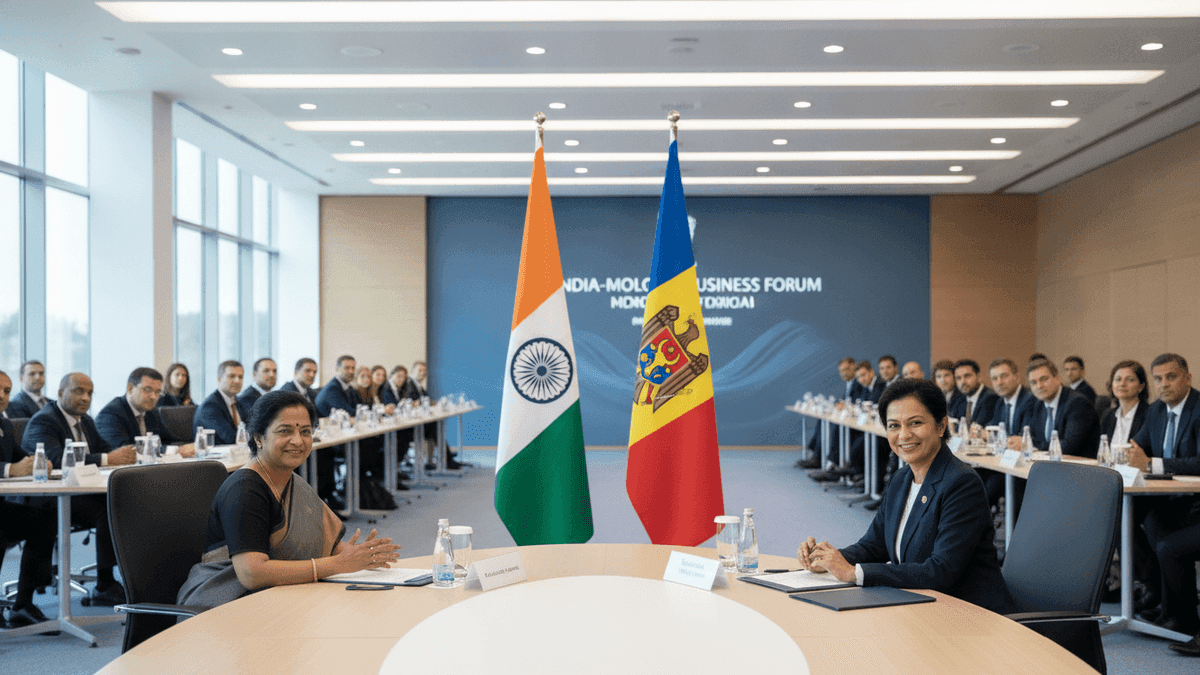
The India-Moldova Business Forum in Chișinău sets a new framework for bilateral economic ties, focusing on digital and green sectors, aligning with India’s Viksit Bharat 2047 vision.
The recent India-Moldova Business Forum, convened in Chișinău on July 20, 2026, marked a significant moment in the evolving landscape of global economic diplomacy. Presided over by Smt Droupadi Murmu, the President of India, alongside H.E. Maia Sandu, President of Moldova, the event underscored a structural shift towards leveraging complementary economic strengths rather than merely reinforcing historical ties that commenced in 1992.
India’s commitment to its ‘Viksit Bharat 2047’ vision positions it as a rapidly expanding major economy, driven by robust entrepreneurship, digital transformation, and a burgeoning manufacturing sector. This internal growth trajectory inherently creates an outward-looking imperative, seeking new markets and strategic partners. The forum illustrated how India’s economic dynamism acts as a foundational pull factor for engagement with nations like Moldova, which present unique strategic advantages.
Moldova, in turn, offers a compelling proposition rooted in its reform-oriented governance and its progressive integration with broader European markets. This confluence of factors creates an attractive environment for Indian businesses seeking entry points into the European economic sphere. The strategic location of Moldova becomes not just a geographical point, but a structural bridge for trade and investment flows.
Key sectors identified for collaboration — including digital technologies such as AI, cybersecurity, fintech, and digital public infrastructure, alongside infrastructure development and renewable energy like solar, battery storage, and green hydrogen — reveal a pattern of future-focused economic alignment. These areas represent high-growth structural themes that are critical to modern economies, moving beyond conventional commodity trade to knowledge-intensive and sustainable development partnerships.
This bilateral engagement exemplifies a broader analytical framework where nations with distinct, yet complementary, economic and geopolitical characteristics find common ground through shared policy objectives. India’s emphasis on a transparent and investor-friendly environment, coupled with Moldova’s reform agenda, creates a predictable framework for fostering lasting economic relationships. Such forums, therefore, serve as mechanisms for identifying and activating these structural complementarities.
Ultimately, the India-Moldova Business Forum transcends a singular event, serving instead as a case study in how global economic partnerships are being reconfigured. It highlights a durable pattern where fast-growing economies like India seek to build ‘digital-green’ bridges with strategically positioned nations, fostering mutual development through targeted sectoral collaboration and a shared commitment to democratic values and international cooperation.