Livestock Options Report: Crops Up, Exports Strong, Screwworm Threat
By Sivam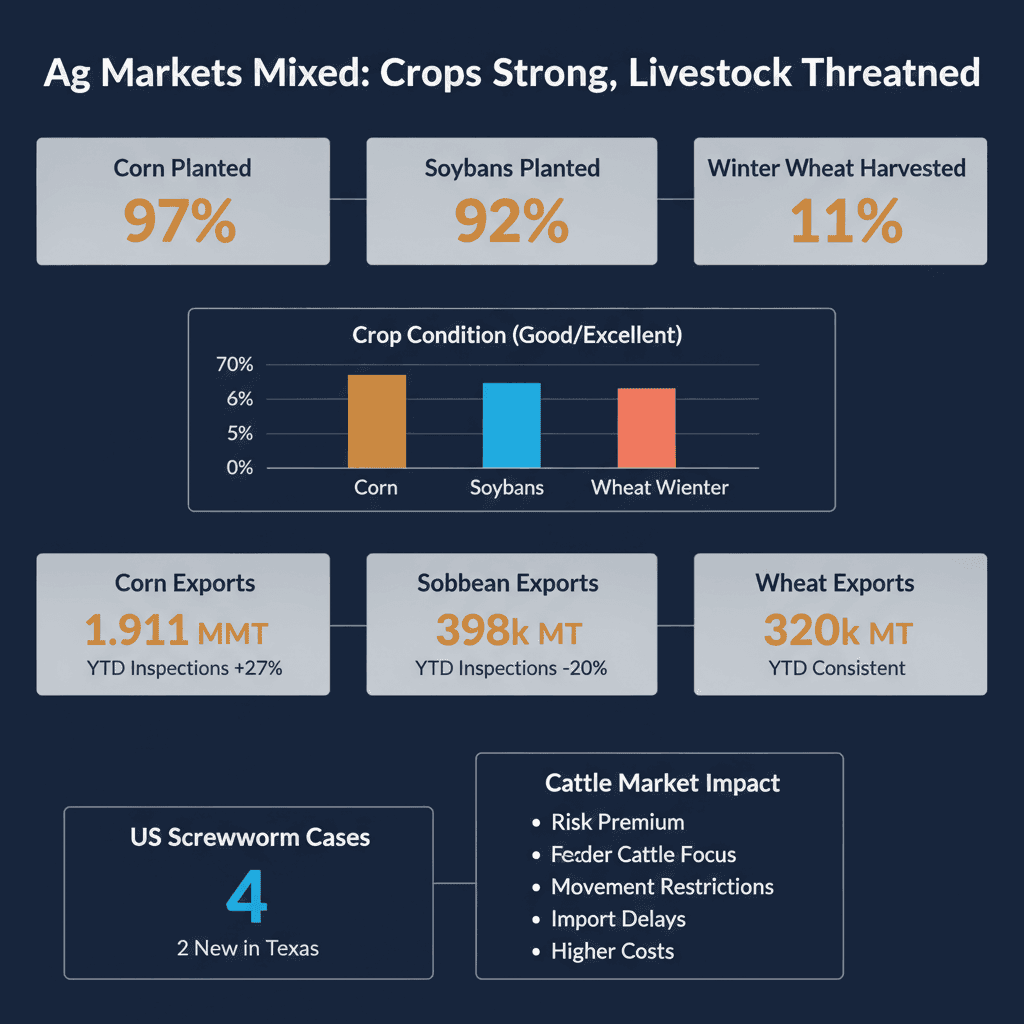
CME Livestock Daily Options Report reveals positive crop progress for corn & soybeans, robust corn exports, and rising concerns over Texas screwworm cases impacting the livestock industry.
Agricultural Markets Show Mixed Performance
The CME Livestock Daily Options Report, issued on June 8, 2026, by StoneX, provided a comprehensive overview of agricultural market conditions and options activity. The report highlighted generally favorable crop progress for corn and soybeans, while noting significant concerns within the livestock sector due to disease outbreaks.
Corn planting has reached 97% completion, with 67% of the crop rated in good or excellent condition. Similarly, soybeans are 92% planted, with 65% rated good or excellent. This strong start suggests that initial planting risks have largely been mitigated, potentially leading to bearish market sentiment if non-threatening weather patterns persist throughout the growing season.
Conversely, winter wheat remains a point of concern for traders and producers. Only 25% of the winter wheat crop is rated good or excellent, and 11% of the harvest has already been completed. This situation makes the market particularly sensitive to early yield and quality results as the harvest progresses.
Export Data Reveals Disparate Trends
Export inspections presented a mixed picture across major commodities. Corn shipments demonstrated robust performance, reaching 1.911 million metric tons (MMT). This figure not only surpassed the previous week’s volume but also exceeded last year’s corresponding period. Key export destinations for corn included Mexico, South Korea, Spain, Japan, and Venezuela, contributing to a 27% increase in year-to-date corn inspections compared to the previous year.
Soybean exports, however, were notably weaker, totaling 398k metric tons (MT). This represented a decline from both the prior week and the previous year’s figures, with Egypt identified as the primary destination. Year-to-date soybean inspections are now approximately 20% behind last year’s pace, signaling a less favorable export environment for the oilseed.
Wheat inspections amounted to 320k MT, a decrease from the preceding week but consistent with last year’s levels. Major destinations for wheat included Mexico, Indonesia, Venezuela, the Philippines, and Burma. Overall, the export data provided support for corn, was neutral to soft for wheat, and largely underwhelming for soybeans.
Screwworm Detections Threaten Livestock Sector
A significant concern for the livestock industry emerged with the confirmation of two additional New World screwworm cases in Texas. These new detections, involving a calf and a dog, bring the total number of U.S. cases to four. The geographical spread of these incidents has intensified worries regarding the potential for wider containment challenges.
New World screwworm larvae are a serious threat to livestock, as they infest open wounds and feed on living tissue, leading to severe health issues and economic losses. In response to these confirmed cases, the United States Department of Agriculture (USDA) has initiated comprehensive containment measures. These measures include enhanced surveillance protocols, strict movement controls for animals, and the strategic release of sterile flies to disrupt the screwworm reproductive cycle.
This developing situation has introduced a risk premium into the cattle market, particularly affecting feeder cattle. Traders are now factoring in the potential for increased restrictions on animal movement, possible delays in Mexican cattle imports, and higher disease control expenses. The report also detailed specific options activity across various commodities, including Corn, Beans, Soymeal, Bean oil, Wheat, Kc wheat, Hogs, Live Cattle, and Feeder Cattle, providing a snapshot of market positions and trading volumes for different contract months and strike prices, reflecting these evolving market dynamics.