Awfis Eyes GCC Growth with Premium Strategy; Snap Alumni Launch Fund
By Sivam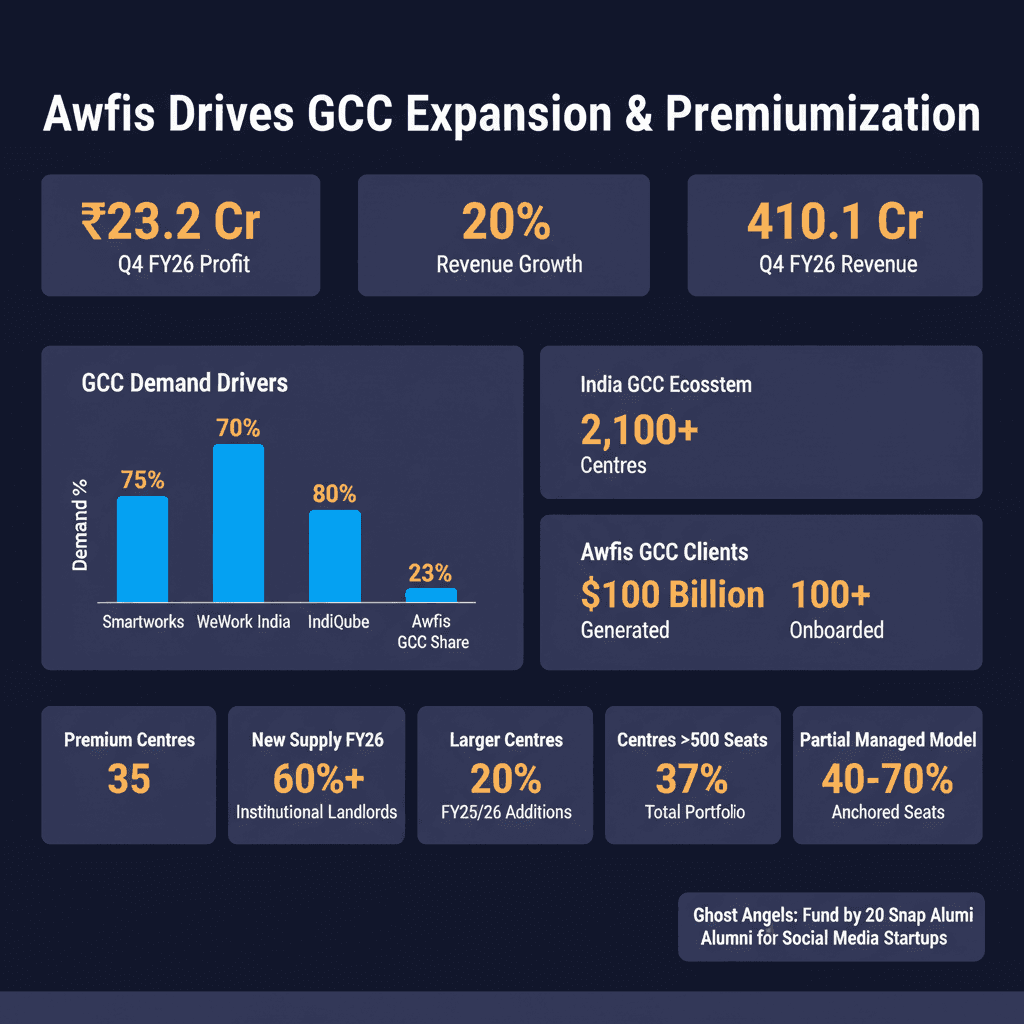
Awfis leverages a premiumization strategy for GCC expansion after strong Q4 FY26 results. Meanwhile, Snap alumni introduce Ghost Angels, a new fund for social media startups.
Awfis, a leading coworking space provider, is executing a premiumization strategy to capitalize on the burgeoning growth in the Gulf Cooperation Council (GCC) region. This strategic pivot follows its successful listing in India and aims to expand its top-line revenue by attracting higher-value clients. In a parallel development, a group of 20 former Snap employees has launched Ghost Angels, a new investment fund dedicated to supporting emerging social media startups.
Awfis Reports Strong Q4, Shifts Business Model
The company reported a strong performance in Q4 FY26, with profit more than doubling year-over-year to ₹23.2 Cr, while operating revenue increased 20% to ₹410.1 Cr. Awfis has sustained growth by continuously experimenting with its business model and reshaping its positioning within the flexible workspace market. Historically, Awfis focused on an asset-light managed aggregation (MA) model, leasing properties directly from owners and operating them while sharing revenue and costs. This model, while capital-efficient, primarily catered to the affordable segment and limited revenue per centre.
Capitalizing on GCC Demand and Premiumization
Brokerage Choice Institutional Equities attributed Awfis’ robust Q4 performance to strong GCC demand, the premiumization of its centres, and operating leverage. The broader industry is witnessing a similar trend, with competitors like Smartworks, WeWork India, and IndiQube reporting 70-80% of demand driven by GCCs. India currently hosts the world’s largest GCC ecosystem, comprising over 2,100 centres that generate nearly $100 billion in revenue, according to a Nasscom-Zinnov report. These Global Capability Centres (GCCs) are evolving beyond outsourcing hubs to full-fledged capability centres, driving significant demand for flexible office solutions due to lower upfront capital expenditure and scalability needs.
To meet this surging GCC demand, Awfis is intensifying its focus on Grade A institutional supply. Amit Ramani, MD and CEO of Awfis, stated that “Global enterprises and GCCs evaluating India today are making decisions based on asset quality, compliance credentials, and infrastructure standards that meet global benchmarks.” Over 60% of Awfis’ new supply signed in FY26 originated from institutional landlords, with all new centres launched during the year located in Grade A or A+ assets.
Strategic Expansion and Profitability Initiatives
The company is actively scaling its premium Elite and Gold centre formats, currently operating 35 such facilities. These premium properties support better commercial structures and foster longer-term partnerships, serving as a natural home for high-value clients. Awfis is also increasing the average size of its centres, with facilities added in FY25 and FY26 being 20% larger than its legacy portfolio, and centres with over 500 seats now constituting 37% of its total portfolio.
Awfis is employing forward leasing as a strategic tool to secure under-construction Grade A properties in prime micro-markets ahead of competitors. Additionally, it is developing a new developer partnership model where institutional developers share capital expenditure costs while Awfis manages operations. To balance growth with profitability, Awfis has introduced a Partial Managed Office model, under which new properties are signed only when 40-70% of seats are already anchored by enterprise or GCC clients. This approach compresses occupancy ramp-up times, enhances Day 1 revenue visibility, and significantly de-risks the economics.
Outlook and Ghost Angels Fund Launch
This strategy is already yielding results, with GCC clients now contributing 23% of Awfis’ rental revenue. The company has onboarded over 100 GCC clients to date and reports additional GCC mandates in its pipeline. However, the competitive landscape is intensifying, with rivals such as WeWork India, Smartworks, and Table Space aggressively pursuing the same opportunities in India’s expanding flexible workspace market. The key challenge for Awfis will be to effectively position itself to capture the largest share of this GCC-driven boom.
Concurrently, a new investment vehicle named Ghost Angels has been launched by 20 former employees of Snap Inc. This fund aims to support emerging social media startups, seeking to identify and back the next wave of innovation within the dynamic social media landscape.