RBI Holds Repo Rate Steady, Eases NRI Investment
By Varun Mittal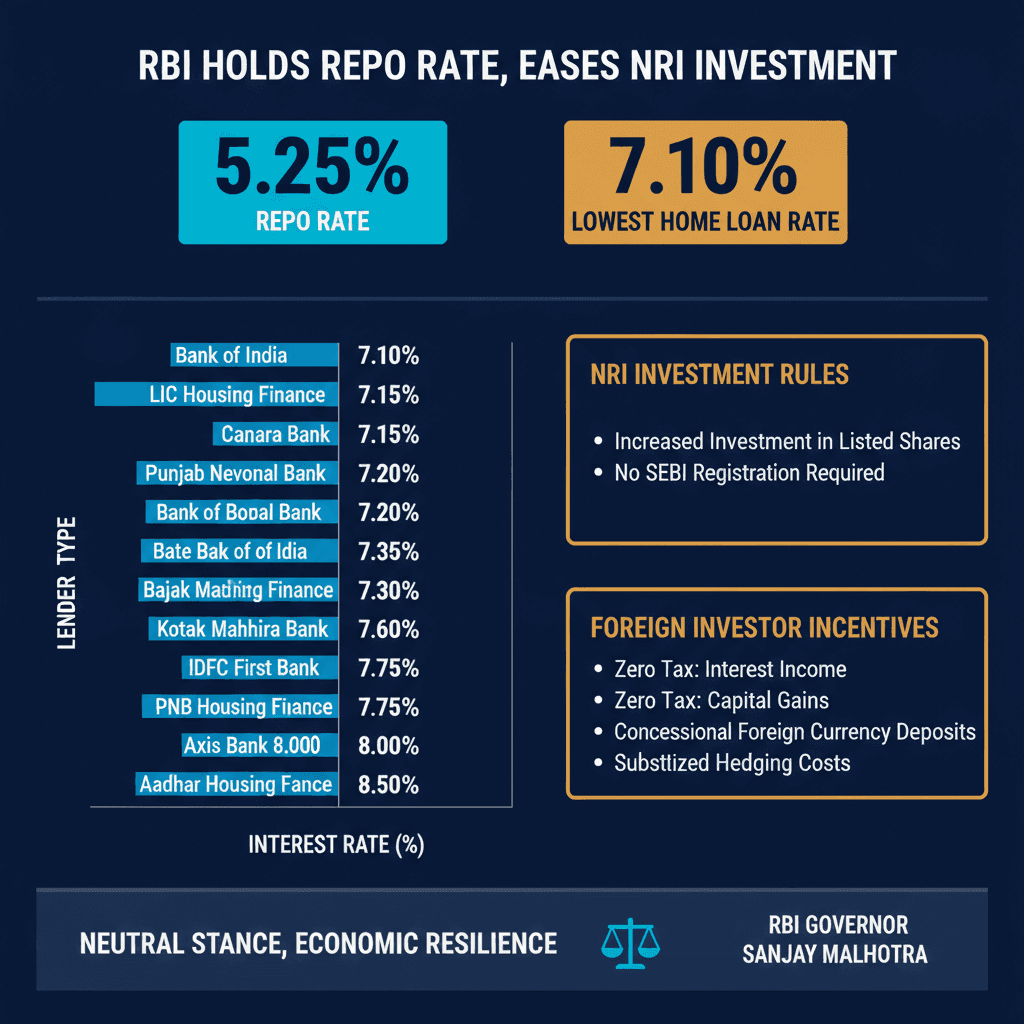
RBI keeps repo rate at 5.25% amid inflation concerns. Eases NRI/OCI investment rules to boost foreign capital and strengthen the rupee. Home loan rates stable.
The Reserve Bank of India (RBI) has opted to maintain its benchmark repo rate at 5.25%, a decision made unanimously by the Monetary Policy Committee (MPC). This move signifies a “neutral” stance, indicating the central bank’s strategy to await greater clarity on evolving economic signals, particularly in light of amplified inflation risks that continue to pose a challenge to price stability.
This crucial decision directly impacts the cost of borrowing across the Indian financial landscape. As a direct consequence of the unchanged repo rate, home loan interest rates across various banks in India are expected to remain stable, offering a predictable environment for prospective and existing borrowers alike.
Home Loan Rates Remain Stable Across Lenders
An analysis of home loan offerings reveals a competitive market, particularly within public sector banks. Bank of India stands out by offering one of the most competitive rates at 7.10%. Other prominent public lenders include Canara Bank at 7.15%, Punjab National Bank at 7.20%, Bank of Baroda also at 7.20%, and State Bank of India at 7.25%. These rates highlight the ongoing efforts by public institutions to attract borrowers.
In the private banking sector, Federal Bank is currently providing the lowest rate at 7.30%. Following this, Kotak Mahindra Bank offers rates at 7.60%, while both HDFC Bank and IDFC First Bank are positioned at 7.75%. Axis Bank’s rates stand at 8%. The varied offerings demonstrate the differing risk appetites and market strategies among private lenders.
Housing finance companies also contribute to the competitive landscape. LIC Housing Finance presents an attractive rate of 7.15%, closely followed by Bajaj Housing Finance at 7.25%. PNB Housing Finance offers rates at 7.75%, and Aadhar Housing Finance is at 8.5%. Overall, borrowers seeking the most competitive rates may find favorable options with institutions like Bank of India, LIC Housing Finance, and Canara Bank, where rates commence from approximately 7.1% to 7.15% per annum.
RBI Eases Investment Rules for Non-Resident Indians
Beyond monetary policy, the RBI has introduced significant measures aimed at bolstering foreign capital inflows and supporting the Indian rupee. A key reform includes the relaxation of investment rules for Non-Resident Indians (NRIs), Overseas Citizens of India (OCIs), and other individuals residing abroad. These changes will permit increased investment in Indian listed shares without the previous requirement for SEBI registration, simplifying the investment process and encouraging greater participation in India’s capital markets.
Additional incentives to attract foreign funds include the elimination of taxes on interest income and capital gains for eligible foreign investors in government securities. The central bank is also providing more concessional terms for foreign-currency deposits from non-resident Indians and subsidizing hedging costs for specific offshore borrowings. These steps are designed to make Indian assets more appealing to international investors.
Economic Resilience Amid Global Headwinds
RBI Governor Sanjay Malhotra addressed the broader economic landscape, acknowledging India’s stronger macroeconomic fundamentals when compared to previous crises. Despite this inherent strength, he underscored that the nation’s economic outlook remains clouded by a confluence of external challenges. These include escalating geopolitical tensions, persistently high commodity prices, and ongoing disruptions across global supply chains, all of which continue to exert pressure on the economic environment.
The RBI’s decision to maintain a “neutral” stance on the repo rate, coupled with its proactive measures to attract foreign investment, reflects a comprehensive strategy. This approach aims to balance the need for domestic price stability with efforts to enhance external sector resilience and ensure continued growth in India’s capital markets, navigating both internal and external economic complexities.