India’s Banking Sector: Stronger Balance Sheets, Lower NPAs
By ThePip Desk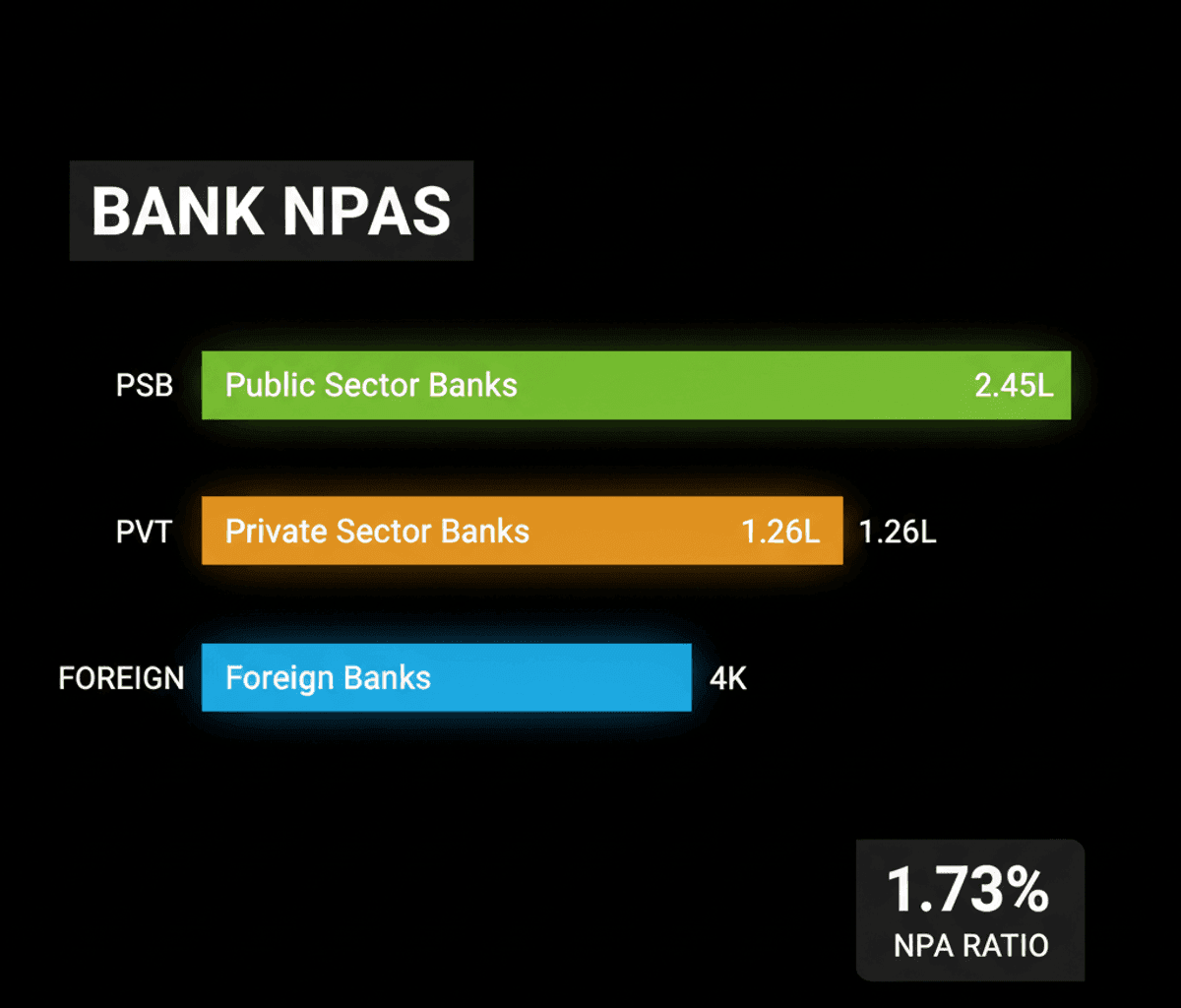
India’s banking sector sees historic NPA reduction to 1.73% by March 2026, signaling robust financial health driven by policy reforms and proactive asset management.
India’s scheduled commercial banks have engineered a significant structural improvement in their financial health, evidenced by a dramatic reduction in Gross Non-Performing Assets (NPAs). By March 2026, the aggregate NPA ratio stood at a robust 1.73 percent, a substantial decline from 2.75 percent recorded in March 2024. This consistent downward trend is not merely a cyclical fluctuation but rather a clear outcome of targeted policy measures and comprehensive financial reforms spearheaded by the government and the Reserve Bank of India (RBI).
Understanding this transformation requires a look at first principles. Non-Performing Assets represent loans where borrowers have ceased making payments, effectively eroding a bank’s capital, hindering its ability to lend further, and undermining depositor and investor confidence. A high NPA ratio acts as a drag on economic growth by constraining credit flow and forcing banks to divert resources from productive lending to recovery efforts. The observed reduction, therefore, signals a fundamental strengthening of the banking system’s core function.
The Framework: Building a Regulatory Moat Against Default
The consistent decline in NPAs can be attributed to the deliberate construction of a robust regulatory and resolution framework. Central to this architecture is the Insolvency and Bankruptcy Code (IBC), which provides a time-bound and transparent mechanism for resolving corporate defaults. Prior to the IBC, asset recovery was often protracted and inefficient, allowing stressed assets to fester. The IBC fundamentally shifted the power dynamics, empowering creditors and accelerating resolution, thereby injecting much-needed discipline into the lending ecosystem.
Beyond the IBC, other legislative and operational reforms have reinforced this structural shift. Legislative amendments for Multi-State Cooperative Societies have plugged critical gaps in governance and oversight within a historically vulnerable segment. Simultaneously, the establishment of dedicated Stressed Asset Management Verticals within banks demonstrates an institutional commitment to focused recovery and proactive resolution, moving beyond a reactive approach to problem loans.
Proactive Management and Empirical Evidence
Complementing these resolution mechanisms are Early Warning Systems, which represent a crucial layer of proactive risk management. These systems allow banks to identify potential defaults at an earlier stage, enabling timely intervention and preventing slippage into full-blown NPAs. This shift from post-default recovery to pre-default mitigation is a hallmark of a maturing and resilient financial system, embedding preventative measures directly into the operational fabric of banking.
The efficacy of these frameworks is borne out by the numbers across diverse banking segments. Public Sector Banks (PSBs), historically a significant contributor to India’s NPA challenges, saw their NPAs dramatically decrease from ₹6.16 lakh crore in March 2021 to ₹2.45 lakh crore by March 2026. This represents a 60.23% reduction over five years. Private Sector Banks experienced a similar positive trajectory, with NPAs declining from ₹2.02 lakh crore to ₹1.26 lakh crore, a 37.62% decrease. Even foreign banks reported a notable drop from ₹10,199 crore to ₹3,990 crore, a 60.88% reduction, underscoring the widespread impact of the reforms.
Nuance and the Counter-Thesis
While the overall trend is unequivocally positive, an analytical lens also requires acknowledging nuances. Small Finance Banks, for instance, saw a rise in NPAs during this period. This particular trend might be explained by their newer vintage, rapid expansion into underserved segments, or differing risk appetites compared to established commercial banks. It highlights that while the macro framework is strong, specific sub-segments may present unique challenges requiring tailored micro-interventions.
Some might argue that these reductions are merely a cyclical clean-up, a natural consequence of a robust economic environment. However, this interpretation often misses the underlying structural changes. While economic cycles certainly influence asset quality, the sustained, multi-year decline across varied banking entities, coupled with the introduction and maturation of tools like the IBC and Early Warning Systems, points to a fundamental and durable shift in how India’s banking sector manages and resolves stressed assets. This is not just a strong tide lifting all boats; it is the construction of a stronger hull.
Beyond the Numbers: Understanding the Deeper Implications
What many often overlook when observing such headline figures is the intricate policy architecture that underpins them. The success is not accidental but a testament to sustained governmental and regulatory commitment to financial sector stability. The ability to reduce NPAs so significantly frees up capital, allowing banks to increase lending to productive sectors, thereby fueling economic growth. It also bolsters investor and depositor confidence, essential for a stable financial ecosystem.
For the astute observer of financial markets, this means looking beyond merely the NPA percentage. It necessitates an understanding of the mechanisms of asset resolution, the robustness of regulatory frameworks, and the proactive measures banks are compelled to adopt. The shift towards a more disciplined credit culture and efficient recovery processes is a durable takeaway, influencing how credit risk is priced and managed across the economy.
The long-term perspective suggests that India’s banking sector is transitioning towards a more resilient and transparent structure. The lessons learned from previous asset quality cycles have been codified into policy and operational frameworks that are designed to withstand future economic pressures more effectively. This commitment to structural reform, rather than temporary fixes, positions the sector for more sustainable growth and stability, reinforcing the foundational strength of the broader Indian economy.