India Inc FY27: Profit Surge Amidst Margin Squeeze
By Business Desk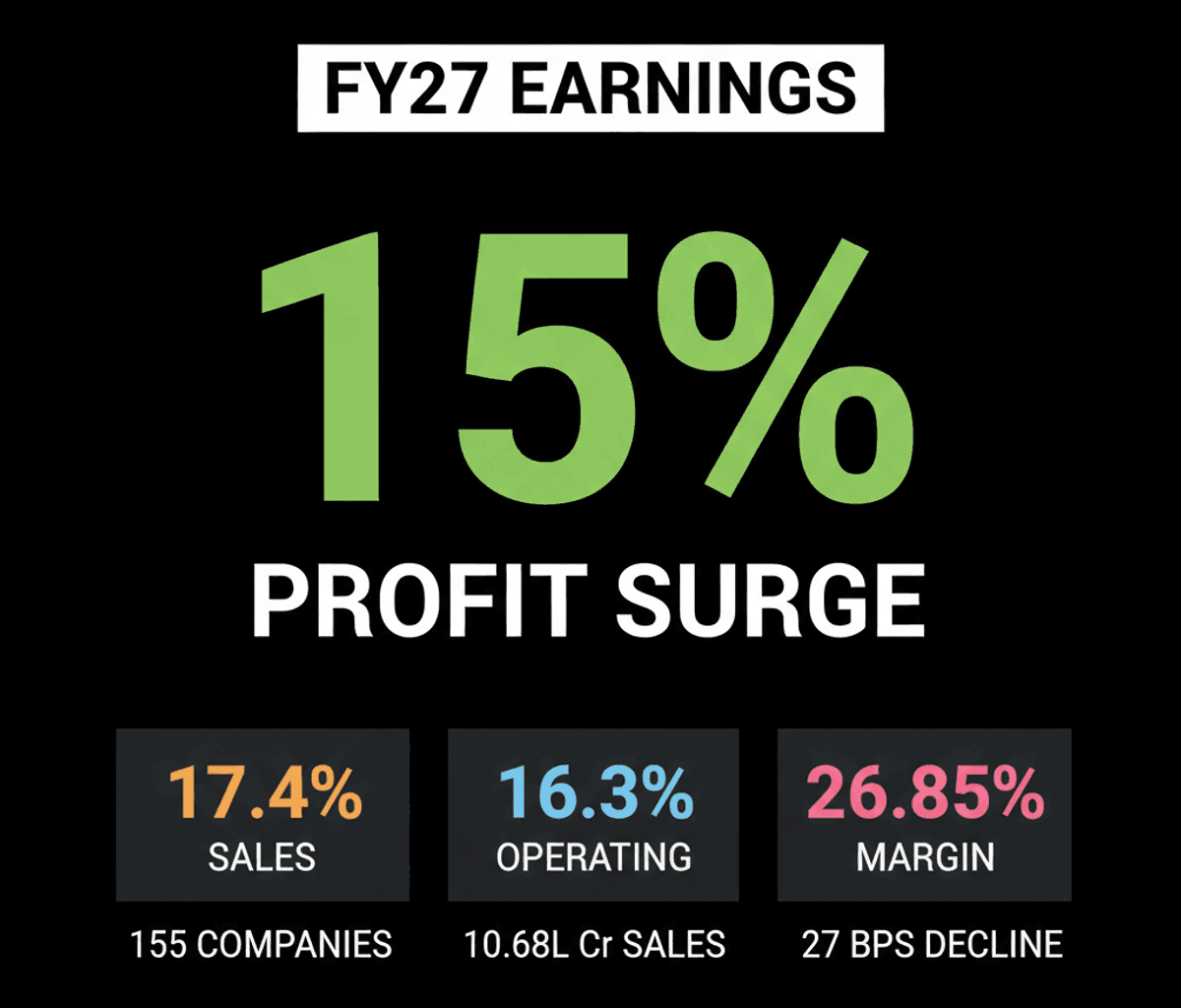
India Inc. saw 15% net profit growth in FY27, driven by domestic demand. However, rising input costs led to margin compression, impacting profitability despite strong sales.
Corporate India initiated the financial year 2027 with a notable 15% surge in net profit, a performance primarily underpinned by robust domestic demand. This initial analysis, encompassing 155 companies including those in financial services, reveals a structural pattern of growth driven by internal market dynamics. While aggregate net sales expanded by 17.4% year-on-year, reaching Rs 10.68 lakh crore, and operating profit climbed 16.3%, the period also signaled an underlying pressure on profitability that warrants closer inspection.
The observed operating margin decline of 27 basis points, settling at 26.85%, serves as a critical indicator of this pressure. This compression in margin structure occurred because total expenditure increased by 17.9%, slightly outpacing the growth in sales, largely due to escalating input costs. Such a dynamic suggests that while revenue generation remains strong, the ability to translate top-line growth into bottom-line expansion is being challenged by the cost environment, a recurring theme in inflationary cycles.
Diving deeper into the sectoral contributions, domestic-facing industries emerged as the undisputed backbone of this growth. Banking, telecom, and industrials demonstrated particular strength. Private sector banks, including prominent names like ICICI Bank, HDFC Bank, Axis Bank, and Kotak Mahindra Bank, collectively posted healthy profit growth. This was fueled by improved credit expansion, sound asset quality, and reduced provisioning, even as intense competition for deposits began to impact funding costs, illustrating the inherent trade-offs in a tightening liquidity environment.
In stark contrast, export-oriented technology companies, such as TCS, HCLTech, and Wipro, presented a more varied and subdued performance. Their results reflect the persistent caution in discretionary spending across developed markets and a continued conservative approach to hiring, highlighting a significant divergence in economic resilience between domestic and global demand cycles. Furthermore, the data consistently shows raw material costs increasing as a proportion of sales, underscoring the broad-based nature of cost pressures across the corporate landscape.
Despite these margin headwinds, Corporate India has largely maintained balance-sheet discipline. Employee expenses rose by a manageable 8.1%, which is below the pace of revenue growth, and finance costs increased by only 3.7%. This suggests that companies have managed leverage effectively even amidst elevated interest rates. The early earnings reports for FY27 therefore reinforce a critical structural pattern: domestic sectors will continue to be the primary engine of growth, while export-oriented businesses are likely to experience a more protracted and slower recovery phase.