HKMA & Türkiye Central Bank Partner on Fintech Innovation
By ThePip Desk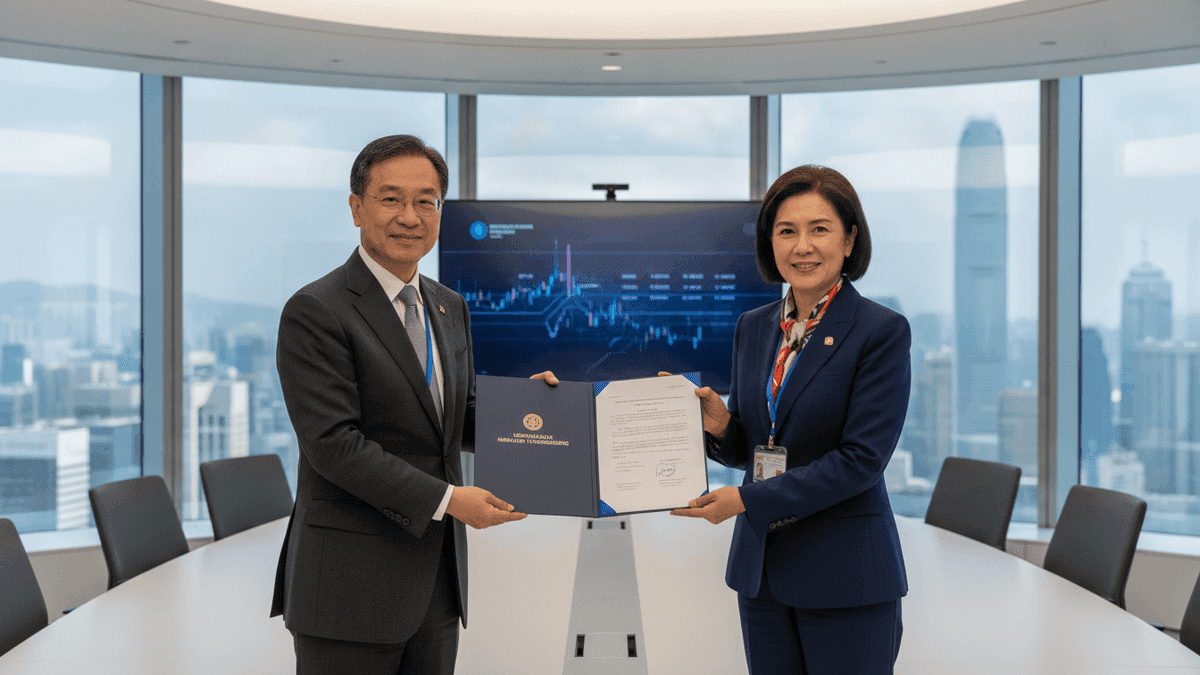
Hong Kong and Türkiye central banks launch a fintech innovation partnership, pioneering a new era of digital finance governance and regulatory synergy.
The Hong Kong Monetary Authority (HKMA) and the Central Bank of Türkiye (CBRT) have formally established a strategic partnership focused on advancing fintech innovation. This significant collaboration, formalized through a Memorandum of Understanding (MoU) signed on June 30, 2026, represents a proactive stance by two key financial authorities to address the evolving landscape of digital finance through structured cooperation.
The core thesis here is that bilateral central bank agreements like this one are not merely ceremonial; they are foundational building blocks for a more coherent global digital financial ecosystem. They represent a pragmatic, bottom-up approach to regulatory alignment, crucial in an era where digital assets and services inherently transcend national borders. This partnership underscores the growing recognition that individual national regulatory frameworks, while necessary, are insufficient on their own to manage the complexities and opportunities presented by rapid technological shifts in finance. The agreement’s focus on information sharing, joint exploration of emerging financial technologies, and the development of innovative projects directly addresses the structural challenge of regulating borderless digital innovation.
The Question: Why Cross-Border Cooperation is Now Essential
The rapid evolution of financial technology, encompassing everything from central bank digital currencies (CBDCs) to tokenized assets and instant cross-border payment systems, poses a fundamental challenge to traditional, geographically bounded regulatory paradigms. Innovation often outpaces regulation, creating potential for regulatory arbitrage and uneven competitive landscapes. Central banks are increasingly recognizing that to foster innovation responsibly while maintaining financial stability and consumer protection, a coordinated, international approach is indispensable. This MoU between the HKMA and CBRT exemplifies a strategic response to this imperative, moving beyond mere observation to active, shared development.
First Principles of Digital Finance Governance
At its heart, digital finance operates on networks that are inherently borderless. A digital payment can traverse continents in seconds, and a distributed ledger technology (DLT) platform knows no national boundaries. This fundamental characteristic means that regulatory oversight, traditionally fragmented by national jurisdiction, must adapt. The first principle guiding effective digital finance governance is therefore one of interoperability and shared understanding. Without common standards, coordinated supervisory approaches, and mutual information exchange, the benefits of digital innovation—such as efficiency and inclusion—can be hampered by friction, or worse, exploited by bad actors. Partnerships like this MoU lay the groundwork for a future where digital financial services can flourish within a robust, globally informed regulatory perimeter.
The Framework: Bilateral Regulatory Harmonization as a Strategic Lever
This partnership can be understood through the framework of ‘Bilateral Regulatory Harmonization.’ Rather than waiting for a monolithic global regulatory body to emerge—a process often slow and politically complex—central banks are increasingly forging direct, strategic alliances. This approach allows for tailored collaboration, focusing on specific shared interests and challenges. For the HKMA, positioning Hong Kong as a ‘global fintech bridge,’ and for the CBRT, expanding Türkiye’s influence as a ‘financial technology hub in the Mediterranean and Middle East regions,’ these bilateral ties are strategic levers. They enable the sharing of regulatory best practices, joint pilot programs, and the development of compatible digital infrastructure, thereby creating de facto zones of regulatory synergy that can later inform broader multilateral efforts. This mechanism fosters trust and practical experience at a granular level, which is critical for the eventual scaling of digital financial ecosystems.
The Evidence: Specifics of the HKMA-CBRT Accord
The MoU, signed on June 30, 2026, explicitly outlines several key areas of cooperation. These include strategic knowledge exchange, the sharing of regulatory best practices for new technologies, and potential collaboration on pilot programs and digital infrastructure initiatives. Mr. Eddie Yue, Chief Executive of the HKMA, highlighted the agreement as a ‘solid foundation for exchanging expertise,’ while Mr. Fatih Karahan, Governor of the CBRT, emphasized its role in ‘deepening bilateral ties’ and fostering ‘a dynamic, technologically advanced, and inclusive financial landscape.’ These statements confirm the intent to move beyond theoretical discussions to tangible, actionable projects aimed at creating a future-proof financial ecosystem. The partnership is not just about observing trends but actively shaping them through joint development and shared learning.
The Counter-Thesis: Limitations of Bilateralism
One might argue that while bilateral agreements are a positive step, they ultimately represent a piecemeal approach to a global problem. Critics could suggest that such agreements, while valuable, lack the universal scope and enforceability required to truly harmonize a fragmented global digital finance landscape. A more comprehensive, multilateral framework, perhaps under the auspices of international bodies like the Bank for International Settlements (BIS) or the Financial Stability Board (FSB), might appear to be a more effective long-term solution. This perspective holds that a patchwork of bilateral MoUs, however well-intentioned, could still leave gaps or create inconsistencies that hinder truly seamless cross-border innovation.
However, this counter-thesis overlooks the pragmatic advantages of bilateralism as an initial, agile response. Multilateral consensus building is inherently slow and often requires significant compromises that dilute effectiveness. Bilateral agreements, by contrast, allow for faster implementation, deeper trust-building between specific partners, and the ability to pilot solutions in a controlled environment. They serve as proving grounds for concepts that can later be scaled. The HKMA-CBRT MoU, therefore, should be viewed not as a substitute for multilateral efforts, but as a complementary, and often necessary, precursor that builds the practical experience and shared understanding required for broader global cooperation to succeed.
What Most People Get Wrong
A common misconception is that central banks are predominantly reactive entities, primarily responding to financial crises or established market trends. What this partnership, and similar initiatives globally, reveals is a significant proactive shift. Central banks are not merely regulating existing fintechs; they are actively engaging in shaping the future architecture of digital finance. They are becoming innovators and facilitators themselves, recognizing that a stable and efficient financial system in the digital age requires co-creation and foresight, rather than just retrospective oversight. This proactive engagement, particularly through international collaboration, is what differentiates the current era of central banking from previous ones.
What This Means for Market Participants
For businesses and innovators operating in the fintech space, this partnership signals a trend towards greater regulatory predictability and, potentially, more integrated digital markets across jurisdictions. As central banks converge on best practices and explore common digital infrastructures, the cost and complexity of navigating disparate regulatory environments for cross-border services may decrease. This creates a more fertile ground for innovation by reducing friction and providing clearer guidelines. For financial institutions, it implies a need to monitor these evolving regulatory partnerships closely, as they will likely influence future compliance requirements and market access strategies. The direction is clear: a future of increasingly interconnected and collaboratively regulated digital financial services.
Perspective: The Long View of Digital Financial Architecture
The strategic partnership between the HKMA and the CBRT is a testament to the enduring adaptability of central banking institutions in the face of profound technological change. It represents a critical, foundational step towards building a more resilient, efficient, and inclusive global digital financial architecture. These bilateral agreements, by fostering deep knowledge exchange and joint development, are essential mechanisms for central banks to remain relevant and effective stewards of financial stability and innovation in an increasingly digital and interconnected world. They underscore a long-term commitment to evolving governance structures that can keep pace with, and indeed help shape, the future of finance.
When considering the landscape of global digital finance today, it is worth asking whether the current pace of bilateral and multilateral central bank collaboration is sufficient to manage the velocity of technological change. This partnership suggests a growing urgency among authorities to actively construct, rather than merely observe, the future financial system.