India’s Banks Cut Staff: Digital Transformation Drives Workforce Shift
By Business Desk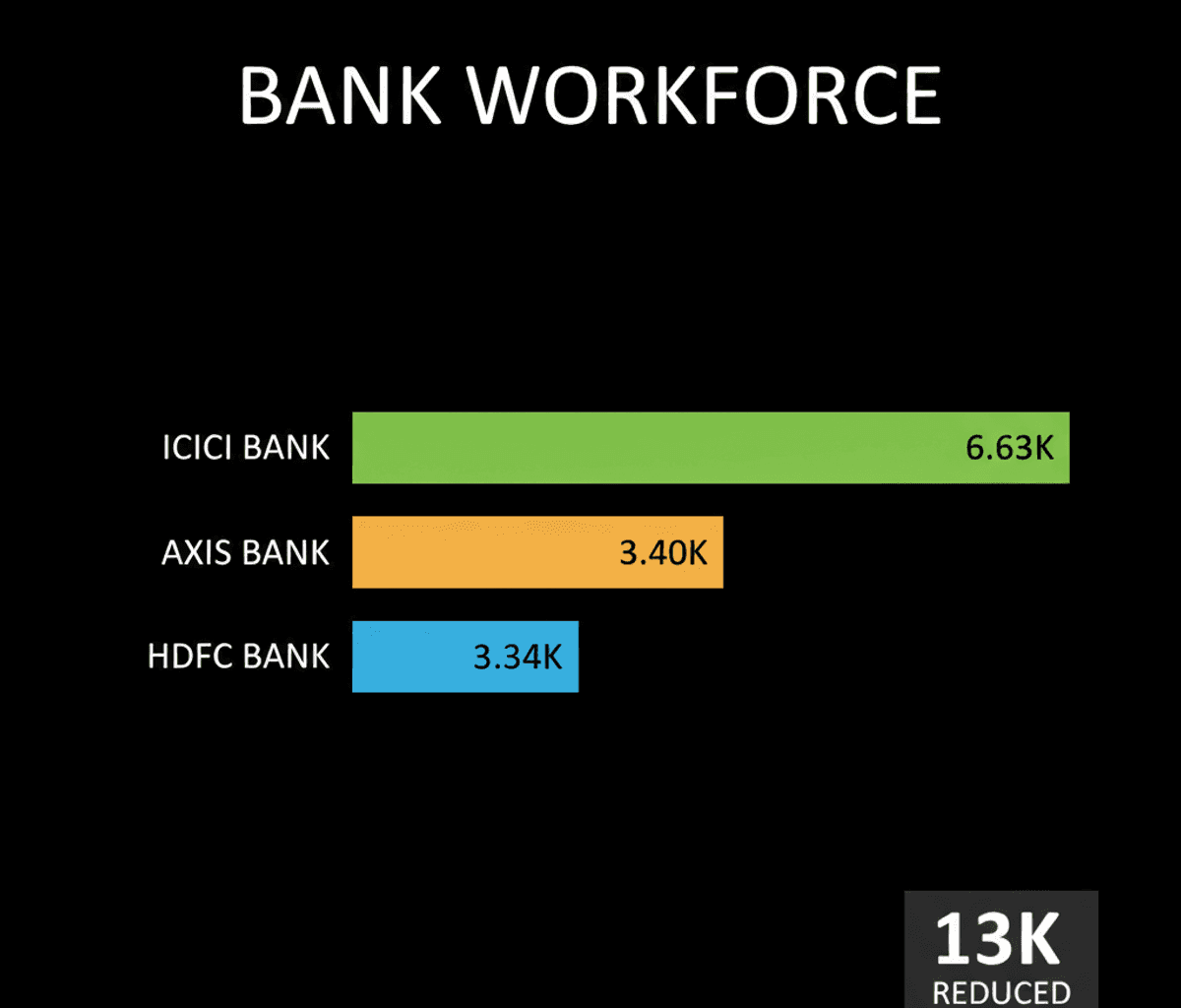
India’s leading private banks like HDFC, ICICI, and Axis are reducing staff by over 13,000 due to digital adoption and AI, signaling a productivity-focused structural shift.
India’s premier private banks, HDFC Bank, ICICI Bank, and Axis Bank, collectively scaled back their workforces by over 13,000 employees in Financial Year 2026. This significant shift signals a deeper structural transformation within the banking sector, driven by advanced digital technologies and artificial intelligence, rather than conventional cost-cutting layoffs.
Specific figures highlight this trend: ICICI Bank saw a reduction of 6,633 employees, HDFC Bank’s headcount decreased by 3,343, and Axis Bank recorded approximately 3,400 fewer staff members. Executives from these institutions, including Axis Bank’s Subrat Mohanty and HDFC Bank’s Sashidhar Jagdishan, have explicitly stated that these adjustments stem from natural attrition, a more selective approach to hiring, and the internal redeployment of existing talent.
The underlying mechanism behind this workforce recalibration is the profound impact of digital transformation on banking operations. A decade ago, core banking functions like customer onboarding and service were heavily reliant on physical infrastructure and extensive manual processes. Today, the proliferation of mobile applications, Unified Payments Interface (UPI), streamlined online loan applications, digital Know Your Customer (KYC) protocols, and AI-driven chatbots have fundamentally altered the productivity equation. These innovations empower banks to manage a significantly larger volume of business with a comparatively smaller human footprint.
Artificial intelligence, in particular, acts as a critical force multiplier. Its capabilities extend to accelerating loan processing, bolstering fraud detection systems, conducting sophisticated customer behavior analysis, and automating a broad spectrum of back-office activities. This integration of AI creates a distinct operational leverage, enabling banks to enhance throughput and efficiency without a proportional increase in human capital.
A Boston Consulting Group report reinforces this structural shift, projecting that AI and generative AI could automate between 35% and 40% of low-value banking tasks over time. This automation hinges on sustained investment in technology, robust governance frameworks, and strategic employee reskilling initiatives. Consequently, while the overall number of banking jobs might not drastically shrink, their nature is undeniably evolving, pivoting towards specialized roles in technology, cybersecurity, data science, analytics, digital product development, and relationship management, while diminishing the demand for routine operational positions.
This workforce optimization occurs against a backdrop of robust growth projections for the Indian banking sector. Motilal Oswal Financial Services anticipates a 14.6% credit growth for banks in FY27, with private sector banks poised to lead this expansion at an impressive 15.8%. Furthermore, the sector’s earnings are expected to climb by approximately 15% annually between FY26 and FY28, with private banks potentially achieving around 20% growth.
The confluence of these trends reveals a potent structural pattern: India’s leading private banks are demonstrating an ability to expand their business and profitability substantially without necessitating a commensurate increase in their human workforce. This indicates a new era of capital efficiency in banking, where digital platforms and automation are not merely tools but foundational drivers of scalable growth, fundamentally reshaping the industry’s operational model and human capital requirements.