Bitcoin Lending Matures: Institutional Shift & Growth
By Sivam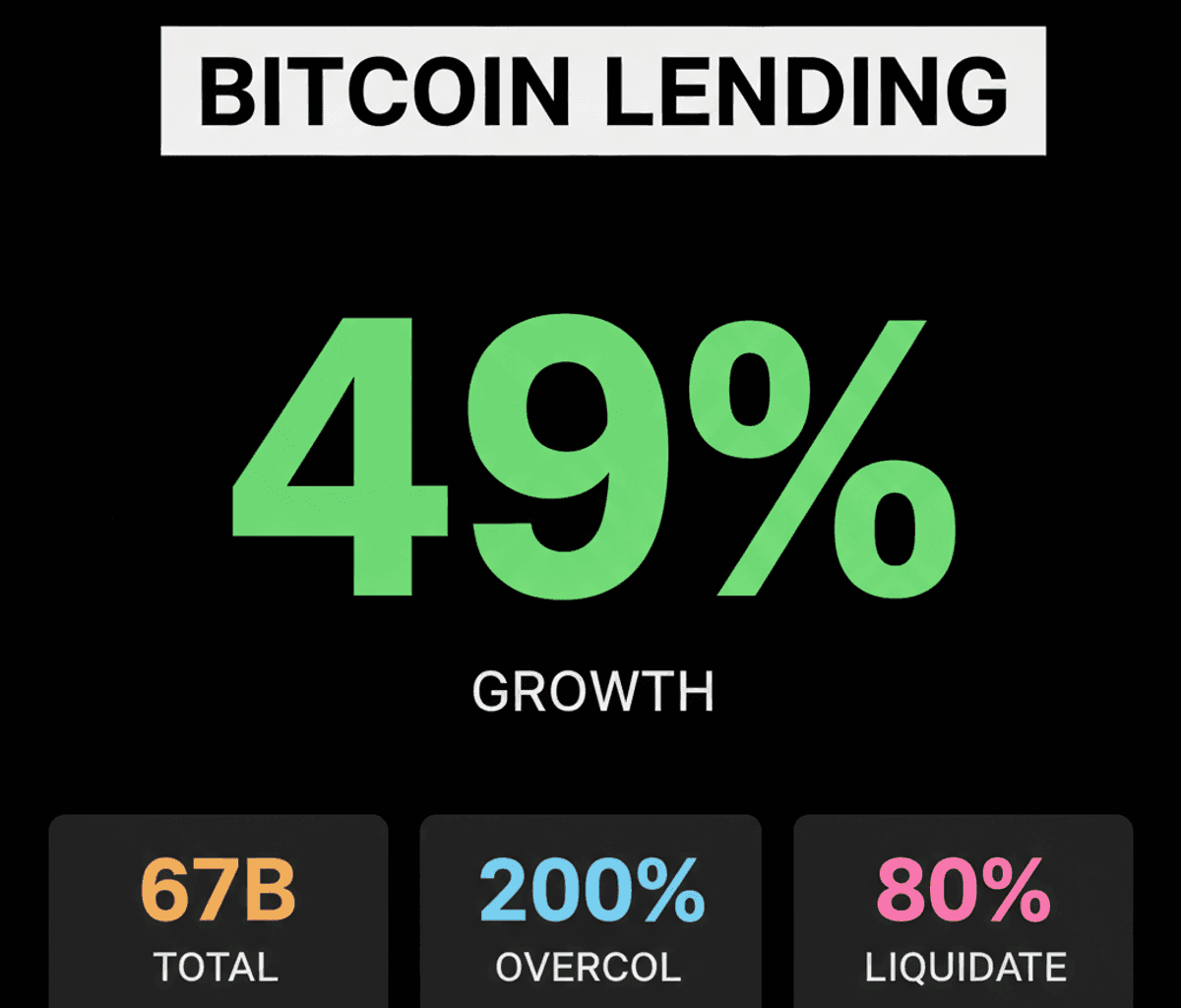
Bitcoin lending evolves post-2022, embracing institutional safeguards like overcollateralization and attracting significant capital, with crypto lending surging 49%.
The landscape of Bitcoin-backed lending has undergone a profound structural transformation, moving decisively towards enhanced collateralization and transparency. This evolution, catalyzed by the market downturns of 2022, signifies a pivot that has attracted substantial institutional engagement, fundamentally altering the operational mechanics of digital asset financing.
Quantitatively, this shift is evident in the market’s expansion. Total crypto-backed lending has surged by 49% year-over-year, reaching an aggregate of $67 billion. A critical milestone in this maturation is Ledn’s $188 million asset-backed security (ABS), which remarkably secured an investment-grade rating, underscoring the sector’s increasing alignment with established financial benchmarks.
This demand is primarily driven by what analysts term the ‘hodler’s dilemma’: Bitcoin holders seeking liquidity for diverse needs—ranging from mortgages to business investments—without divesting their long-term digital assets. This fundamental need has spurred the development of more sophisticated lending models that prioritize robust risk mitigation.
Current lending models have adopted safeguards mirroring traditional finance. These include stringent overcollateralization requirements, such as 200% loan-to-value (LTV) ratios, coupled with continuous collateral monitoring. Automated liquidation triggers, often set at 80% LTV, further institutionalize risk management, ensuring proactive responses to market volatility. Ledn, for instance, has reported zero losses on its collateralized consumer loans, a performance record pivotal in its ABS achieving an investment-grade status, further bolstered by the introduction of backup servicers like Zaria.
The integration of the Lightning Network is poised to significantly streamline these operations. By facilitating instant and low-cost margin calls, collateral postings, and liquidations, the Lightning Network enhances the efficiency and reliability of the lending process. This technological advancement is expected to contribute to a reduction in credit spreads over time, as a growing pipeline of institutional capital enters the market.
Broader institutional validation underscores this structural shift. The U.S. Securities and Exchange Commission’s (SEC) approval of the first spot Bitcoin ETFs, alongside clearer regulatory frameworks like the GENIUS Act and the potential CLARITY Act, signals a more accommodating environment. This regulatory clarity, combined with Bitcoin’s demonstrated resilience during recent bear markets, solidifies its perception as a highly liquid, fungible asset with minimal counterparty risk within a structured lending environment.
The trajectory of Bitcoin-backed lending suggests a deepening integration into the global financial system. The convergence of robust risk management, technological efficiencies, and increasing institutional capital points towards a future where digital assets are not merely speculative instruments but foundational components of a more interconnected and sophisticated financial ecosystem.