India-UK FTA: Tariff Quotas & Auto Imports Explained
By ThePip Desk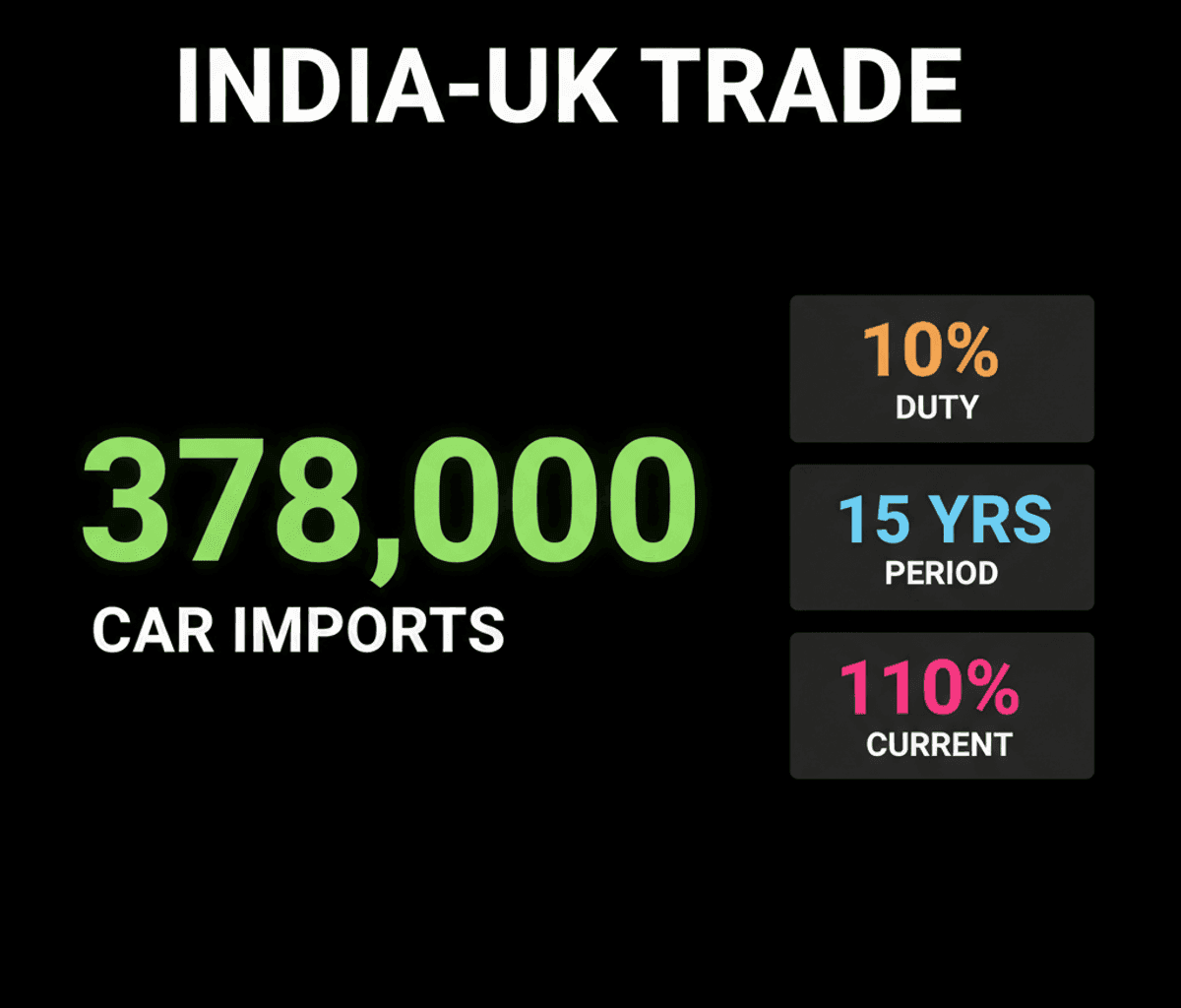
India details duty concession process for UK vehicle imports under CETA from July 15, introducing structured tariff rate quotas for automotive trade.
India has formally outlined the procedure for importers seeking government approval for duty concessions on passenger cars and goods vehicles originating from the United Kingdom. This crucial development precedes the implementation of the Comprehensive Economic and Trade Agreement (CETA), set to commence on July 15, and fundamentally alters the landscape for automotive imports from the UK.
Under the CETA framework, India is poised to drastically reduce import duties on automotive products, moving from approximately 110% down to a targeted 10% over time. This reduction is not universal but is structured through specific Tariff Rate Quotas (TRQ) for both nations. Over a 15-year period, India will permit the import of 378,000 conventional-engine passenger cars from the UK at these significantly reduced customs duties.
The Mechanism of Tariff Rate Quotas
The Directorate General of Foreign Trade (DGFT) has specified that only Original Equipment Manufacturers (OEMs) or their authorized dealers and channel partners in the UK are eligible to apply for these TRQs. Applicants must furnish a pre-purchase agreement from a UK OEM, detailing the precise quantity of vehicles slated for supply during the TRQ year, which spans from January 1 to December 31. These TRQ certificates are valid for a maximum duration of 12 months, or until the end of the calendar year, whichever occurs first.
Structural Impact on Automotive Import Duties
The system introduces a phased approach to duty reductions and quota allocations. In the initial year, specific quotas and duty adjustments are applied across different engine segments. For cars exceeding 3,000 cc (petrol) and 2,500 cc (diesel), 10,000 units will see duties reduced to 30% from the previous 110%. Similarly, 5,000 units of cars between 1,500 cc and 3,000 cc (petrol) or 2,500 cc (diesel) will benefit from duties lowered to 50% from 66%.
The mass-market segment, encompassing vehicles up to 1,500 cc, is allocated 5,000 units in the first year, with duties also reduced to 50% from 66%. The quota for conventional-engine passenger cars is projected to peak at 37,000 units in the fifth year, at which point duties will stabilize at 10%. Importers are explicitly encouraged to transfer the advantage of these concessional duties directly to the end consumers, suggesting a potential shift in market pricing for these imported vehicles.
Strategic Protection for Domestic EV Market
Notably, India has maintained a strategic protective stance for its mass-market Electric Vehicle (EV) segment. The agreement does not extend concessions to UK-manufactured EVs priced below GBP 40,000 (CIF). However, from the sixth year onwards, a differentiated structure emerges for higher-value EVs. Electric, hybrid, and hydrogen passenger cars priced between GBP 40,000 and GBP 80,000 CIF will see duties reduced to 50%, subject to a quota of 400 units. For vehicles exceeding GBP 80,000 CIF, duties will be lowered to 40%, with an import limit of 4,000 units.
This structured approach to tariff reduction and quota allocation under the CETA signals a calculated recalibration of India’s automotive import policy, particularly impacting the premium and luxury vehicle segments from the UK, while selectively protecting nascent domestic sectors like mass-market EVs. The phased rollout and explicit quotas underscore a framework designed to manage market integration over an extended period.
What This Means for the Automotive Sector
The introduction of these TRQs represents a significant structural shift in India’s automotive import regime with the UK. This policy mechanism, which sets quantitative limits on goods that can be imported at a reduced tariff rate, inherently creates a competitive dynamic among eligible importers. The long-term trajectory, culminating in a 10% duty for conventional vehicles and tiered reductions for high-value EVs, indicates a strategic opening to foreign manufacturers that is carefully balanced against domestic industrial policy objectives.
Perspective: Managing Market Dynamics Through Phased Liberalization
This phased liberalization, rather than an immediate and complete tariff elimination, allows India to gradually integrate UK automotive products while enabling domestic industries to adapt. Such a framework is common in large trade agreements, aiming to mitigate sudden market disruptions. The explicit call for importers to pass on duty benefits to consumers suggests an intent to stimulate demand within these newly opened segments, potentially fostering a more diverse and competitive high-end automotive market over the next decade and a half.