India EV Market: 12% Penetration by FY27
By Business Desk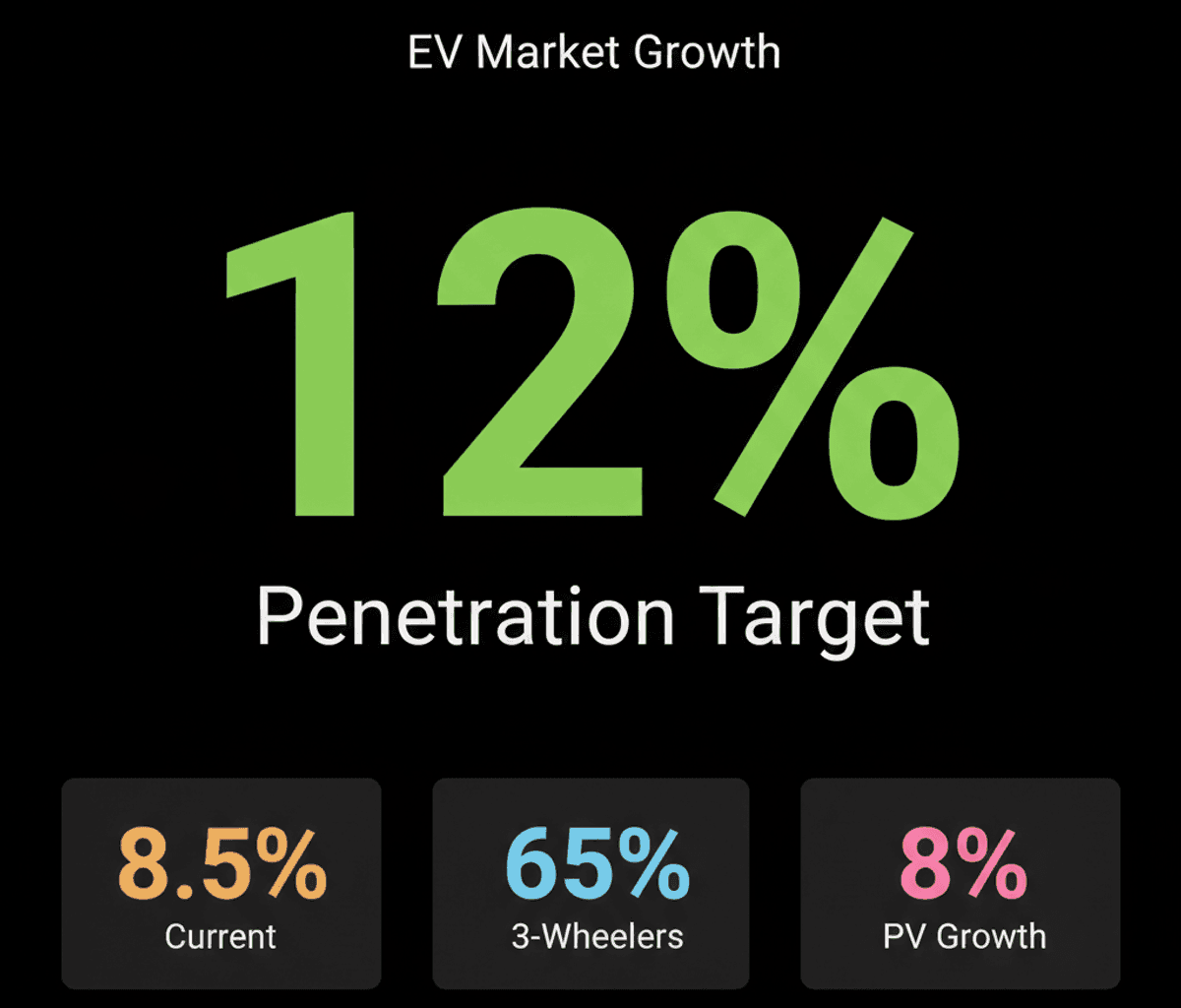
India’s EV market to hit 10-12% penetration by FY27, driven by 2 & 3-wheelers. Explore growth drivers and segment-specific forecasts.
India’s electric vehicle (EV) market is on track to significantly expand, with projections indicating a 10% to 12% penetration across all vehicle segments by fiscal year 2027. This marks a notable increase from the 8.5% recorded in the previous fiscal year, underscoring a clear shift in the country’s mobility landscape.
This substantial growth is primarily propelled by the two-wheeler and three-wheeler segments, which benefit significantly from lower operating costs and consistent government support. The broader EV adoption, however, reveals varied performance across different vehicle categories.
- Electric two-wheelers are anticipated to hit 8% to 10% penetration by FY27, climbing from 6.6%, supported by reduced running costs and the ease of home charging.
- Electric three-wheelers are set to lead the charge, projected to achieve 62% to 65% penetration, an increase from 59%, thanks to their compelling business case for commercial users and robust government backing.
- In contrast, the passenger vehicle segment is expected to grow from 4.4% in FY26 to 6% to 8% by FY27, grappling with higher purchase prices and limited charging infrastructure outside major urban areas.
- The e-bus category is also tracking towards a 6% to 8% penetration rate, up from 4.37% in FY26, with its expansion highly dependent on the rapid development of dedicated charging hubs.
The growth story is not uniform; while government support and lower operating costs are key drivers for specific segments, passenger vehicles face hurdles from higher purchase prices and inadequate charging infrastructure. This highlights a critical disparity in adoption rates, with e-buses also depending heavily on the rapid expansion of charging hubs to meet their projected growth.
Building a Domestic EV Ecosystem
To sustain this ambitious trajectory, the Indian EV sector must evolve beyond mere vehicle assembly, focusing instead on establishing a robust domestic value chain. This strategic shift is crucial for reducing the current high dependency on imports for critical components, particularly advanced batteries. Significant capital expenditure in indigenous manufacturing capabilities remains paramount.
Investors should closely monitor how original equipment manufacturers (OEMs) navigate the complex balance between maintaining healthy profit margins and scaling new technologies. The sustained strength of government procurement and consistent consumer demand will be vital in supporting the extensive infrastructure investments needed for reliable long-distance EV mobility. These factors will dictate the sector’s long-term viability and growth prospects.