India’s Ethanol Blending Policy: 20% Target Maintained for Stability
By Business Desk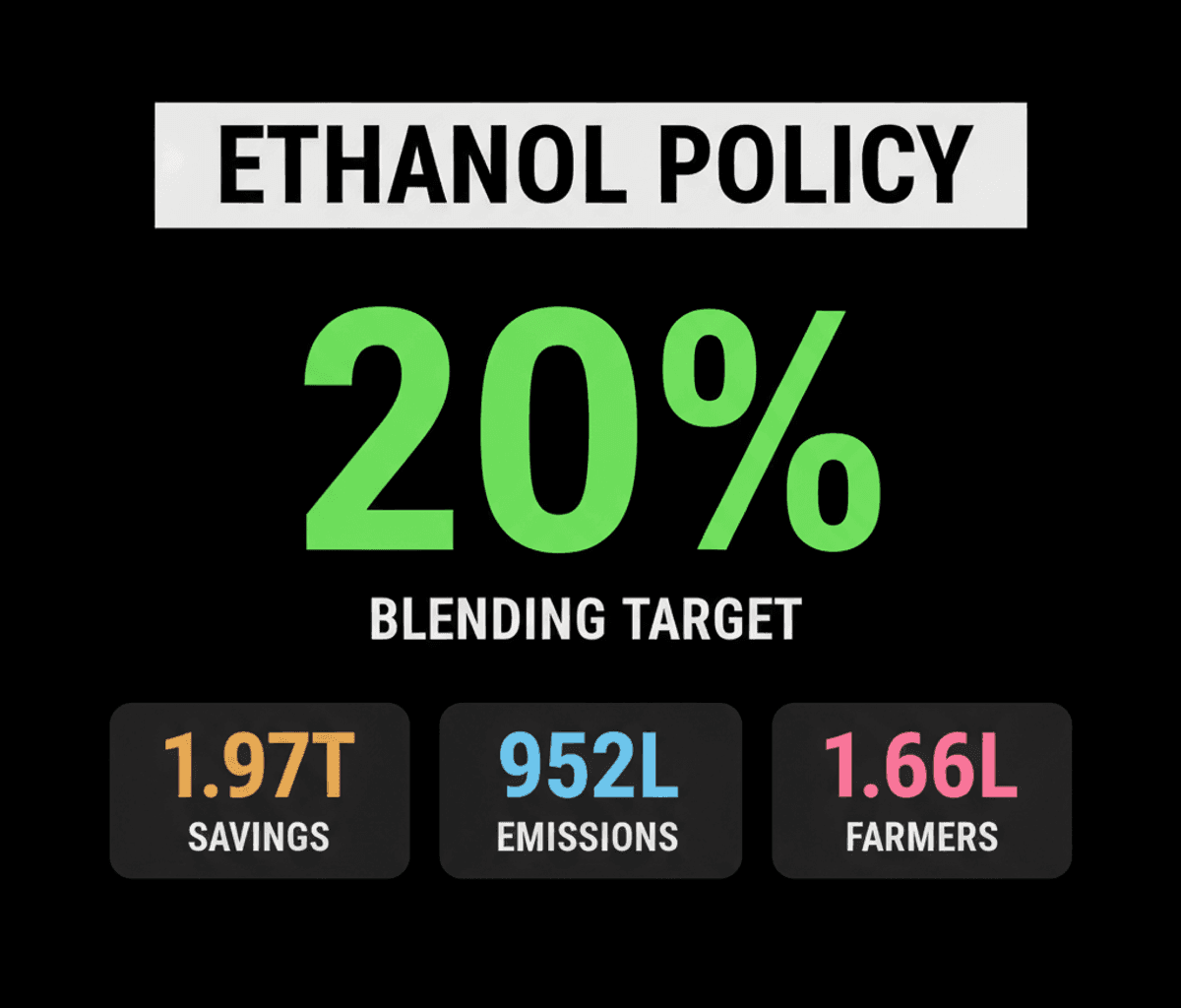
India maintains its 20% ethanol blending target, a stable policy delivering economic, environmental, and agricultural benefits. Learn about its impact.
India’s Minister of State for Petroleum and Natural Gas, Suresh Gopi, has confirmed that the government currently holds no immediate plans to elevate ethanol blending in petrol beyond the established 20% target. This decision signifies a period of policy stability, with any future adjustments contingent upon rigorous scientific evaluations and comprehensive consultations involving all pertinent stakeholders, including major automobile manufacturers, oil marketing companies, and critical research institutions.
This steadfast approach follows India’s remarkable achievement of its 20% ethanol blending target five years ahead of the initial schedule. The Ethanol Blended Petrol (EBP) Programme has seen the average blending level surge from a mere 1.53% in the 2013-14 fiscal year to a robust 20% by the 2025-26 supply year, demonstrating a consistent and effective policy trajectory.
The Policy Framework: A Multi-pronged Approach
The EBP Programme, initiated in 2014-15, has yielded substantial benefits across multiple sectors, illustrating a successful, integrated policy framework. Economically, the initiative has driven foreign exchange savings exceeding Rs 1.97 trillion by significantly reducing crude oil imports. This reduction corresponds to displacing nearly 316 lakh tonnes of crude oil, bolstering India’s energy security and fiscal health.
Environmentally, the program has played a crucial role in mitigating climate impact, preventing approximately 952 lakh tonnes of carbon dioxide emissions. This aligns with broader national sustainability goals and represents a tangible step towards cleaner energy consumption. Concurrently, the EBP has delivered significant socio-economic advantages, generating over Rs 1.66 lakh crore in additional income for farmers, thereby integrating agricultural prosperity with national energy policy.
Addressing Operational and Resource Concerns
Concerns regarding the performance of E20 fuel have been addressed with data indicating a lack of widespread, verified complaints. Minister Gopi noted that neither vehicle manufacturers, automobile associations, nor consumer groups have reported systemic issues such as engine failure, fuel pump malfunctions, corrosion, or water contamination. This is particularly salient given that over 20 crore two-wheelers and 3 crore petrol cars, many not initially certified for E20, have been operating on E15-plus and E19-E20 petrol for several years without verified widespread issues.
While older vehicles engineered for E10 fuel might experience a marginal 3-5% reduction in mileage, E20 offers inherent advantages, including higher octane levels and cleaner combustion. Furthermore, vehicle warranties have remained valid, providing consumers with assurance. The government’s analysis suggests the overall benefits outweigh these minor trade-offs, precluding any proposal to reintroduce lower-blend or non-blended petrol options due to associated increased costs and diminished advantages.
The program’s impact on food security has also been rigorously assessed. Minister Gopi assured that only surplus grains are diverted for ethanol production, strictly after fulfilling public distribution system requirements and maintaining essential buffer stocks. Trends indicate an increase in rice diversion for ethanol, while maize diversion has decreased. Maize now constitutes approximately 37% of ethanol production feedstocks, reflecting a strategic diversification.
Moreover, the environmental footprint of ethanol production itself has been optimized. Ethanol plants operate as zero-liquid-discharge units, efficiently utilizing only 3-5 litres of processed water per litre of ethanol produced. This operational efficiency underscores the comprehensive approach to sustainability embedded within the blending program.
The current policy stance, maintaining the 20% ethanol blending target, reflects a mature program where the structural benefits—economic, environmental, and agricultural—are well-understood and demonstrably achieved. This stable trajectory provides predictability for stakeholders and reinforces India’s commitment to a pragmatic, data-driven energy transition.