India CV Growth Decelerates to 4-6% in FY27: ICRA
By Sivam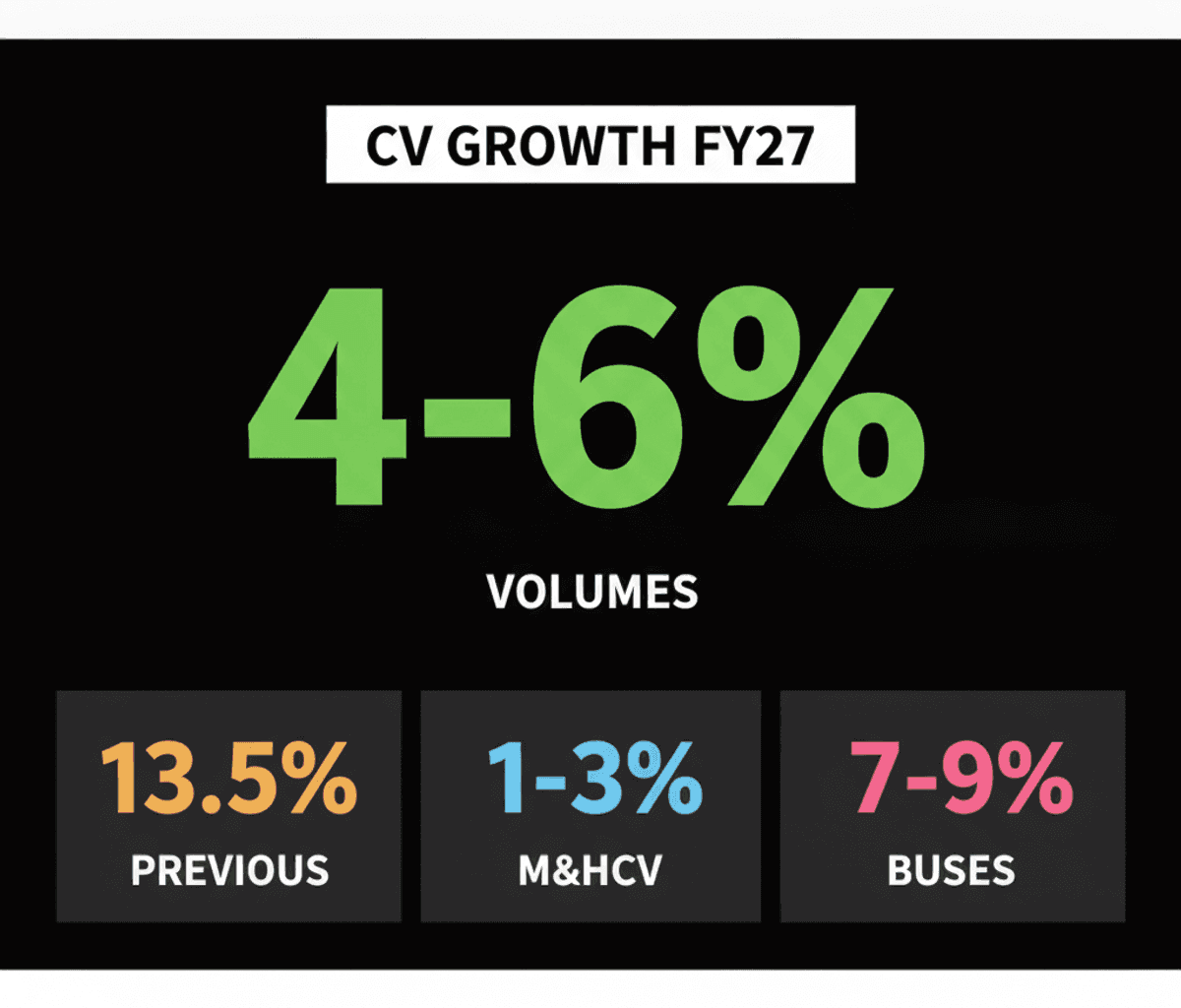
ICRA forecasts a structural slowdown in India’s Commercial Vehicle (CV) market, projecting 4-6% growth in FY27 after a strong previous year. Learn about the key drivers.
India’s Commercial Vehicle (CV) industry is poised for a significant deceleration in its growth trajectory, with ratings agency ICRA projecting a moderate 4-6 per cent year-on-year (YoY) increase in wholesale volumes for the current financial year (FY27). This forecast marks a notable shift from the healthy 13.5 per cent YoY growth observed in May of the preceding fiscal year, underscoring a fundamental structural pattern at play.
The primary mechanism driving this moderation is the ‘broadened base’ effect, a first-principles concept in market analysis. When an industry experiences exceptionally strong growth in a given period, subsequent growth rates are naturally compared against this elevated base. This often leads to lower percentage increases, even if absolute volumes continue to expand, reflecting a recalibration rather than an inherent weakness in demand.
Within this overarching trend, ICRA’s detailed projections highlight varied performance across segments for FY27. Medium and Heavy Commercial Vehicles (M&HCVs) and Light Commercial Vehicles (LCVs) are anticipated to record YoY volume growth of 1-3 per cent and 6-8 per cent, respectively. The buses segment is expected to outpace these, demonstrating a projected 7-9 per cent YoY growth, as confirmed by ICRA data.
Understanding Cyclical Market Dynamics
This anticipated moderation in the overall CV industry’s growth rate is not necessarily a signal of fundamental distress but rather an illustration of market cycles and the impact of the base effect. After a period of robust expansion, such as the 13.5 per cent growth witnessed in May, a return to more sustainable, albeit lower, growth percentages is a natural progression. This pattern often gets misinterpreted as a slowdown, whereas it is a statistical consequence of prior strong performance.
For observers of the Indian economy, it is crucial to understand that raw growth percentages must always be contextualised by the base period’s performance. The 4-6 per cent growth projected for FY27, while lower than previous peaks, still signifies an expanding market. This analytical lens allows for a more nuanced understanding of market health, moving beyond simple year-on-year comparisons to appreciate the underlying structural dynamics.
The durable takeaway here is that in cyclical industries like commercial vehicles, the interpretation of growth figures requires a framework that accounts for the ‘base effect’. A decelerating growth rate, when viewed through this analytical prism, reveals a market adjusting to a higher baseline, rather than necessarily contracting. This perspective is vital for discerning genuine market shifts from statistical artifacts.